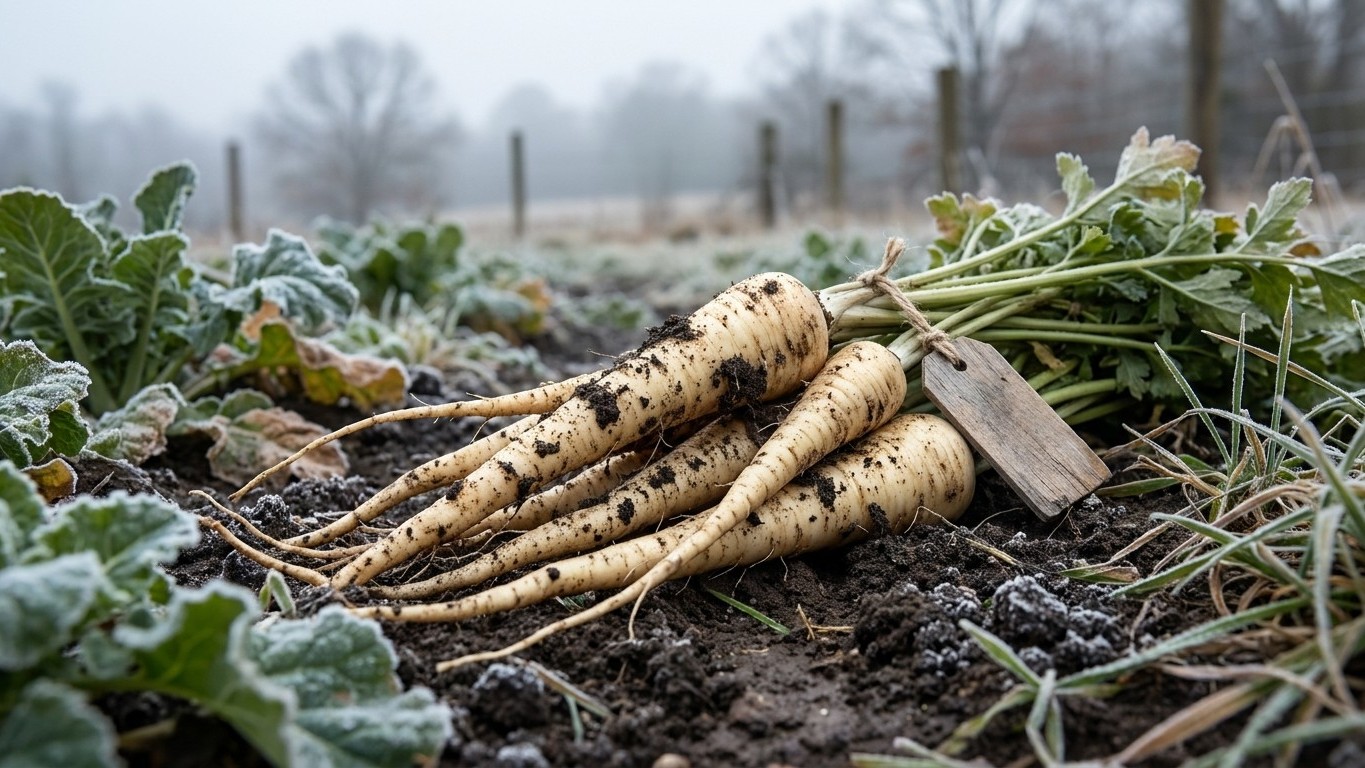

Yes, the Halifax area gets cold enough, for long enough, to sweeten parsnips properly, and the growing season leaves plenty of room to size up the roots first. The mean minimum temperature in the coldest month sits well below freezing there, which is the exact exposure that converts stored starch into sugar. The timing question matters more than the cold question: sow early, let the roots mature, then leave them in ground through several hard frosts before digging.
The short answer
Start with the number that actually decides this. In Halifax, the mean daily minimum in the coldest month runs 13.3°F, according to Environment and Climate Change Canada’s 1981-2010 Climate Normals. That figure describes an average night in the depths of winter, not a record low and not a monthly average. It tells you what a typical cold night looks like, over and over, across weeks. That’s the pattern that matters for parsnips, because sweetening isn’t triggered by one sharp cold snap. It comes from sustained exposure to cool, frosty conditions that slowly convert the root’s stored starch into sugar, according to Utah State University Extension.
Frost exposure, not zone rating
A hardiness zone tells a gardener whether a perennial plant will survive winter where it’s planted. It says nothing about whether a biennial root vegetable, dug and eaten the same year it’s grown, gets enough cold exposure to taste sweet. Those are two separate questions, and conflating them leads gardeners astray. A region can carry a mild zone rating and still deliver plenty of frost, or carry a harsh rating and still have a short, weak frost season. What matters for parsnips is the actual pattern of cold nights the crop sits through in the ground, not a zone number stamped on a map.
Halifax clears that bar. A coldest-month mean minimum of 13.3°F means the ground cools hard and stays cool through winter, which is well past the light, occasional frost that barely dents a parsnip’s starch content. Roots left in the ground there through several weeks of that cold will sweeten, not just survive. The caveat worth repeating: this is a single reference station. Nova Scotia isn’t one climate, and coastal, inland, and upland districts around the province will vary in how quickly and how hard that cold sets in each fall.
Does the season fit?
- The average last spring frost at Halifax Stanfield falls on May 7, per Environment and Climate Change Canada’s 1981-2010 Normals. That’s a mean date, not a guarantee: in roughly half of all years, frost arrives later than that.
- Parsnip seed goes into the ground in place, 2 to 3 weeks before that average last frost, which lands somewhere around mid-to-late April for this area. Germination is slow, typically 14 to 21 days, so don’t dig up the row and re-sow if nothing has broken the surface after a week or ten days.
- From that seeding date, Utah State University Extension puts full maturity at 100 to 120 days. Counted forward from a late-April sowing, that lands the crop’s maturity window somewhere in late July through mid-August.
- The average first fall frost at the same station falls on October 18, again a mean rather than a safe cutoff date, with roughly half of years seeing frost arrive later.
- That leaves close to two months between when the roots reach full size and when the first average frost hits. That gap is exactly the room the crop needs to sit in cooling soil and take on several frosty spells before you lift it.
- The verdict for the Halifax area: the season fits comfortably, with weeks of buffer at both ends. Gardeners in northern or upland parts of the province, where spring frost tends to linger later and fall frost tends to arrive earlier than the coastal Halifax reading, should tighten that buffer accordingly and lean toward the earlier end of the sowing window.
What goes wrong here
- Forked roots from heavy or stony ground. A parsnip taproot pushing down through compacted clay or a bed full of stones splits around the obstruction instead of growing straight. Utah State University Extension recommends deep, sandy soil for this crop, and where the ground is heavy, double digging the bed before sowing so the root has a clear, loosened path down.
- Forked roots from overwatering. This is a separate cause from soil texture, not a variation on it. Inconsistent or heavy watering pushes the developing root to branch as it searches for moisture unevenly distributed through the soil profile. Keep watering steady and moderate through the growing season rather than soaking heavily and then letting the bed dry out.
- A season that stalls before the roots size up. Cold, wet spring soil can push germination past the normal 14 to 21 day window and eat into the growing season before the crop even emerges. Hold to the 2 to 3 week window before the average last frost rather than sowing earlier into ground that hasn’t warmed, since a stalled start compresses the time left to reach 100 to 120 days.
- Ground freezing solid before you get to harvest. With a coldest-month mean minimum well below freezing, the risk in this climate isn’t a winter too mild to sweeten the crop, it’s a winter cold enough to lock the ground hard before digging is done. A heavy mulch layer over the row once the first frosts pass keeps the soil workable and lets you keep pulling roots later into the fall.
Common questions
How many weeks of frost does it actually take to sweeten a parsnip?
Utah State University Extension states that the crop tastes best after several weeks of cool, frosty weather, without giving an exact week count. That figure isn’t published in the source material, so treat “several weeks” as the working guidance rather than a fixed number.
Can I sow earlier than 2 to 3 weeks before the last frost to bank extra time?
Parsnip seed germinates slowly, 14 to 21 days under good conditions, and cold, wet spring soil only slows that further. Sowing well ahead of the recommended window tends to leave seed sitting in ground too cold to germinate rather than gaining real growing days.
Should all the roots come out at once, or can some stay in the ground over winter?
Given how hard the ground can freeze once winter sets in around Halifax, mulching heavily over the row and digging roots as needed through late fall is the more practical approach than trying to leave the whole bed until a single harvest date.
Does Nova Scotia’s hardiness zone tell me anything about parsnip sweetness?
No. Hardiness zone measures whether a perennial plant survives winter where it’s planted; it says nothing about the frost exposure a root crop needs to convert starch to sugar. The coldest-month mean minimum, 13.3°F at Halifax, is the figure that actually answers the sweetening question.