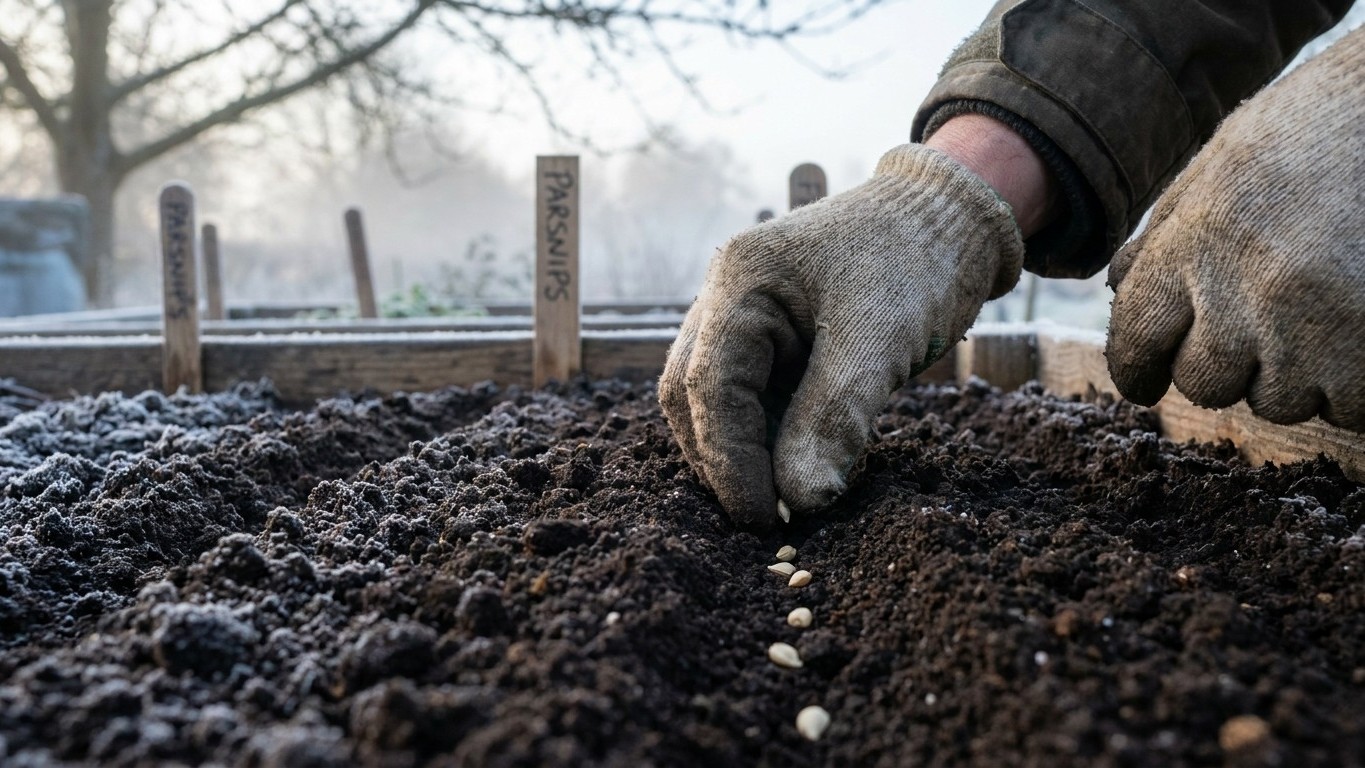

Nova Scotia’s coldest month averages a mean minimum of 13.3°F, cold enough to hand parsnips the extended chill they need to convert starch to sugar. Sow seed directly in the ground two to three weeks before the average last spring frost of May 7, so roughly mid-to-late April, and expect germination in 14 to 21 days. The 100 to 120 day growing period fits inside the province’s frost-free window with room left for the crop to sit through fall frost before harvest.
The short answer
The question that actually decides parsnip flavor here isn’t the hardiness zone printed on a seed packet. It’s whether this stretch of coastline and clay delivers real, sustained cold once the leaves die back. Nova Scotia does. The mean daily minimum for the coldest month, drawn from the Halifax reference station in Environment and Climate Change Canada’s 1981-2010 normals, sits at 13.3°F. That’s not a record low or a monthly average temperature. It’s the typical low reached most nights during the coldest stretch of winter, and it tells you this isn’t a place where frost passes through once and disappears.
That distinction matters because parsnip sweetness has nothing to do with what zone map a garden falls into. According to Utah State University Extension, the crop needs several weeks of cool, frosty weather after it matures, because that cold is what triggers the plant to break down stored starch into sugar. A parsnip pulled in September, before any hard cold arrives, will be starchy and flat. The same root left in frozen ground through October and into November comes out sweet. Nova Scotia’s climate gives that exposure in spades. A mean coldest-month minimum in the low teens Fahrenheit means the ground stays cold for weeks at a stretch, not days, and that’s precisely the mechanism the crop depends on.
So the short answer on timing: sow in place two to three weeks ahead of the average last spring frost, which lands on May 7 in the Halifax record. That puts most direct seeding somewhere in the second half of April, adjusted a bit for how quickly a given garden’s soil warms and dries out enough to work. Parsnip seed is notoriously slow, and Utah State University Extension notes it can take 14 to 21 days to germinate, sometimes longer in cool, damp soil. Gardeners who don’t know this often assume the seed failed and till the bed under, only to find volunteer seedlings popping up two weeks later. Mark the row, be patient, and resist the urge to re-sow before three full weeks have passed.
None of this is a guess based on general zone comfort. It’s built from the actual frost mechanism the crop needs, matched against a specific, sourced cold reading for this province. A garden further inland or at higher elevation than the Halifax station will run colder still, which only reinforces the answer: Nova Scotia is a place where a parsnip grown properly won’t just survive, it will develop the sweetness the crop is grown for in the first place.
Does the season fit?
Working the calendar out in order shows how much room this climate actually leaves.
- The average last spring frost at the Halifax Stanfield station is May 7. That date is a mean, not a guarantee, so in roughly half of all years frost arrives after it. Treat it as the middle of a window rather than a line you can plant right up against.
- Sowing happens two to three weeks before that mean date, which places direct seeding in the field around mid-to-late April for most gardens tied to this reference point.
- From the day seed goes into the ground, Utah State University Extension puts parsnips at 100 to 120 days to maturity. Counting forward from a mid-to-late April sowing lands maturity somewhere in the second half of July through mid-August.
- The average first fall frost, again from the Halifax normals, falls on October 18. That’s roughly nine to ten weeks after the crop reaches maturity in most years, and again, it’s a mean date, so real frost can arrive earlier or later depending on the season and the specific site.
- That gap between maturity in high summer and the average first fall frost in mid-October is exactly the stretch parsnips are meant to sit through. Left in the ground rather than pulled early, the roots take on the frost exposure that triggers the starch-to-sugar conversion, and Nova Scotia’s frost-free season is long enough to reach maturity with weeks to spare before that cold sets in.
- The frost-free window itself, from May 7 to October 18, runs to roughly 164 days start to finish. Against a 100 to 120 day crop, that leaves an extra 44 to 64 days of buffer even before accounting for the fact that parsnips are usually left in the ground well past the first frost, sometimes into winter, rather than harvested the moment they mature.
Put together, this is a comfortable fit, not a tight one. A gardener who sows on time has margin for a late spring, a slow germination stretch, or a maturity date that runs past 120 days without the crop running into a shortened season.
What goes wrong here
- Forked or twisted roots from heavy, stony ground. Much of Nova Scotia’s soil carries a legacy of glacial till, meaning clay, compacted layers, and buried stones close to the surface. A taproot that hits a rock or a dense clay pan will split into two or three legs instead of growing straight down. Utah State University Extension recommends deep, sandy soil for this reason, and where the native ground is heavy, it should be double dug to break up compaction well below where the root will travel.
- Forked roots from overwatering. This is a separate cause from heavy ground, and the two get lumped together too often. A parsnip root growing in soil that’s kept consistently soggy, rather than evenly moist, will also fork or grow stubby side roots, even in a bed with decent structure. Watering deeply but less frequently, rather than a little every day, keeps the root growing down instead of branching sideways.
- A season that runs out. This isn’t the primary risk here given how much buffer the frost-free window provides, but a very late sowing, well past the two-to-three-week window before the average May 7 frost, can push maturity close enough to the October frost date that the crop doesn’t get the full 100 to 120 days it needs. Sowing on schedule, and re-sowing promptly if an early attempt fails to germinate, keeps that buffer intact.
- Giving up on germination too soon. Not a growing failure exactly, but a common self-inflicted one: parsnip seed can take 14 to 21 days to show above ground. Gardeners who assume nothing came up and till the row under before three weeks have passed often destroy a bed that was about to germinate fine.
Common questions
Can parsnips be started indoors and transplanted in Nova Scotia?
Parsnips are sown directly in the ground where they’ll grow. The long taproot doesn’t transplant well, and disturbing it early tends to produce the same forking problems that come from heavy soil or overwatering.
Is Nova Scotia’s winter cold enough to sweeten parsnips left in the ground?
Yes. A mean coldest-month minimum of 13.3°F, from the Halifax reference station, reflects weeks of sustained cold rather than a brief dip, which is what Utah State University Extension identifies as the trigger for converting stored starch into sugar.
What happens if parsnip seed doesn’t come up after a week or two?
Wait it out. Germination normally takes 14 to 21 days according to Utah State University Extension, and cool, damp spring soil can push that toward the longer end. Re-sowing before three weeks have passed risks disturbing seedlings that were still on the way.
Why did my parsnip roots come out forked instead of straight?
Two separate causes produce the same result. Heavy, stony, or compacted soil deflects the taproot as it grows down, while inconsistent or excessive watering can cause forking even in decent soil. Deep digging addresses the first; even, moderate watering addresses the second.