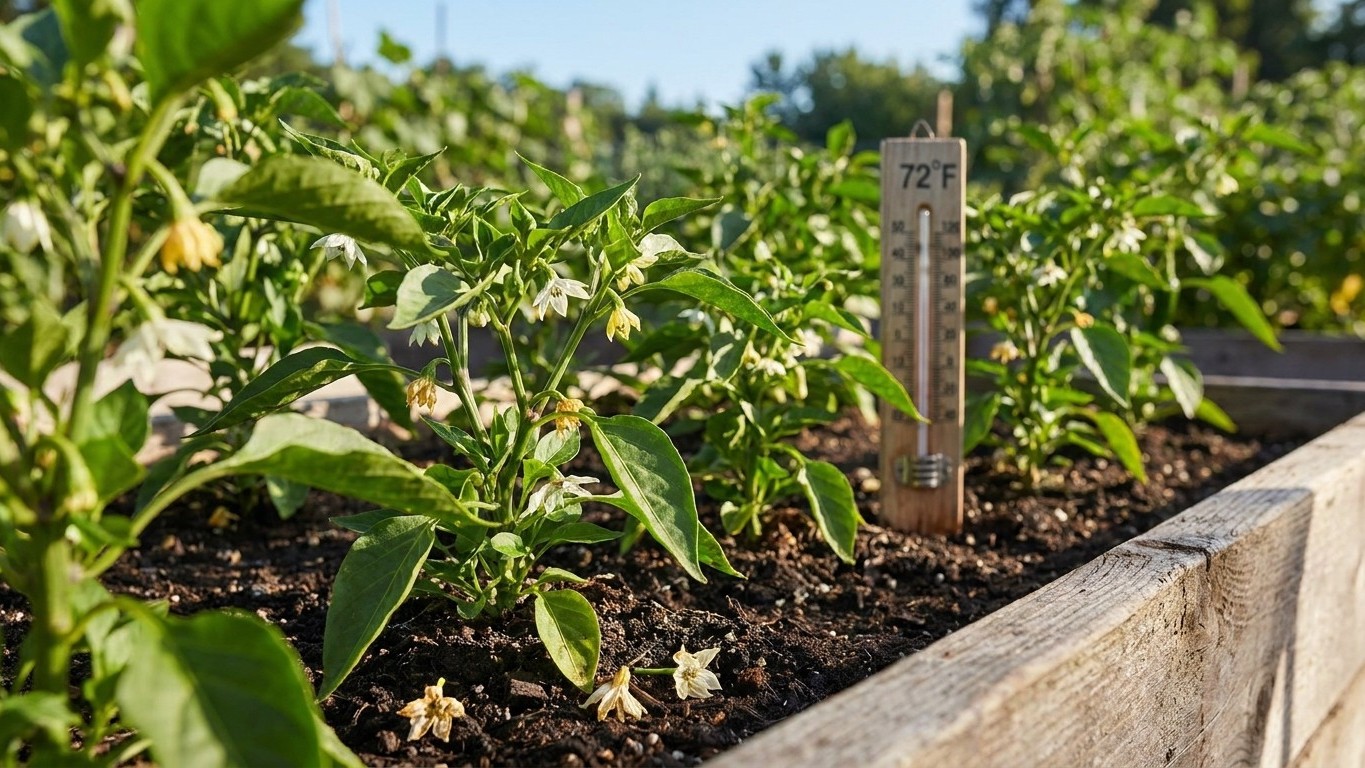

Start pepper seed indoors in Nova Scotia between mid-March and early April, counting 8 to 10 weeks back from a transplant date in late May to mid-June, well after the last frost and once soil has warmed. Halifax’s reference station averages zero days a year at or above 90 F, so summer heat rarely threatens fruit set here. The cool end matters more: this site does not track summer night minima, so watch your own nighttime temperatures before setting plants out.
The short answer
The Halifax reference station records an average of 0.0 days a year at or above 90 F, according to Environment and Climate Change Canada’s Canadian Climate Normals for 1981-2010. For a crop that can lose blossoms once daytime highs climb past that mark, this is about as favorable a heat pattern as pepper growers get. Fruit set failure from heat is not something most Nova Scotia gardens have to plan around season after season, at least not at the station this figure comes from.
That’s only half the equation. Pepper fruit set fails at both ends: nights below 55 F stall pollen viability just as surely as days above 90 F do, according to Utah State University Extension. A stretch of unusually cool nights in late spring or early summer, the kind that can slip into a Maritime growing season even after the calendar says summer has arrived, drops blossoms just as effectively as a heat wave would elsewhere. Wind off the Atlantic, an overnight fog bank, a cold snap tucked behind a passing low, any of these can push a June or early-July night below that 55 F line.
Here’s the gap in the record: this site carries days-above-90 F counts for Nova Scotia’s reference station, but it does not carry summer night minima. There’s no published number here for how many nights in a typical Nova Scotia summer dip below 55 F, and it would be a mistake to guess one from the province’s latitude or from how cold January gets. Coastal exposure, elevation, and distance from open water all shift nighttime lows in ways latitude alone can’t predict, and the coldest month of the year tells you nothing reliable about a June or July night. The Annapolis Valley, the Halifax area, and the uplands of Cape Breton can post noticeably different overnight patterns from each other even on the same calendar date.
What that means in the garden: watch your own thermometer through late May and June instead of relying on a general date. If overnight lows are still dropping into the 50s after peppers go into the ground, blossoms can drop even while the days feel plenty warm to work outside in short sleeves. Row cover, cloches, or simply holding transplants indoors a week or two longer are the practical responses, not a fixed date this data set can hand you.
When to start seed here
The math runs backward from transplant day, not forward from the day you sow. Here’s how to work it for a Nova Scotia garden.
- Start with the average last frost. Environment and Climate Change Canada’s 1981-2010 normals put the mean last spring frost at Halifax Stanfield International Airport on May 7. That’s a midpoint, not a guarantee: in roughly half the years on record, frost has arrived after that date. Treat May 7 as the center of a window, never as a safe planting line.
- Add time for the soil to catch up. Utah State University Extension calls for transplanting once soil has reached 60 F, not simply once frost risk has passed. Air temperature crossing the frost line and soil temperature crossing 60 F run on two different clocks, and soil almost always lags behind. This site does not publish a soil-warming date for Nova Scotia, so check a soil thermometer at transplant depth in your own bed rather than assume a fixed number of weeks after May 7.
- Pencil in a realistic transplant date. Given the mean frost date plus the extra lag for soil warming, most Nova Scotia gardens land somewhere in late May to mid-June before conditions reliably support both a frost-clear forecast and warm-enough ground. Coastal and low-lying gardens often run later than inland ones.
- Count back 8 to 10 weeks from that transplant date. Utah State University Extension recommends starting pepper seed indoors 8 to 10 weeks before transplanting. Working from a transplant window in late May to mid-June, that puts indoor seed-starting somewhere between mid-March and early April for most of the province.
- Adjust for your own county. Gardeners farther from Halifax’s coastal moderation, or at higher elevation, should expect a later transplant date, and that pushes the whole seed-starting window later too, since the 8-to-10-week count is measured backward from transplant, not forward from a fixed calendar day.
What goes wrong here
Most pepper failures in this climate trace back to one of a handful of predictable causes, and each has a workable fix.
- Blossom drop in a hot spell. Even though the reference station averages 0.0 days a year at or above 90 F, a run of unusually hot, still afternoons during flowering can still push blossoms past the point of setting fruit. Light shade cloth over plants during the hottest part of the day, and steady deep watering to keep plants from adding heat stress on top of temperature stress, both help flowers hold on.
- Blossom drop from a cool night. Nights below 55 F stall pollen just as heat does, and this site does not track how often Nova Scotia summers dip that low, so it’s on the gardener to watch the forecast. Row cover pulled over plants on cool evenings, or simply delaying transplant by a week or two when a cold stretch is forecast, protects blossoms already forming.
- Sunscald on exposed fruit. Strong late-spring and summer sun can scorch pepper fruit left without leaf cover, especially after aggressive pruning opens up the canopy. Leaving foliage full around developing fruit, rather than trimming for a tidier-looking plant, is usually the simplest fix.
- Blossom-end rot. Uneven watering, a dry stretch followed by a heavy soak, disrupts calcium uptake and shows up as a sunken dark patch on the fruit’s blossom end. A steady watering schedule and a layer of mulch to even out soil moisture between waterings address this more reliably than any fertilizer aimed at the symptom itself.
Common questions
Can I direct-sow pepper seed outdoors in Nova Scotia?
Utah State University Extension’s guidance is built around starting peppers indoors 8 to 10 weeks before transplant, not sowing directly in the garden. With a mean last frost of May 7 and soil that needs to reach 60 F on top of that, direct-sown pepper seed would face a very short remaining season to mature fruit in most of the province.
What if my last frost doesn’t match May 7 some years?
It won’t, in roughly half the years on record. May 7 is the average from Environment and Climate Change Canada’s 1981-2010 normals for Halifax Stanfield International Airport, meaning frost falls later than that date about as often as it falls earlier. Build in a margin rather than treating May 7 as a hard cutoff, and lean later if your site sits inland, at elevation, or away from the coast’s moderating effect.
How do I know when my soil has hit 60 F?
A basic soil thermometer, pushed to the depth you’ll set the transplant roots, is the direct way to check. This site does not publish a soil-warming date for Nova Scotia, so there’s no shortcut date to substitute for measuring your own bed.
Does the 0.0 days-above-90 F figure mean peppers never struggle with heat here?
No. It means the reference station rarely records days that extreme, which is favorable for fruit set on the hot end. It says nothing about the cool end, where nights below 55 F can drop blossoms just as effectively, and this site does not carry night-minimum data for Nova Scotia, so that risk has to be tracked locally rather than assumed away.