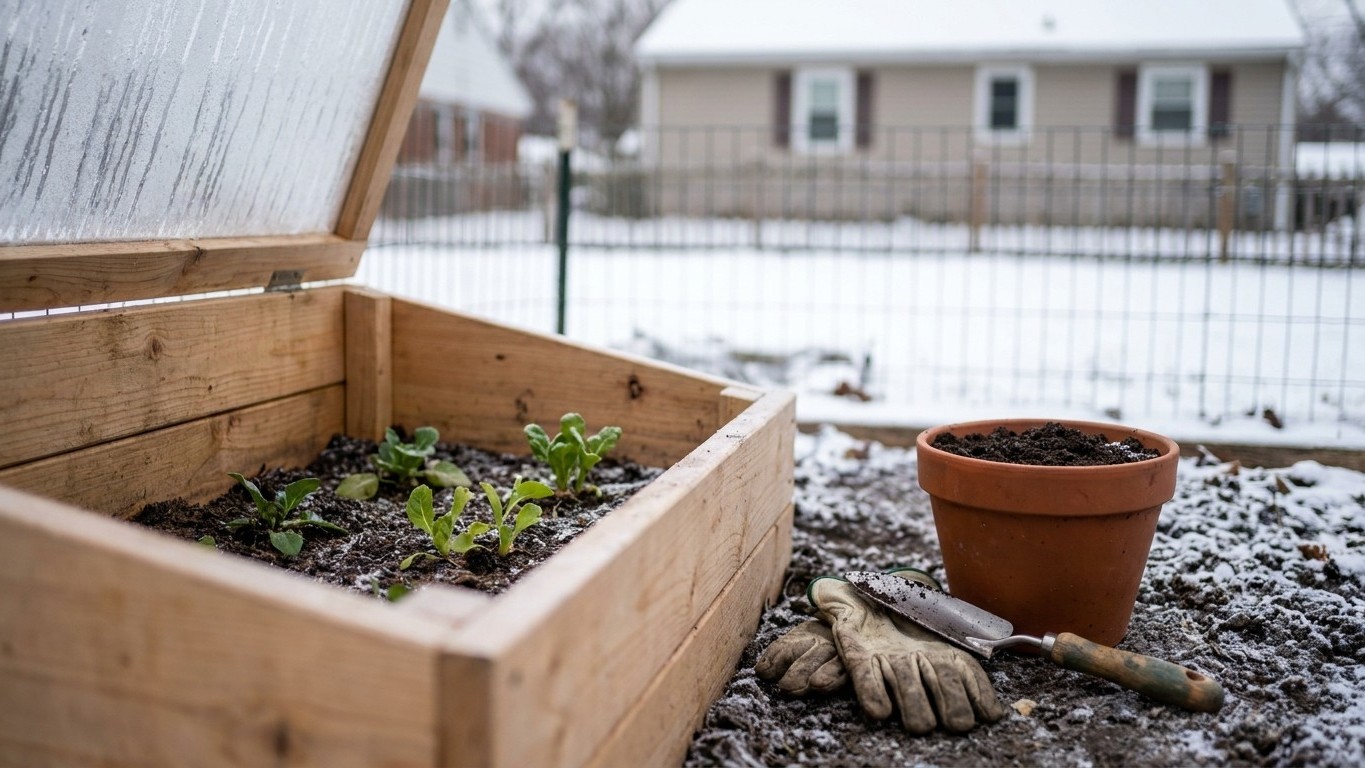

January in Nova Scotia is not a planting month for open ground. The frost window here runs from a mean last spring frost around May 7 to a mean first fall frost around October 18, so this month sits deep inside the dormant stretch. What actually happens now is garlic and shallots finishing their dormancy, cold frames doing quiet work, and seed orders arriving before the good varieties sell out.
What goes in the ground in January

The reason nothing new goes into open Nova Scotia soil this month has nothing to do with the calendar and everything to do with soil temperature. The mean last spring frost at the Halifax Stanfield station sits around May 7, and that figure is a midpoint, not a guarantee: in roughly half of all years the frost arrives later than that date. January sits more than three months before that midpoint, and across most of the province the ground itself is frozen solid or waterlogged from thaw cycles. Direct sowing is not a bad idea this month, it is simply not possible.
Where the ground is still workable
In milder pockets, the Annapolis Valley and areas close to the Bay of Fundy sometimes see a thaw that leaves a few inches of workable topsoil. Where that happens, garlic and shallot cloves that missed their fall planting window can still go in, pushed into loosened soil and mulched heavily with straw. This is a narrow, weather-dependent opportunity, not something to plan around.
Cold frames, tunnels and dormant options
Inside a cold frame or under a low tunnel, hardy greens already established from fall (spinach, mâche, some kales) can keep producing sparingly through the coldest stretch, protected from direct exposure even when outdoor beds are locked up. Bare-root fruit trees, cane fruit and roses can be planted the moment the ground is workable enough to dig a hole, since they are fully dormant and unbothered by cold air as long as roots aren’t sitting in ice. Indoors, forcing rhubarb crowns or chicory roots in a dark, moderately warm space produces a harvest from stock that would otherwise sit idle in the garden.
What to start under cover
Seed starting this month should be counted backward from that mid-May frost mark, not forward from any fixed date on a calendar. As a rule of thumb, onions and leeks grown from seed want roughly ten to twelve weeks indoors before they go out, which puts a January start well within reason for a May transplant. Peppers generally want eight weeks, and tomatoes closer to six, so starting those crops in January risks the opposite problem: plants that outgrow their pots long before the ground and air are warm enough to receive them.
That’s the first failure mode, starting too early and ending up with leggy, rootbound seedlings stretching for light on a windowsill weeks before it’s safe to plant them out. The second failure mode is starting too late, which for slow growers like onions and leeks means running out of season entirely, since they need that long head start to bulb or thicken properly before the shorter days of fall.
January is also the natural month to start onions, leeks and any perennial herb that’s slow from seed (thyme, oregano, sage), since their long runway lines up with a frost mark still months away. Faster crops can wait; these cannot.
What is ready to pick
Outdoors, the honest answer is close to nothing. Anything left standing in an open Nova Scotia bed this month is either buried under snow or has already succumbed to hard freezes. But the kitchen doesn’t go empty, because several sources keep producing through the depth of winter.
Overwintered kale and leeps, if mulched heavily in the fall, can often be dug out from under snow cover, since both crops tolerate freezing and thawing far better than most vegetables. Under a cold frame, salad greens sown in early fall continue to offer light pickings, growing slowly rather than not at all. Indoors, sprouts and microgreens are the most reliable January harvest of all, ready in days rather than weeks and needing nothing but a windowsill and a jar or tray.
This is also the month to walk the root cellar or pantry shelf and check stored squash, potatoes and onions for the ones starting to turn. A soft spot on a squash, a sprouting potato, or an onion gone papery and light usually means it needs to be used now rather than left to spoil the crops sitting next to it. Catching one bad squash before it rots into its neighbors is the difference between losing one and losing a shelf.
The jobs that matter this month
A winter month in the garden is not a blank page, it’s a page about the work that happens before anything is asked to grow. Skipping it now costs real time later in the season.
Pruning, ordering and planning
Dormant pruning of fruit trees and cane fruit is best done while the plants are fully asleep and their branch structure is visible without leaves in the way. Cutting now, rather than waiting until buds swell, reduces stress on the plant and lowers the risk of disease entering fresh wounds during a wetter, more active season. Seed ordering belongs on this month’s list too, since the varieties gardeners actually want (particular tomato lines, specific onion types suited to the province’s day length) tend to sell out early, and a February order often means settling for whatever’s left.
This is also the natural window to sketch next season’s rotation on paper, moving heavy feeders away from where they grew last year and deciding which beds get a cover crop turned under versus a fresh start.
Soil, compost and tools
Soil testing can happen any time the ground isn’t frozen solid enough to stop a probe, and results come back with plenty of lead time to order lime or amendments before spring digging starts. Compost piles built in fall still benefit from an occasional turn to keep them from going anaerobic under snow cover. Indoors, cleaning and sharpening pruners, shears and hoes now means no delay when the first workable soil day of spring finally arrives. Beds, trellises and fencing damaged by winter weather are easier to repair in a slow month than in the rush of April.
What not to do in January
The most common mistake this month is reading a mild stretch of air temperature as a sign the ground is ready. A few days in the 40s F can feel like spring, but soil warms far slower than air, and pushing anything but the hardiest crops into cold, wet ground now usually means rot before germination, not an early start.
A close second is uncovering cold frames, mulch or row cover too eagerly after that same mild spell. Nova Scotia’s winter doesn’t end with one warm week, and stripping protection off overwintering crops or dormant plantings leaves them exposed to the next hard freeze, which tends to follow closer behind a thaw than gardeners expect.
Fertilizing is the third trap. Feeding nitrogen to dormant fruit trees, cane fruit or overwintering greens this month does nothing useful and can actually push soft new growth right before the coldest weeks still ahead, growth that then gets killed back and weakens the plant more than doing nothing at all would have. Nitrogen has a season; this isn’t it. The better move on all three counts is patience: let soil temperature, not a mild afternoon, make the call.
Checking this against your own county
A province-wide month is a starting point, not an instruction. Nova Scotia’s frost dates come from a single station, Halifax Stanfield, and elevation, distance from the Bay of Fundy, and the general difference between the milder south shore and the colder interior or Cape Breton highlands can shift real-world frost windows by weeks in either direction. The hardiness zone figure for Halifax, 6b under the Canadian system (a different scale from the USDA zones used elsewhere, built on seven climate variables rather than one), applies to that reference city and not to the whole province.
For a county-level read, the Nova Scotia Department of Agriculture is the right place to check local conditions and provincial planting guidance before committing seed or soil to any date on this page.
Common questions
Can I plant garlic in Nova Scotia in January?
Only where the ground is still workable during a thaw, and it’s a narrow, weather-dependent window rather than a reliable plan. Fall planting remains the standard approach for garlic in this province.
What is the last frost date in Nova Scotia?
The mean last spring frost at the Halifax Stanfield station is May 7, but that’s a midpoint figure. Frost arrives later than that in roughly half of all years, so it should be treated as the center of a window, not a safe planting date.
What hardiness zone is Nova Scotia?
The reference city of Halifax sits in Canadian hardiness zone 6b, based on Natural Resources Canada’s 1991-2020 normals. That’s a Canadian-system rating built on seven climate variables and doesn’t convert directly to a USDA zone, and it describes Halifax specifically rather than the entire province.
What vegetables can I start indoors in January?
Slow growers with a long runway to the mid-May frost mark make sense now: onions and leeks from seed, along with slow perennial herbs like thyme, oregano and sage. Faster crops like tomatoes and peppers generally do better started later, closer to their own six-to-eight week windows before transplant.