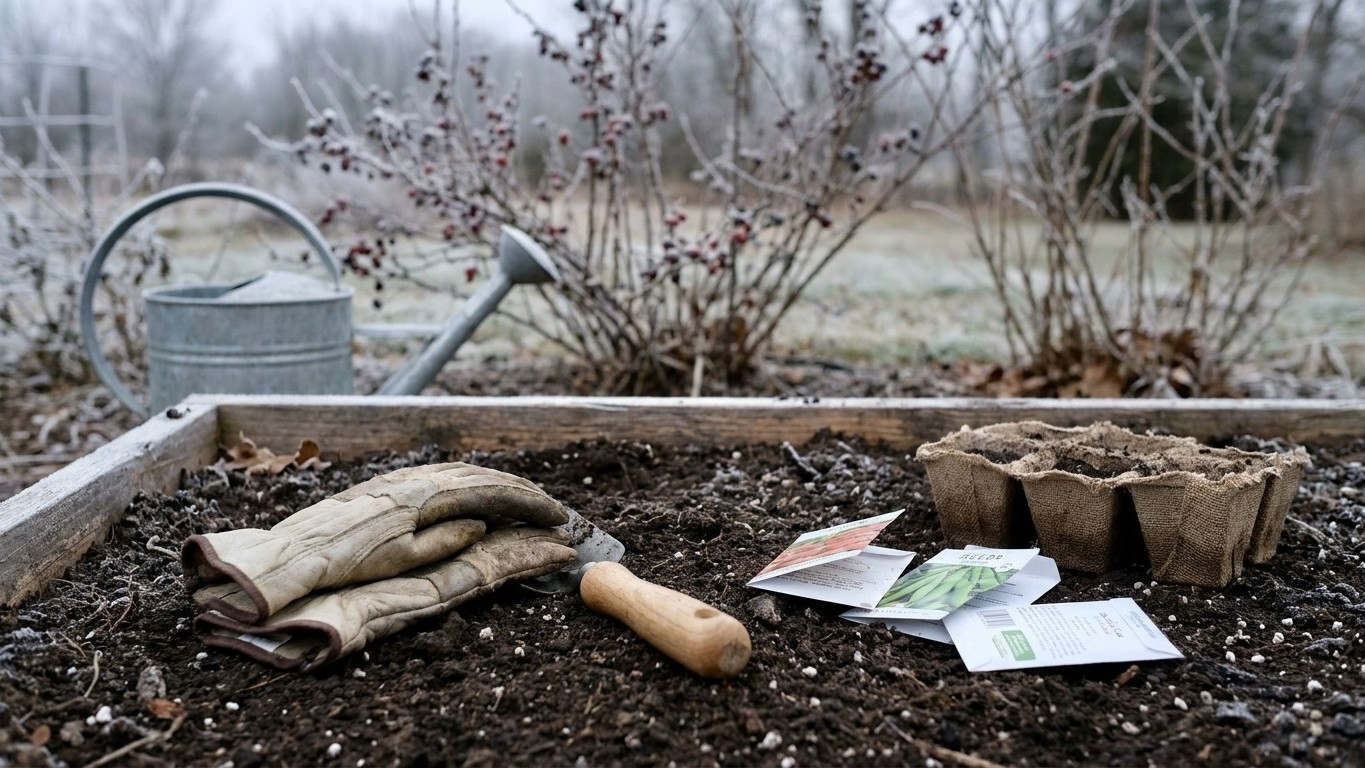

Nothing goes into open ground in Nova Scotia this month, and that is the honest, direct answer. Soil is frozen or saturated across most of the province, and the average last spring frost does not arrive until May 7. What February actually offers is garlic already in the ground, cold-frame greens, dormant bare-root planting where soil is workable, and a full slate of indoor seed starting for the long-season crops that need a head start before spring.
What goes in the ground in February

The decision this month is not made by the calendar. It is made by soil temperature and by how far the ground sits from that average last frost of May 7, a date that itself is a midpoint, not a guarantee: in one year out of two, frost lands even later than that. With roughly thirteen weeks still standing between now and that average date, open-ground planting is off the table for almost everything.
Garlic and shallots are the exception, but only if they went in during fall and the bed is not frozen solid. In a mild coastal pocket, a spell of thaw can leave the top few inches workable enough to firm up cloves that have heaved, or to tuck in a late batch of shallots where the ground has not locked up hard. That is a narrow window, and it closes fast if a freeze follows.
Cold frames and low tunnels are where the real action is. Hardy greens sown in fall, spinach, mâche, claytonia, kale, can keep producing right through this month under a layer of row cover or a frame lid, as long as the frame is vented on sunny days so the plants do not cook. Bare-root fruit trees, cane fruits, and dormant shrubs can go in if a supplier ships them now and the planting hole is diggable, which in Nova Scotia’s zone 6b (Canadian system) is a real if inconsistent possibility depending on the week.
Indoors, this is also the month for forcing. Rhubarb crowns lifted from the garden and brought into a dark, warm spot will push pale, tender stalks weeks ahead of anything outside. Belgian endive roots forced the same way in a dark box or bucket produce chicons through late winter. Neither needs open ground, and both fill a real gap in what the kitchen has to work with.
What to start under cover
Counting backward from May 7 does the work that a fixed date on a seed packet cannot. With roughly thirteen weeks left before that average frost, this is the window for the slowest crops on the seed rack: onions and leeks from seed, celery, celeriac, and artichokes if a gardener wants to try them. These are plants that many growers start ten to twelve weeks ahead of the frost-free date, because they grow slowly at first and need that long runway under lights or on a bright windowsill before they are sturdy enough to face a transplant hole.
Peppers can also go in toward the back half of this month in most seasons, since they run eight to ten weeks to transplant size and are notoriously slow to germinate without bottom heat. Tomatoes, squash, and cucumbers are still too early. Start them now and the arithmetic runs the wrong way: with three and a half months still to go before it is safe to plant out, fast growers like tomatoes turn leggy, rootbound, and stressed long before the ground and air have caught up.
That is the first failure mode, starting too early and ending up with tangled roots in a pot too small, stems stretched thin reaching for light. The second is starting too late and running out of runway altogether, particularly with onions and leeks, which simply will not reach a useful transplant size if they are sown in April instead of now. Getting the backward count right matters more than getting the forward one right.
What is ready to pick
Outdoors, the honest answer is close to nothing. But the garden and the pantry are not the same thing, and there is still real food coming from both this month.
Kale and leeks left standing under snow cover are often still pickable, provided the ground beneath them has not frozen into a solid block. A thaw day is the moment to dig, since leeks in particular sweeten after hard cold and hold in the ground far better than they hold in a fridge drawer. Cold frames sown in fall keep giving small, steady pickings of spinach, arugula, and mâche as long as the lid comes off to harvest and goes right back on.
Indoors, sprouts and microgreens are the fastest return in the whole gardening year, ready in one to two weeks from a windowsill tray with no soil warmth or daylight length to worry about. They are also the simplest way to get fresh green food onto a plate while everything else is still weeks away.
The other job this month is inspection, not harvest. Stored squash, potatoes, and onions need a walk-through every week or two: a soft spot on a squash, a potato going soft and sprouting eyes, an onion gone papery and collapsed at the neck. Pull those out and use them first, because one spoiling squash in a bin will take its neighbors down with it faster than most people expect.
The jobs that matter this month
February carries more weight than its bare planting list suggests, because several jobs have real deadlines attached and no way to make them up later.
Dormant pruning tops the list. Apple and pear trees, along with raspberry and currant canes, are still fully dormant, sap has not started moving, and this is the cleanest window to cut without stressing the plant or inviting disease into a fresh wound. Wait until buds swell and the same cuts cost more in stress and lost fruit.
Seed ordering belongs here too, and it is easy to underrate. Popular varieties, especially of onions, leeks, and anything grown from seed potatoes, sell out from suppliers well before local nurseries stock anything, and a gardener who orders in April is choosing from what is left over, not what they actually wanted.
The quieter jobs matter just as much. Planning next season’s crop rotation on paper now avoids planting the same family in the same bed two years running, which is when soil-borne pests and diseases build up. A soil test sent off this month gives results in time to amend before the ground thaws for good, since lime in particular needs weeks to work into the soil before roots need it. Compost piles built in fall can still be turned on a mild day to keep them working through the cold rather than sitting inert until spring. And tools, pruners, hoes, spades, are worth pulling out, cleaning, sharpening, and oiling now, before the first rush of spring work exposes every dull blade and stuck hinge at the worst possible moment.
Fencing and raised bed frames that took a beating over winter are also easier to repair now, standing in a quiet garden, than in April with seedlings already waiting for a home.
What not to do in February
The classic mistake this month is trusting a warm afternoon over a soil thermometer. A run of mild days can push air temperature well above what it feels like it should be for the season, but the ground underneath stays cold for far longer than the air does. Direct-sowing anything warm-season into that soil, even something as tough-seeming as peas pushed too early into waterlogged clay, usually ends in rot rather than germination.
Uncovering cold frames or pulling mulch off overwintering beds after a mild spell is the second trap. It feels like the right moment to let plants breathe, but Nova Scotia’s frost window does not close until spring is well underway, and a hard freeze following a thaw does more damage to newly exposed crowns and greens than the same freeze would have done under cover. Leave the mulch and the frame lids in place until the pattern of mild weather is sustained, not just a single warm week.
Nitrogen is the third mistake, applied out of habit or eagerness rather than need. Dormant trees, canes, and overwintered greens are not in active growth, and nitrogen put down now either leaches away in the next thaw or, worse, pushes a flush of soft new growth right before the next hard freeze cuts it down. Hold nitrogen until real growth resumes and the plant can actually use it.
Finally, resist starting tomatoes, peppers past their window, and squash indoors just because the seed packets are sitting there. With months still to go before transplanting is safe, early sowing buys nothing but leggy, stressed seedlings by the time the ground is actually ready for them.
Checking this against your own county
A single provincial frost window is a starting point, not an instruction for every backyard in Nova Scotia. The May 7 and October 18 averages come from one station, Halifax Stanfield, and elevation, coastal exposure, and the difference between the Annapolis Valley and the Cape Breton highlands can shift those dates by weeks in either direction. A garden a short drive inland or uphill from the coast can run noticeably colder and later than the provincial average suggests.
For a read closer to home, the Nova Scotia Department of Agriculture keeps resources at novascotia.ca/agri, and pairing that with the province’s own planting calendar gives a far sharper picture than a single station’s averages ever will.
Common questions
Can garlic still be planted in Nova Scotia in February?
Only if it was not already planted in fall and the ground happens to be workable during a thaw. Fall planting remains the more reliable route, since garlic needs a longer cold period to form proper bulbs.
Is it too early to start tomato seeds indoors?
Yes, in most parts of the province. With the average last frost falling May 7, tomatoes started now will be leggy and rootbound long before it is safe to move them outside.
Onions, leeks, celery, celeriac, and artichoke are the standard long-season crops, since they need ten to twelve weeks or more of indoor growth before they are ready to transplant.
Why does the frost date matter more than the calendar month?
Because May 7 is only an average. In roughly half of all years, frost arrives later than that, so planning backward from it, rather than from a fixed date on a seed packet, leaves the margin a Nova Scotia garden actually needs.