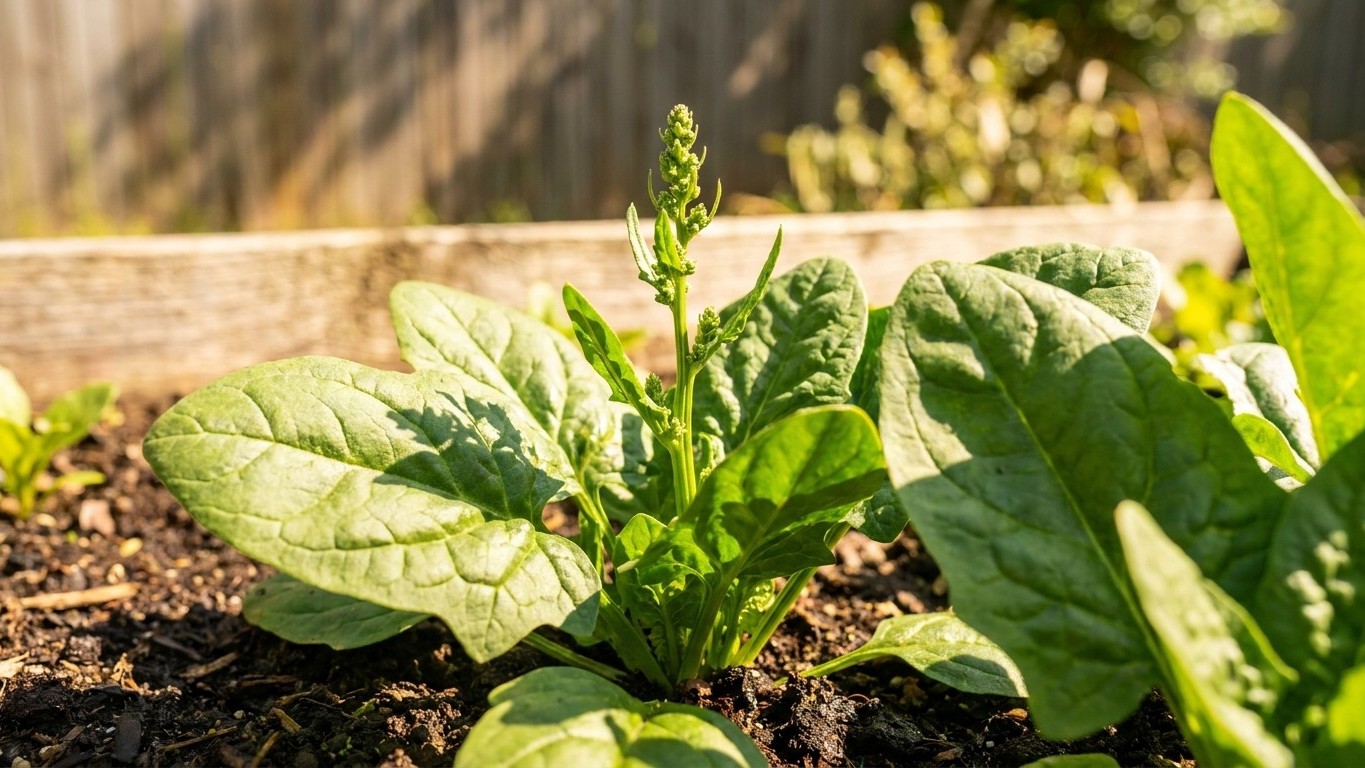

Cut spinach in Nova Scotia from late spring into early summer, before the longest days arrive, and again in autumn before the first hard frost ends the season. Once cut, it is a short-lived crop: UC Davis says it will not hold good quality beyond two weeks, and only at 32°F (0 °C). In a home fridge it gives you a lot less. The rest of this page works out the calendar behind that.
The short answer
The longest day at the Halifax reference point carries 15 h 25 of daylight. That number matters more than any thermometer reading, because spinach flowers in response to long days as well as warmth. Utah State University Extension puts it plainly: spinach bolts during long days and warm temperatures. A cool maritime summer therefore does not buy extra weeks. The plant reads the length of the day, and in Nova Scotia that length climbs past 15 hours every June no matter how foggy the South Shore gets.
So is the limit the day length or the heat? Both, though they work differently. Heat is the gentler constraint here. At Halifax Stanfield International A, Environment and Climate Change Canada counts only 0.6 days a year reaching 32 °C and 2.8 days above 30 °C. Those are extreme days, though, and spinach cares about a much lower line. Growth is best where temperatures stay at or below 75°F (about 24 °C), and that same number is where leaves turn bitter. The station figures above don’t count days between 24 and 30 °C, so they can’t tell you how many of those a summer holds. Day length is the wall you can’t negotiate with. Heat is the one you can sometimes dodge with shade and timing. The full picture of what triggers the flower stalk is in Will Spinach Bolt Early in Nova Scotia?.
What does that mean at the cutting board? Harvest outer leaves as soon as they are big enough to eat, rather than waiting for a showpiece plant. Take the whole plant the moment you see the center stretching upward into a stalk. Bitterness arrives with it, and leaves from a bolting plant are not worth the wait.
Storage follows the same logic of urgency. The UC Davis Postharvest Technology Center lists the ideal as 32°F with 95 to 98 percent relative humidity, and warns that wilting, yellowing and decay increase after 10 to 14 days. At the 41 to 50°F (5 to 10 °C) typical of ordinary distribution conditions, the decline is faster. Two weeks is a ceiling, not a plan. In a home refrigerator, the coldest spot is the back of the bottom shelf. The door is the warmest, and spinach left there starts yellowing in days.
One more point about varieties. Utah State names four (Bloomsdale, Melody, Teton and Olympia) but publishes no data on any of them, so there is nothing to say here about which bolts later or tolerates more heat. The source also gives no days-to-maturity figure for spinach, which is why this page doesn’t offer one.
How long the spring window really is
The calendar starts with the last spring frost. At Halifax Stanfield, the mean date is May 7. That is the midpoint of a window, not a safe date: in one year out of two the last frost lands later. It also comes from an airport station, and northern or upland districts of the province run weeks off that pace. The figure is drawn from Canada’s 30-year climate normals, which are a different period from the US figures used elsewhere on this site, so don’t compare them across the border too tightly.
Spinach sowing starts 2 to 3 weeks before the last frost. Here is how that works out in practice:
- Start from the mean last frost, May 7, and treat it as the middle of the range rather than the finish line.
- Count back two to three weeks. That puts the earliest sowing between about April 16 and April 23, whenever the soil is workable.
- Count forward to the longest day in late June. From April 16 that is about nine and a half weeks, and from April 23 about eight and a half.
- Treat that span as a ceiling, because bolting can begin before the solstice. The source does not publish the day length at which spinach tips over, so there is no way to mark the exact week.
- Subtract any stretch above 75°F (24 °C), when growth stops being good and leaves turn bitter.
The honest answer for Nova Scotia is a spring window of roughly eight to nine and a half weeks at the outside, from first sowing to the longest day, with the best cutting concentrated in the earlier part. A sowing made on the early side of the range gets more of it. A sowing delayed to May, because the ground was wet or the frost lingered, is already working with a shorter runway and with days that are lengthening quickly.
Cool springs do help with one thing, the 75°F line. Coastal fog and a late-opening spring keep leaf growth in the comfortable range for a good part of the window. That helps quality. It does nothing to the day-length clock. Slugs and leaf miners also tend to show up as the weather warms, which is covered in What Eats Spinach in Nova Scotia, and When.
The autumn crop, and when the soil lets you sow
The fall crop is the better bet for many Nova Scotia gardens, because the days are shortening instead of lengthening. It has its own two obstacles, and the first is not the one most people expect.
Warm soil in late summer
Seed germination drops off when soil is above 80°F (about 27 °C). That, not cold, is what blocks an early autumn sowing. Seed pushed into hot ground in July may sit there, germinate poorly, or come up in patches. The window opens when the soil cools below that line, not on a fixed date. The airport station tells you nothing about your own bed, so the practical test is your own soil. A bed in afternoon sun will lag a shaded one by days or even weeks. Shading the row, watering it so it stays cooler, or sowing in the lee of taller plants can all help, though none of those tricks is documented in the source.
For the full picture of the crop itself, see Growing Spinach in Nova Scotia.
The frost that ends the season
The Utah State guidance is to plant 50 to 75 days before the date you want to harvest. Halifax Stanfield’s mean first fall frost is October 18. Count back from that date:
- 75 days before October 18 is about August 4.
- 50 days before October 18 is about August 29.
That gives a sowing range of early August to the end of August for a harvest by the average first frost. Like the spring date, October 18 is a midpoint: in half of all years the frost comes later, and in the other half it arrives sooner. A cautious gardener picks a harvest target several days ahead of the mean rather than on it, then counts back from there. Inland and upland gardens should count from their own first frost, which can sit weeks away from the Halifax figure.
The two obstacles pull in opposite directions, which is why this window is narrow. Early August may still mean warm soil. Late August leaves less time before the frost. The sweet spot is whatever date your own soil first drops under 80°F, counted against your own first-frost estimate.
Common questions
How long does cut spinach keep in the fridge?
Up to two weeks is the ceiling, and only at 32°F with high humidity. At 41 to 50°F (5 to 10 °C) it fades faster, and wilting and yellowing increase after 10 to 14 days. Store it in the back of the bottom shelf, not in the door, and eat it early in the week.
Does a cool Nova Scotia summer let spinach keep going?
Not for long. Spinach bolts in response to long days as well as warmth. With 15 h 25 of daylight on the longest day at the Halifax reference point, a cool summer slows the heat problem but does not stop the day-length one.
Which variety should I choose?
Utah State names Bloomsdale, Melody, Teton and Olympia but publishes no data about any of them. There is no sourced basis here for ranking them on bolting, flavor or cold tolerance, so check seed packet descriptions and compare.
Is May 7 my last frost date?
Only if you garden near Halifax Stanfield, and even then it is just the midpoint. Half of years see a later frost. Uplands and northern districts run weeks off that pace, so use it as a starting reference and adjust with your own observations in the garden.