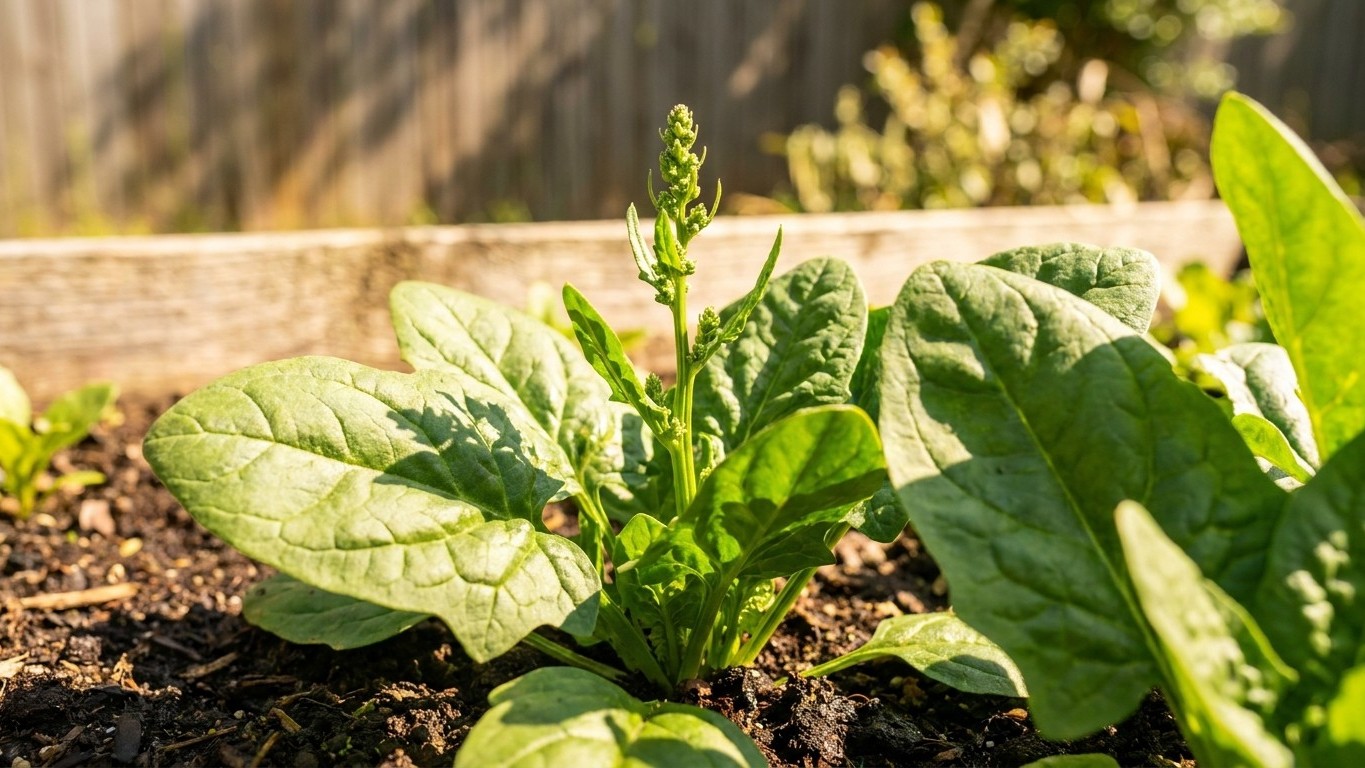

In Nova Scotia, spinach is rarely lost to anything with a mouth. The calendar does the damage. Long days and warm weather push the plant to flower, and once it does, the leaves turn bitter and the harvest ends. That leaves two workable windows, spring and autumn, both shorter than a seed packet suggests. Slugs and insects are real, but the sourced climate data behind this page says nothing about them, so they stay out.
The short answer
Fifteen hours and 25 minutes. That is the daylight on the longest day of the year, calculated for the latitude of the Halifax Stanfield International A station before atmospheric refraction adds roughly seven minutes. It is a long day by any standard, and for spinach it is a problem. Utah State University Extension is clear that spinach bolts during long days and warm temperatures. Long days alone are enough to start the flowering. A mild, foggy-coast summer therefore does not buy extra weeks, because the plant is reading the length of the day, not the thermometer.
The extension source publishes no hour threshold for the switch, so no one can honestly name the exact date it flips in Halifax. What the numbers do show is that the daylight stays long for a wide stretch around the solstice, and a spinach plant sown into it is on a short fuse.
So is the limit the day length or the heat? Both, and in that order. Daylight sets the clock. Heat sharpens it. Halifax Stanfield averages 2.8 days a year above 30 °C and just 0.6 days above 32 °C, so scorching days are rare there. That does not rescue spinach, because its ceiling sits far lower. The plant grows best where temperatures do not exceed 75 F (about 24 °C), and that same number is where bitterness starts. One figure, two consequences: growth slows and flavor turns. It is a temperature, never a calendar date, so no one can tell you “stop on June 10” with any authority.
The same station caution applies everywhere on this page. Halifax Stanfield sits at an airport outside the city, and a province is not one climate. Northern and upland districts, including much of Cape Breton, run weeks behind it in spring and can get frost earlier in autumn. Treat every date below as the midpoint of a window, not a promise.
The Utah State source names four varieties, Bloomsdale, Melody, Teton and Olympia, and publishes no data about any of them. No bolting rankings, no days to maturity. Anyone who tells you one of them beats the Nova Scotia summer is guessing. For the broader picture, see Growing Spinach in Nova Scotia, and for the flowering question on its own, Will Spinach Bolt Early in Nova Scotia?
How long the spring window really is
The arithmetic is short, and it is humbling. Environment and Climate Change Canada puts the average last spring frost at Halifax Stanfield on May 7, based on the older 30-year climate normals. Spinach is sown 2 to 3 weeks before the last frost, which gives the whole calendar to work with:
- Find the midpoint. May 7 is an average. In one year out of two the last frost lands later, so it marks the middle of a window, not a safe date.
- Count back two to three weeks. That puts sowing between about April 16 and April 23, as soon as the ground can be worked.
- Count forward to the longest day. The solstice falls around June 21. From April 16 that is roughly nine and a half weeks. From April 23 it is about eight and a half.
- Subtract what the plant loses on its own. Days are already long well before the solstice, and any stretch above 75 F (about 24 °C) slows growth and sours the leaves. The sources publish no date for when either one bites, so the loss cannot be priced exactly.
- Read the result. Spring spinach here is a crop measured in weeks, with a hard outer limit near eight and a half to nine and a half weeks from sowing, and a usable harvest that is shorter than that.
Notice what is missing. The source publishes no days-to-maturity for spinach, so this page will not give one. Nobody can say how many of those weeks go to growing and how many are left for cutting. What the arithmetic does say is that a late start is expensive. Every week the seed waits for the soil, a week comes off a window that was never wide.
A cold spring is no consolation either. If the last frost drags toward the later side of its range, sowing slides with it, while the solstice stays put. A single, well-timed sowing as early as the soil allows usually serves better than several staggered ones, since the later batches run straight into long days and warmth.
The autumn crop, and when the soil lets you sow
Autumn is the more forgiving season, because days shorten instead of lengthen. Two things stand in the way, and neither is what most gardeners expect.
The soil is still too warm to germinate
Seed germination drops once the soil goes above 80 F (about 27 °C). Early August in Nova Scotia is no tropical affair, but warm soil is exactly the problem for a seed that wants cool ground. Nobody here is held back by cold. It is the leftover summer heat in the top inch of soil that blocks the sowing. This page has no published soil-temperature series for the province, so a cheap soil thermometer, pushed in at seed depth in the morning, beats any date on a calendar. Shading the bed and watering it before sowing can cool the surface a few degrees, though that is a gardener’s trick, not a sourced figure.
The frost that ends the season
The source’s rule for a fall crop is to plant 50 to 75 days before the date you want to harvest. Environment and Climate Change Canada puts the average first fall frost at Halifax Stanfield on October 18, again an average, so in about half of years it arrives earlier. Counting back from that date:
- 75 days before October 18 is about August 4.
- 50 days before October 18 is about August 29.
That is the sowing window if the harvest is meant to finish right at the average frost. Because half of all years bring frost sooner, a sensible gardener sets the harvest target a couple of weeks earlier, around October 4. Counting back from there gives roughly July 21 to August 15, which collides with the warm-soil problem above. The two obstacles squeeze the window from both sides: sow too early and the seed will not come up evenly, sow too late and the frost arrives before the plants have grown out. The details of timing are covered in When to Sow Autumn Spinach in Nova Scotia.
Common questions
Does a cool Nova Scotia summer keep spinach from bolting?
Not reliably. Long days alone can trigger flowering, and Halifax gets 15 h 25 of daylight at the solstice. A mild summer helps with heat and bitterness, but it does not shorten the day.
Can I sow in July for an autumn crop?
You can try, but germination is reduced when the soil is above 80 F (about 27 °C), and midsummer soil can sit near that. Check the soil temperature at seed depth before you commit seed, and keep the bed shaded and moist.
Is May 7 a safe date for spring sowing?
It is the average last frost at Halifax Stanfield, taken from the older 30-year normals, so the frost falls later in one year out of two. Spinach goes in 2 to 3 weeks ahead of it. Inland and northern districts run weeks behind the airport.
How long does harvested spinach keep?
Less time than you would like. UC Davis Postharvest reports that spinach “will not maintain good quality for more than 2 weeks,” and only at 32°F with 95 to 98 percent humidity (UC Davis Postharvest Technology Center). Two weeks is a ceiling, not a plan. At 41 to 50°F, which is what a fridge door actually holds, leaves wilt, yellow and decay faster. Put the bag at the back of the bottom shelf, the coldest spot, and eat it early.