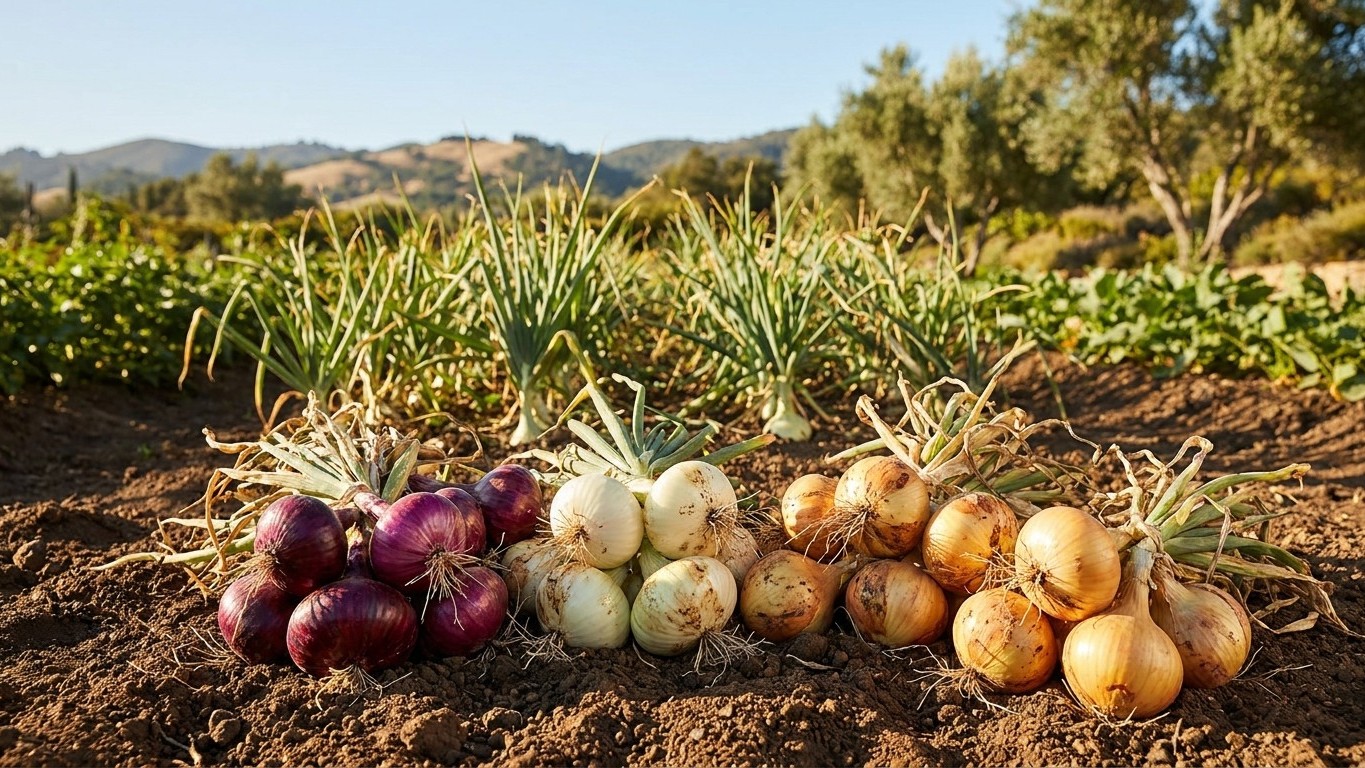

Lift onions once most of the tops have fallen over and the necks have gone soft, on a dry day. Then cure them in a warm, airy, dry spot until the necks are tight and the skins feel papery. Only after that do they go into storage, which for onions means roughly 45 °F to 55 °F and 50 to 60 percent humidity. In Nunavut, the short season and the long summer daylight shape every step, from which variety bulbs at all to where in the house a bag of cured onions can sit.
Keeping them, and for how long
The storage conditions set the target for everything that happens earlier, which is why they come first. Clemson Cooperative Extension’s Home & Garden Information Center gives the ideal as “between 45 °F and 55 °F, and 50 to 60 percent humidity.” Write this on a sticky note and put it where you keep the bulbs: 45 °F to 55 °F with 50 to 60 percent humidity.
Onions want dry air. Carrots, beets and other root crops want the opposite, a cold and damp cellar. A single room cannot hold both well, so if you grow both, plan two storage spots. The papery outer skin is the onion’s own packaging. Damp air softens it, and moisture at the neck is how rot gets inside. Warm air does a different kind of damage: it wakes the bulb up, and it starts to sprout.
Duration is where gardeners get let down. Clemson describes ideal conditions, and sound, well-cured bulbs held in those conditions keep well. That is a ceiling. A house rarely stays inside that temperature and humidity band all winter, and every week outside it takes something off the total.
The bulbs themselves matter as much as the room. Pungent, thick-skinned varieties generally hold longer than mild, sweet ones, which carry more water. The best onion varieties for Nunavut are chosen first for whether they will bulb in your daylight, and keeping quality is a second filter. Several things shorten storage life whatever the variety:
- A thick, green neck that never dried down
- Bruises or fork nicks from lifting
- Feeding or pest damage from the growing season (see what eats onion in Nunavut, and when)
- Skipping the cure and storing bulbs straight from the ground
Check the stored bulbs every few weeks. Pull out any that feel soft at the shoulder or smell sour. One rotting onion will spoil the ones touching it, and a handful of checks over the winter is cheaper than losing the bag.
Where in the house that actually is
A thermometer reading matters more than a room’s name. Still, some rooms are better bets than others, and some are clearly wrong. A domestic refrigerator runs colder than the 45 °F floor and is humid inside, so it fails on both counts. A heated living space is too warm, and the dry air that comes with heating does nothing to offset the heat. A garage or an unheated entry swings with the weather, and in a Nunavut winter that means freezing nights that turn a bulb to mush once it thaws.
| Spot | Temperature against 45 to 55 °F | Humidity | Verdict |
|---|---|---|---|
| Refrigerator | Too cold | Too damp | Avoid |
| Heated main room | Too warm | Usually dry | Short-term only |
| Garage or arctic entry | Swings from mild to freezing | Varies | Risky |
| Cool interior room, closet or pantry away from heat | Closest to the range | Usually dry enough | Best bet |
In most Nunavut homes the closest match is a cool, unheated or lightly heated interior room, a closet on an inside wall, or a pantry shelf far from the furnace and the water heater. Houses on permafrost often have no basement, so the root-cellar option many southern gardeners count on is not available. Think small and indoors instead.
Put the bulbs in mesh bags, open crates or a shallow box with air gaps, never in a sealed plastic tub. Air movement keeps the necks dry. Keep them away from outside walls that get very cold and from windows.
Leave a min-max thermometer, ideally one that also reads humidity, in the exact spot for a week before the onions go in. Skip that check and you are guessing, and a spot that feels cool to the hand can sit well above 55 °F by the afternoon or dip near freezing overnight. If the reading lands outside the range, try another shelf or another room before you commit the harvest.
When do you lift onions in Nunavut, and how do you cure them?
How do you know the tops are ready to lift?
Watch the plants, not the calendar. When most of the green tops have bent over at the neck and started to yellow, the bulb has finished growing. The neck goes soft and floppy at that point. Lift on a dry day, loosen the soil with a fork set well away from the bulbs, and handle them gently, since a bruise is a starting point for rot. Where the season is short, do not wait for the ground to freeze hard, because bulbs caught in frozen soil will not keep.
Whether the plants reach that stage at all depends on daylight. Bulbing is triggered by day length, not by warmth. The reference station for these numbers is Rankin Inlet A, at 62.82 degrees north. On the longest day of the year it gets 19 h 41 of daylight (a geometric calculation from the latitude, before the roughly seven extra minutes atmospheric refraction adds). Clemson Cooperative Extension gives the bulbing threshold for short-day onions as about 12 hours.
| Onion type | Starts bulbing at | At Rankin Inlet | What to expect |
|---|---|---|---|
| Short-day | About 12 hours | Threshold passed very early in the season | Bulbs early and stays small |
| Long-day | 14 to 16 hours | Daylight well above that | Bulbs fully |
That is why northern gardens grow long-day onions. A reader far from Rankin Inlet, to the north or south, should look up their own latitude, because day length changes with it. Start with the overview of growing onions in Nunavut if you are still choosing what to plant.
How do you cure onions where the fall is short and cool?
Curing dries the neck and the outer skins so they seal the bulb. Spread the onions in a single layer, tops still attached, somewhere warm, dry and airy and out of rain and hard direct sun. In a cool northern fall that is usually indoors: a spare room, a covered porch on a dry stretch, or racks near a fan. A heated room is too warm for storage, but it works fine for the cure. Wait until the necks are tight and the skins papery. When the necks are tight and the skins rustle, trim the roots and cut the tops to a short stub.
Common questions
Can I store onions in a refrigerator?
It is a poor long-term spot. A domestic fridge is colder than the 45 °F lower limit and humid, and onions want dry air at 50 to 60 percent humidity. A cut onion is a different matter, since it keeps best wrapped in the fridge for a few days.
What if my onions never form a bulb?
Check the variety. A long-day type waits for 14 to 16 hours of daylight, and where days stay shorter than that it makes only leaves. In Rankin Inlet the longest day is 19 h 41, so a long-day onion has the light it needs there. A short-day onion bulbs at about 12 hours and stays small.
Do I have to cure onions before storing them?
Yes. Bulbs go into storage only once the necks are tight and the skins are papery. An uncured onion carries moisture in the neck and rots there.
How long will stored onions last?
Sound, well-cured bulbs held at 45 °F to 55 °F and 50 to 60 percent humidity keep well. That is a maximum for good conditions, and sweet varieties and any bruised bulbs fall short of it. Your county extension office or a local gardening group can tell you what has worked in your community.