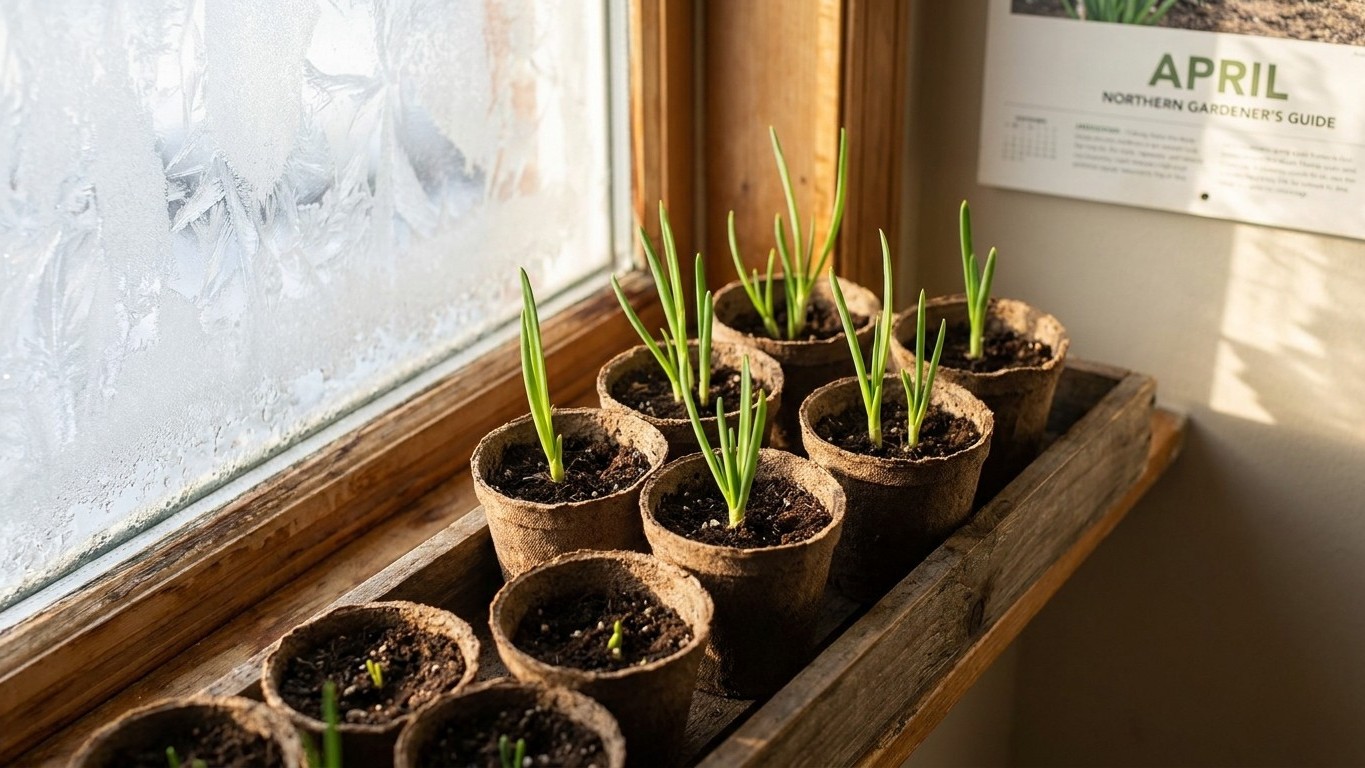

In Nunavut, onions go into the ground as transplants, not as seed sown straight into the soil, and the timing works backward from one number: 19 hours and 41 minutes of daylight at Rankin Inlet on the summer solstice. That much light triggers bulbing fast, so the plant has to already be sized up before the trigger fires. Only a variety built for latitudes this far north, started indoors weeks ahead of the last frost, has a real chance at a usable bulb.
The short answer for Nunavut

Rankin Inlet sits at 62.82 degrees north. On the longest day of the year, the sun keeps the sky lit for 19 hours and 41 minutes, one of the longest summer days used anywhere on this site’s onion pages. That figure matters more than temperature, because onions decide when to stop growing leaves and start building a bulb based on day length, not warmth. Clemson Cooperative Extension’s home garden guidance lays out the mechanism plainly: short-day onions start bulbing once daylight reaches roughly 12 hours, while long-day types hold off until 14 to 16 hours (Clemson HGIC, Onion). In a place where summer days blow past 19 hours, the trigger for a long-day onion arrives early and stays active for weeks.
That’s the entire logic behind the calendar here. Because bulbing starts as soon as day length crosses the threshold, and Rankin Inlet crosses it fast once summer arrives, the plant has almost no runway to build leaf mass before the bulb-making switch flips. The practical answer: start onion seed indoors in late winter, under lights, and transplant seedlings outside only after the last frost has passed. Direct-seeding outdoors in spring simply doesn’t leave enough weeks between a safe planting date and the solstice trigger.
Of the varieties documented on this site, exactly one has a published range that reaches Rankin Inlet’s latitude: Redwing, a long-day onion rated for 43 to 65 degrees north. That upper limit isn’t decorative. It’s the difference between a variety that can still be building size when the long Arctic days hit their peak, and one that was never meant to see daylight this extreme. Everywhere else in the U.S. onion-growing map, gardeners choose between short-day, intermediate-day, and long-day types depending on how far south or north they sit. In Nunavut, the choice narrows to almost nothing, and the calendar narrows with it: start early, transplant promptly, and let the long days do the rest of the work before the short season runs out.
What will not work here
Planting an onion late in this climate does not push the harvest back a few weeks. It shrinks the harvest, because whatever size the plant has reached the moment day length crosses the bulbing threshold is the size the bulb will end up. A transplant that’s still small and spindly when the trigger fires stays small and spindly at harvest, no matter how much longer it stays in the ground afterward. There’s no catching up once bulbing starts.
That single mechanism rules out most of the varieties catalogued for this site. Short-day and intermediate-day onions are bred to trigger at lower daylight thresholds, roughly 12 hours for short-day types and 13 to 14 for intermediate ones. At Rankin Inlet’s latitude, the day length blows past both thresholds well before the plants have any real size on them, so bulbing starts almost immediately and locks in a tiny bulb. This isn’t a feeding problem or a soil problem. It’s a variety mismatch, and no amount of fertilizer fixes it.
- Gabriella (short-day, 20-35N): triggers within days of emergence at this latitude, no size gained
- Madalyn (short-day, 20-35N): same early trigger, tiny bulb locked in
- Red Rock (short-day, 30-36N): threshold crossed weeks before the plant matures
- Red Sensation (short-day, 25-35N): bulbing starts far too early for northern day length
- Texas Grano 1015Y (short-day, 25-35N): bred for a 12-hour trigger, useless this far north
- Vidora (short-day, 25-35N): same early-trigger problem as other short-day types
- White Castle (short-day, 30-38N): bulbs before real leaf growth happens
- Cabernet, Calibra, Candy, Elsye, Expression, Monastrell, Red Long of Florence, Red Long of Tropea, Scout, Sierra Blanca (all intermediate-day, ranges 32-50N): trigger at 13-14 hours, which Rankin Inlet’s summer day length exceeds by early season
A second group fails for a different reason. These are long-day onions, the same category as Redwing, but their published ranges stop well south of Nunavut. Catalogue data doesn’t extend their recommended zone up to 62.82 degrees north, meaning they haven’t been documented as reliable through a growing season this short and this extreme:
- Ailsa Craig (long-day, 38-60N): range tops out short of Rankin Inlet’s latitude
- Barolo, Blush (long-day, 38-55N): same northern limit shortfall
- Bridger (long-day, 35-50N): rated well south of this territory
- Frontier (long-day, 40-50N): 50N is the published ceiling
- New York Early, Patterson (long-day, 38-50N and 38-55N): neither reaches 62.82N
- Powell (long-day, 43-47N): a narrow range that stops well short
- Red Carpet (long-day, 40-45N): rated for mid-latitude growing only
- Rossa di Milano (long-day, 38-50N): southern-leaning long-day range
- Safrane, Talon (long-day, 42-50N): both cap out well below Nunavut
- Walla Walla Sweet (long-day, 35-55N): its 55N ceiling is 8 degrees short of Rankin Inlet
What changes across Nunavut
Nunavut is not a single point on a map, and 62.82 degrees north describes Rankin Inlet, not the whole territory. The territory stretches from mainland communities around that latitude up through Baffin Island and into the high Arctic archipelago, where settlements like Grise Fiord sit far beyond Rankin Inlet’s latitude, close enough to the pole that summer brings weeks of continuous daylight and winter brings weeks of continuous dark. A gardener in one of those high Arctic communities is working with a longer, more extreme daylight swing than the numbers above, and a shorter frost-free window on top of it.
| Location type | Latitude / daylight | What it changes |
|---|---|---|
| Rankin Inlet (reference city) | 62.82N, 19h41 on the solstice | Baseline used for this page: Redwing is the only documented fit |
| High Arctic communities (e.g., near Grise Fiord) | Well north of 62.82N, daylight approaching continuous at the solstice | Bulbing trigger arrives even faster; frost-free season shrinks further, leaving even less room for direct seeding |
The direction of the error matters. A gardener closer to the territory’s southern mainland edge may find conditions a little closer to what’s described here, with slightly shorter summer days and a marginally longer frost-free stretch. Someone further north or on an island community should assume the calendar is tighter, not looser, than what Rankin Inlet’s numbers suggest. In either case, Redwing remains the only variety on this site with a published range reaching this far north, but how much of a head start a transplant needs before it goes outside depends on exactly where in the territory that garden sits.
Checking this against your own garden
Rankin Inlet’s numbers are a starting point, not a guarantee for every yard in Nunavut. Before locking in a planting date, it’s worth confirming a few details specific to the actual location:
- Look up the latitude of the nearest community, since a few degrees north or south shifts the solstice day length and the bulbing timeline with it
- Check local frost-free dates through Environment and Climate Change Canada’s climate normals for the closest weather station, rather than assuming Rankin Inlet’s frost pattern applies elsewhere in the territory
- Ask a local agricultural extension contact or community garden coordinator whether Redwing or comparable long-day stock has actually been grown successfully nearby
- Track how many weeks of usable growing time exist between a realistic last-frost transplant date and the solstice, since that window determines how much size the plant can gain before bulbing locks it in
- Note whether the garden site gets full sun through the long summer days, since shading late in the season cuts into the leaf growth the plant needs before the trigger hits