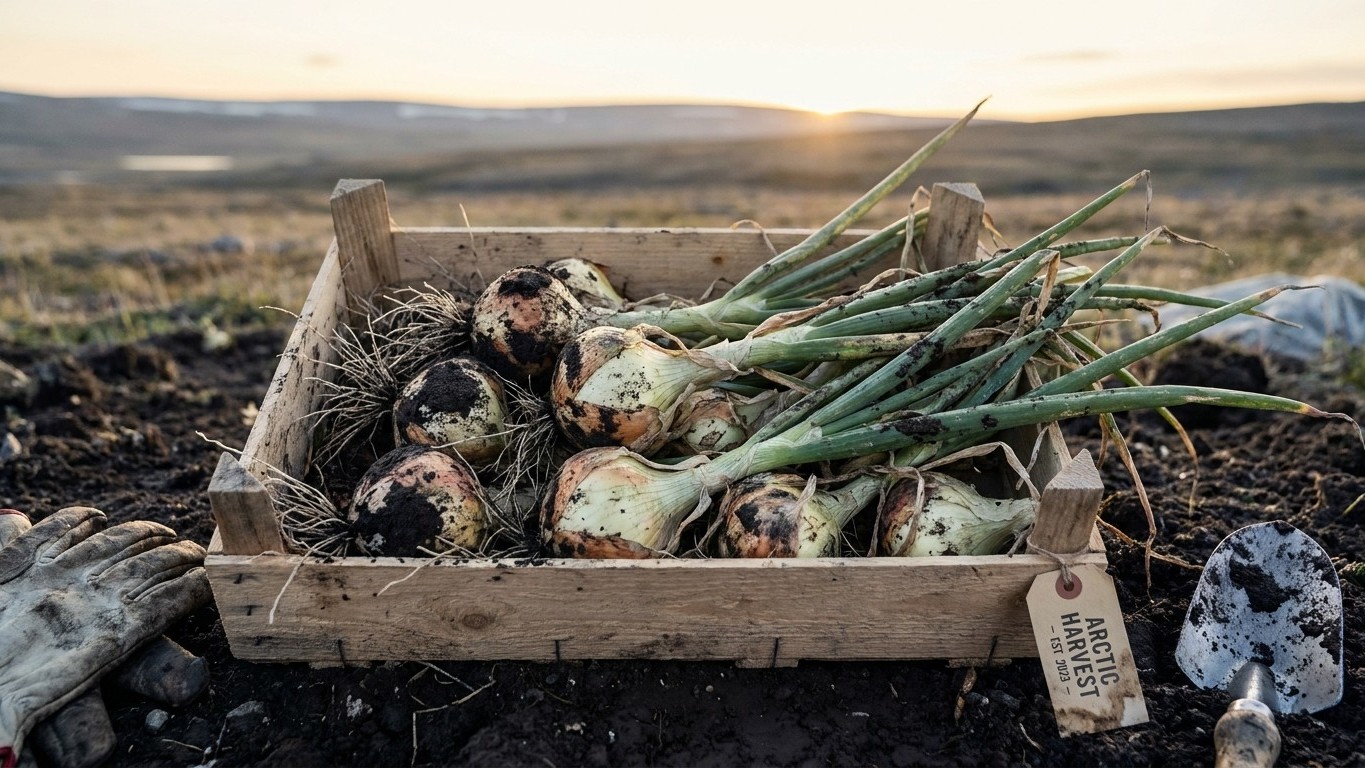

At 62.82°N, Nunavut sits inside the narrow band where long-day onions finally get enough summer light to bulb, but almost every other type sold in stores will fail here. Only one variety documented on this site has a published range that reaches this latitude. The rest either bulb too early and stay tiny, or never bulb at all and just keep growing leaves until frost kills them.
How long your longest day is

Rankin Inlet, the reference station for this territory, sits at 62.82 degrees north. On the longest day of the year, that location gets 19 hours and 41 minutes of daylight. That single number decides almost everything about which onion you can grow, because onions don’t bulb from heat or fertilizer or how deep you plant them. They bulb from day length. A plant reads the hours of light hitting its leaves and, once that number crosses a variety-specific threshold, it stops making leaves and starts pulling sugars down into a bulb instead.
Short-day onions trip that switch at around 12 hours, according to Clemson Cooperative Extension’s Home & Garden Information Center. That’s a threshold Rankin Inlet blows past by early May, long before the plant has grown enough leaf mass to build a decent-sized bulb. Intermediate types need something in the 13 to 14-hour range, which still arrives here too early in the season for a full-size onion to form. Long-day varieties hold out for 14 to 16 hours before switching over, and that’s the group this far north can actually satisfy, since Rankin Inlet’s peak of 19 hours and 41 minutes clears even the highest long-day requirement with room to spare.
One city isn’t the whole territory
Rankin Inlet is the only station this data comes from, and Nunavut is enormous. Communities well south of Rankin Inlet, or those tucked closer to Hudson Bay’s coastline, won’t share its exact daylight curve, and gardeners near either edge of the territory should check their own latitude before assuming these numbers apply directly to their yard. The pattern holds broadly across the whole territory, though: this far north, day length is generously long in summer, which rules out short-day and intermediate onions everywhere in Nunavut, not just at Rankin Inlet. Everything below in this article follows from that one fact, the daylight number, not the calendar, not the soil, decides the variety.
Which varieties bulb in Nunavut
Of the 28 onion varieties documented on this site, exactly one has a published latitude range that covers 62.82°N: Redwing, a long-day variety rated for 43 to 65 degrees north. That range comfortably wraps around Rankin Inlet’s latitude, which is why it’s the only realistic pick among The Best Onion Varieties for Nunavut catalogued on this site. For exact sowing and transplanting dates, see When to Plant Onions in Nunavut.
- Redwing — long-day, published range 43-65°N
The 27 varieties that will not bulb here
This is the list that matters more, because it’s the one that explains a failed garden. Every variety below has a published latitude ceiling that sits below Nunavut’s latitude, meaning the day length this far north never matches what the plant expects, or it matches too early for the plant to be ready.
- Ailsa Craig (long-day, 38-60°N)
- Barolo (long-day, 38-55°N)
- Blush (long-day, 38-55°N)
- Bridger (long-day, 35-50°N)
- Cabernet (intermediate-day, 35-45°N)
- Calibra (intermediate-day, 35-45°N)
- Candy (intermediate-day, 33-40°N)
- Elsye (intermediate-day, 32-45°N)
- Expression (intermediate-day, 32-45°N)
- Frontier (long-day, 40-50°N)
- Gabriella (short-day, 20-35°N)
- Madalyn (short-day, 20-35°N)
- Monastrell (intermediate-day, 35-46°N)
- New York Early (long-day, 38-50°N)
- Patterson (long-day, 38-55°N)
- Powell (long-day, 43-47°N)
- Red Carpet (long-day, 40-45°N)
- Red Long of Florence (intermediate-day, 38-50°N)
- Red Long of Tropea (intermediate-day, 35-48°N)
- Red Rock (short-day, 30-36°N)
- Rossa di Milano (long-day, 38-50°N)
- Safrane (long-day, 42-50°N)
- Scout (intermediate-day, 32-46°N)
- Sierra Blanca (intermediate-day, 32-45°N)
- Talon (long-day, 42-50°N)
- Walla Walla Sweet (long-day, 35-55°N)
- White Castle (short-day, 30-38°N)
Plant a short-day type like Gabriella or Red Rock at this latitude and it starts bulbing almost as soon as it’s in the ground, because the 12-hour threshold arrives here in early spring, while the seedling is still small and underdeveloped. The result is a marble-sized onion, not a proper harvest. Plant a long-day type whose range stops at 60°N, like Ailsa Craig, or Talon at 50°N, and the opposite problem shows up: the plant grows lush, tall leaves all summer, waits for a day length its catalog range never actually promises past its ceiling, and by the time first fall frost arrives it still hasn’t bulbed. The leaves collapse, the neck stays soft, and the bulb rots in the ground or in storage within weeks. A gardener who’s bought a supermarket onion set and watched exactly this happen, big green tops, no real onion underneath, has already lived this exact mismatch. It isn’t a watering problem or a fertilizer problem. It’s the wrong variety for the latitude.
When to plant onions in Nunavut
Because Redwing is a long-day type that needs the season’s full daylight swing to trigger bulbing, timing here is less about the calendar date and more about squeezing a full growing cycle between two frost averages that leave very little room to work with.
The frost window you’re actually working inside
At Rankin Inlet, the average last spring frost falls on June 19, and the average first fall frost arrives September 13, according to Environment and Climate Change Canada’s 1981-2010 climate normals for that station. That’s a frost-free window of roughly 86 days, which is short for onions even under ideal light conditions. These are averages, not guarantees: Environment and Climate Change Canada defines a normal as the midpoint of a range, meaning frost falls later than June 19 in about half of all years, and earlier than September 13 in the other half. Treat both dates as the center of a window, not a safe line to plant or harvest by.
Given that tight window, starting onions from seed outdoors after the last frost simply doesn’t leave enough time for a long-day bulb to size up before the first fall frost shuts things down. The practical approach used across short-season northern climates is to start seedlings indoors well ahead of the outdoor season, or to set out young transplants or sets as soon as the ground is workable and the worst of the spring frost risk has passed, rather than waiting for the June 19 average to arrive. That gives the plant the maximum number of long-daylight weeks to bulk up leaves before the extended June daylight triggers bulbing, and the maximum number of weeks after that to actually fill out the bulb before the September 13 average frost arrives.
Because the frost-free season runs shorter here than in almost any other Canadian province documented in this series, and because only one variety on this site’s list is rated for this latitude at all, the margin for error is thin. A gardener working from further-south seed catalogs, where planting advice assumes a longer season and a different set of varieties entirely, should treat that advice as background reading only, not as a schedule to follow here.