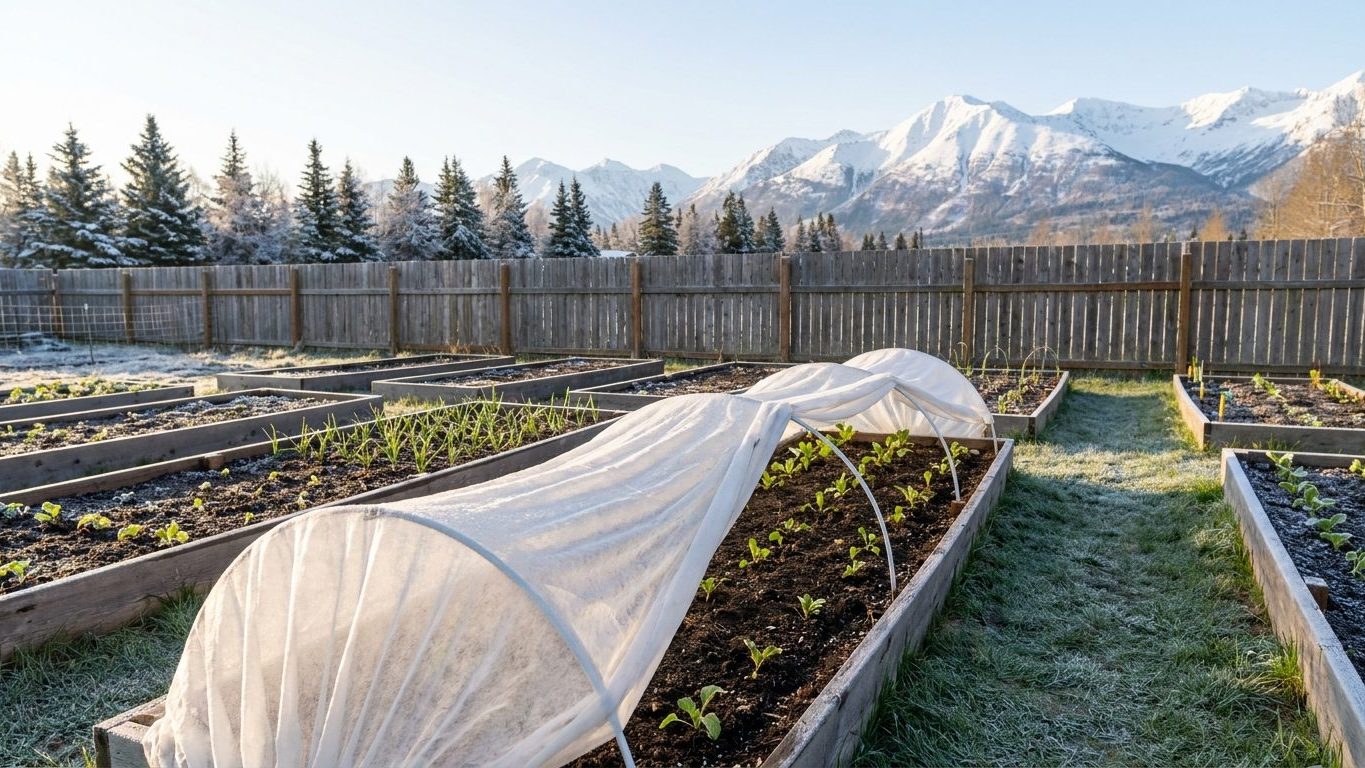

Cover your beds the night before a frost, not on a calendar date. At Rankin Inlet the mean last spring frost is June 19 and the mean first fall frost is September 13. So covers belong over the beds from planting in June until the first fall frost, and they come off on warm, sunny days. Both dates are midpoints, and frost can land weeks on either side of them.
The short answer for Nunavut
Put covers on whenever the overnight forecast sits near freezing, from the day you plant until the season ends. Rankin Inlet has about 86 frost-free days between the mean last spring frost (June 19) and the mean first fall frost (September 13). Those dates come from Environment and Climate Change Canada’s 1981-2010 normals for the Rankin Inlet airport station, and they are averages. In one year out of two, the last spring frost falls later than June 19 and the first fall frost arrives earlier than September 13. Treat each date as the middle of a window, never as a safe date.
When do covers go on in spring?
Lay row cover or a low tunnel over prepared beds before planting, as soon as the snow is gone and the soil can be worked. The cover traps daytime warmth and takes the edge off the cold ground. Keep it on after planting through every night that threatens frost, which in a typical year means well past June 19. A light fabric cover helps on a marginal night and is not enough for a hard freeze. Plastic over hoops buys more on a sunny day and loses it fast after sundown.
When do covers go back on in fall?
Start watching the forecast as the nights lengthen. Because September 13 is a midpoint, the first frost arrives earlier than that date about half the time. Keep fabric or hoops ready at the bed’s edge, so a cold night means five minutes of work. Covers in September protect crops that are nearly finished. They are not a way to start new ones. For the full toolbox, see Extending the Growing Season in Nunavut.
What will not work here
Eighty-six frost-free days on average is a short runway, and anything slow eats it. Warming the soil under clear plastic before planting sounds sensible, but it takes time out of the average season. Do it in the weeks when the ground is still thawing, then plant right after, so the bed never sits idle with the clock running.
Which cover habits fail in a short, cold season?
Planting on June 19 and trusting the date fails half the time, since the average last frost is the midpoint of the window. A covered bed is far safer than a bare one, but only if the cover is on the bed when the cold night arrives. Leaving covers on all day also backfires. On a sunny day, air under plastic climbs quickly, and squash or cucumber flowers cannot be pollinated through fabric. Vent or remove the cover when the day warms up, and replace it before evening.
Wind is the other local enemy. Open tundra and coastal sites give a loose cover nothing to hide behind, and a flapping sheet tears, scrapes seedlings or blows away. Weight the edges with soil, boards or rocks rather than a few pins, and keep hoops low. Tall, unbraced tunnels act like sails. The cover materials that hold up are compared in Which Season Extenders Work in Nunavut.
Crops that need a long, hot summer fail even under cover. Melons and sweet corn want a long warm season, and a few extra degrees from a hoop house cannot make up that gap. Quick, cool-tolerant crops such as lettuce, radishes, spinach and other greens suit the window, and covers make them more dependable.
Covers also do nothing for winter. The mean daily minimum of the coldest month at Rankin Inlet is -34.3 °C (-29.8 °F). A sheet of fabric does not help a perennial survive that. Snow is the real winter blanket, so a bed that holds drifts overwinters better than one scoured bare by wind.
What changes across Nunavut
Nunavut is not one garden. The Rankin Inlet station sits at 62.82 degrees north, and its Canadian hardiness zone is 0a. That is Natural Resources Canada’s system, built on seven climate variables. It does not convert to a USDA zone, so do not compare it with US numbers. The territory stretches far north and far east of that station, so no single answer covers it.
The farther north you live, the later your last frost and the earlier your first one. A community well north of 62.82 degrees should expect a narrower window than the one above and should check its own latitude. Day length matters too. Summer light is long at these latitudes, so cool-tolerant leafy crops get plenty of daylight and are held back by cold, not by lack of sun. Long daylight is also what triggers onions to form bulbs, which is one more reason to pick varieties suited to northern light.
Terrain shifts the dates as well. Coastal sites chilled by sea ice and cold water warm up more slowly than sheltered ground a short way inland. A south-facing slope or a wall that blocks wind can run ahead of an exposed bed in the same community. If your site is exposed, start later in spring and cover earlier in late summer. If it is sheltered, you may have a little more room.
For the zone of your own community, use the Canada’s Plant Hardiness Site map from Natural Resources Canada and look up your municipality. Do not assume the Rankin Inlet zone applies to you.
Where to check this for your own county
Nunavut has no counties, and there is no state-style extension service. The nearest federal source is Agriculture and Agri-Food Canada, which is the place to start for northern growing guidance. Look there for planting calendars written for northern or short-season regions and for lists of varieties trialled in cold, short-summer conditions.
Then narrow it down to your own community. A recommendation for your own area beats a territory-wide one. The dates in this article come from a single station, Rankin Inlet, and work as a territory-level starting point. Your community’s Hamlet office, a local greenhouse project or a northern gardening group will know when the snow actually leaves your beds and when the first hard freeze actually hit last year. Ask what cover materials survive the local wind, and which hardy crops the neighbors have grown successfully.
Write down what you learn. A few seasons of notes on your own frost dates, with covers on and off, will tell you more than any average does.
Checking this against your own garden
Your own observations outrank every date above. Three signs are worth watching, and none of them needs an instrument.
- Soil warmth by feel. Push your hand a few inches into the bed in the morning. If the soil aches and feels like a cold tap, wait or add cover. If it feels cool but not painful, you can plant hardy crops. A bed that warms sooner than your neighbor’s has a warmer microclimate, and you can plant a little earlier there.
- First true leaves. The first pair of leaves on a seedling are seed leaves. The next, differently shaped pair are true leaves. When they appear, the plant can take more air. If growth stalls with purple-tinged leaves, the bed is too cold and needs its cover back.
- First male flowers. Squash and cucumbers open male flowers first. Once they appear, open or lift the cover during the day so pollinators can reach them. If flowers open early in your garden, it is warmer than average.
Keep notes on the dates each sign appears. After a season or two they become your own calendar.
Common questions
Is June 19 a safe planting date for Nunavut?
No. June 19 is the mean last spring frost at Rankin Inlet, so in about half of years frost comes later. Plant on or after that date only with covers ready, and expect colder sites farther north to run later.
How long can I leave covers on?
Fabric row cover can stay on for days if the crop does not need pollination, but vent or lift it on warm sunny days. Clear plastic should come off during the day. Crops that need pollinators, such as squash and cucumbers, need uncovered days once male flowers open.
Will covers protect perennials through a Nunavut winter?
Not on their own. The coldest-month mean daily minimum at Rankin Inlet is -34.3 °C (-29.8 °F), and the Canadian hardiness zone there is 0a. Covers help in the shoulder seasons. Snow cover and choosing very hardy plants matter far more in winter.
Do the 1981-2010 normals still apply?
They are the best published averages for the Rankin Inlet station, but they are decades old. Treat them as a midpoint and trust your own recent frost dates over them where the two differ. Your own notes are the better record.