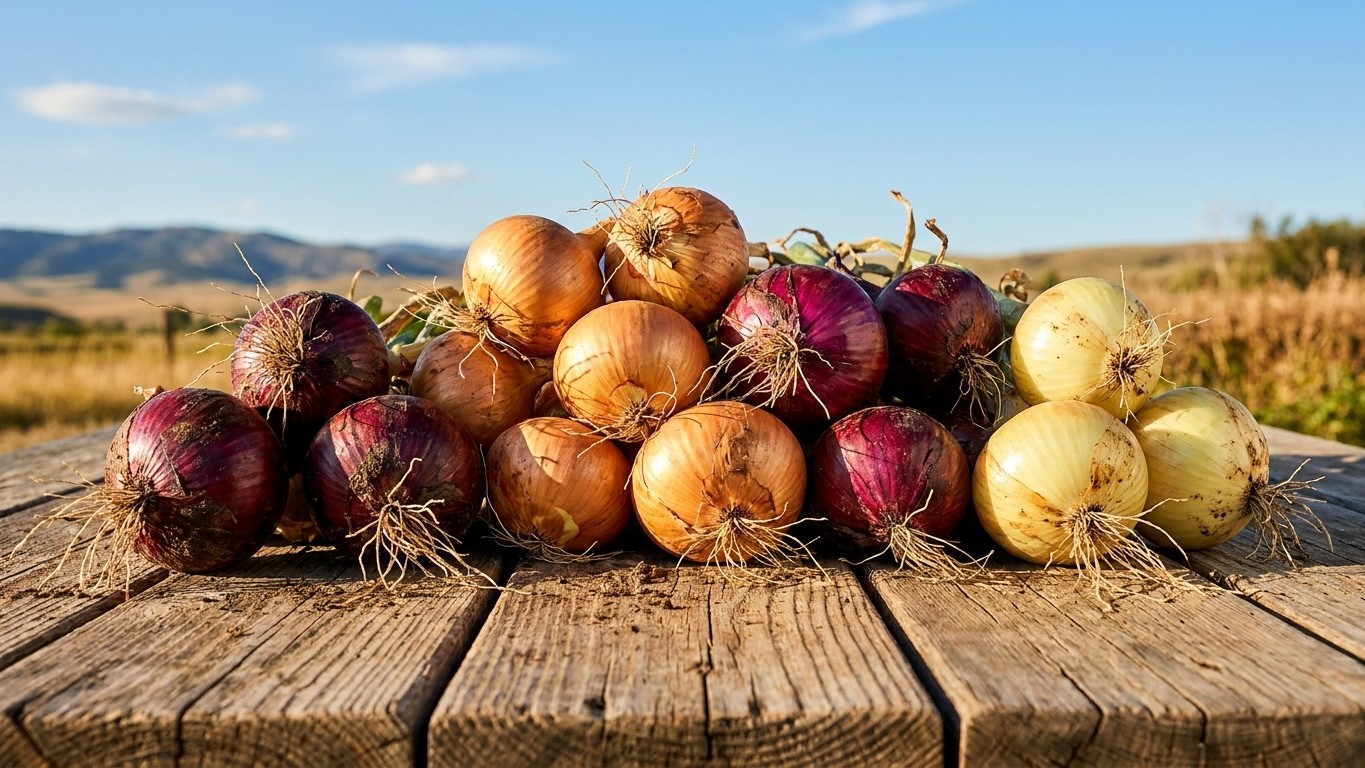

Lift onions once the tops have flopped over and begun to yellow. Pull them on a dry day, then cure them in a warm, shaded, breezy spot until the necks are tight and the outer skins turn papery. Only then do they go into storage. Skip the curing and even a good onion will rot in the crate. The details below decide whether a bulb lasts weeks or most of the winter.
Keeping them, and for how long
Cured onions want cool and dry air. Clemson Cooperative Extension’s Home & Garden Information Center puts it this way: “Ideal conditions are between 45 °F and 55 °F, and 50 to 60 percent humidity.” The number to write down is 45 to 55 °F with 50 to 60 percent humidity. That humidity range is the opposite of what carrots, beets and potatoes like, so one cellar corner rarely serves both well.
Treat any storage period as a ceiling reached only under those ideal conditions. A bulb with a nick, a thick green neck or a damp skin will go soft long before its neighbors. Bulbs bitten by onion maggots or thrips are poor candidates too, and What Eats Onion in Kansas, and When explains how to spot that damage before you load a crate.
Why do sweet onions spoil sooner than pungent ones?
The bite of an onion comes from volatile sulfur compounds, and those same compounds help protect the bulb while it sits in storage. A sweet variety carries fewer of them. University of Missouri Extension (guide G6355) states it plainly: “As a rule, ‘sweet’ onions do not store as well as the more pungent types.” A sweet onion tastes better raw and will not last the winter, so plan to eat those first.
Day length lines up with this trade-off, because it is what triggers bulbing. Short-day types begin forming bulbs at about 12 hours of daylight, according to Clemson Extension, and they tend to run sweeter. Long-day types wait for 14 to 16 hours and tend to keep longer.
| Onion type | Daylight that starts bulbing | Flavor | Storage |
|---|---|---|---|
| Short-day | About 12 hours | Sweeter, fewer sulfur compounds | Eat first; will not last the winter |
| Long-day | 14 to 16 hours | Sharper, more sulfur compounds | Keeps longer, into late winter at best |
Kansas sits in the middle of this range. NOAA NCEI lists the Wichita reference station at 37.65 degrees north, where the longest day of the year runs 14 hours 36 minutes (calculated from that latitude, before the few extra minutes of refracted light). That clears the short-day threshold easily and just reaches the long-day window. A gardener in the far north of the state gets longer summer days than Wichita, and one on the Oklahoma line gets shorter ones, so check your own latitude before choosing. The Best Onion Varieties for Kansas sorts the options by day length and keeping quality.
How do you cure onions before storing them?
Spread the bulbs in a single layer on screens, racks or slatted crates, somewhere warm, dry, shaded and breezy. A covered porch or an open shed works. Rain and direct sun are both a problem, since rain invites rot and strong sun can scald the skins. Leave the tops attached while they dry.
Cure the bulbs until the necks are tight and the skins papery. Bulbs are ready for storage when:
- the necks are tight and dry all the way down
- the outer skins are papery and rustle
- the roots are shriveled and wiry
- the bulbs feel firm with no soft spots
Trim the dry tops to a short stub and brush off loose soil without washing the bulbs. Put any bulb with a thick neck, a flower stalk or a bruise in a separate basket and use it first.
Where in the house that actually is
A kitchen refrigerator runs colder than the 45 °F floor in Clemson’s range and is humid inside, so onions tend to turn soft and sprout when kept there. A heated living space is too warm, and a pantry beside the stove is worse. An attached or detached garage swings with the weather, which in Kansas can mean a hot, damp August and a hard freeze in January. A bulb that freezes and thaws turns to mush.
The room that usually comes closest is a cool interior space away from the furnace and water heater. Examples are a basement corner on a shelf off the floor, an unheated spare room or a closet on the north side of the house. Many Kansas basements are cool but damp in summer, and damp air works against onions. If the basement feels clammy, a small dehumidifier can pull the humidity into range.
Put a thermometer with a humidity readout where the onions will sit and watch it for several days before you load the crate. Check it in the morning and again in the evening, since a spot that reads 50 °F at noon may hit 60 °F by late afternoon. Skipping this step means guessing, and a guess that runs warm or damp costs you the whole harvest by midwinter.
Once the spot passes the test, store the onions in mesh bags, slatted crates or baskets so air moves around every bulb. Avoid sealed plastic bags and solid bins. Keep them away from potatoes and other damp roots, and go through the stored onions every couple of weeks to pull out any that have gone soft before they spoil the rest. For a wider look at growing them here, start with Onions in Kansas.
Common questions
How do I know when onions are ready to lift?
Watch the tops. When most of them have fallen over and started to yellow, the bulbs have stopped growing and are ready. Let the soil dry out before lifting, so the necks start to dry on their own. Lift on a dry day, and loosen the soil with a fork so you do not nick the bulbs.
Can I store sweet onions through the winter?
Not reliably. University of Missouri Extension notes that sweet onions as a rule do not store as well as the more pungent types, because they carry fewer of the sulfur compounds that protect the bulb. Eat sweet varieties first and save the sharper, long-day onions for later in winter.
Can I keep cured onions in the refrigerator?
A domestic refrigerator runs colder than the 45 to 55 °F range Clemson Extension recommends, and the air inside is more humid than the 50 to 60 percent onions prefer. It is a poor place for whole onions. It works fine for a cut onion, wrapped and used soon.
What should I do with onions that have thick necks or flower stalks?
Use them first. A thick, green neck stays moist and lets rot get into the bulb, and a bulb that sent up a flower stalk usually does not store well. Cure them like the rest, but keep them in a separate basket on the kitchen counter so they do not end up in the crate.