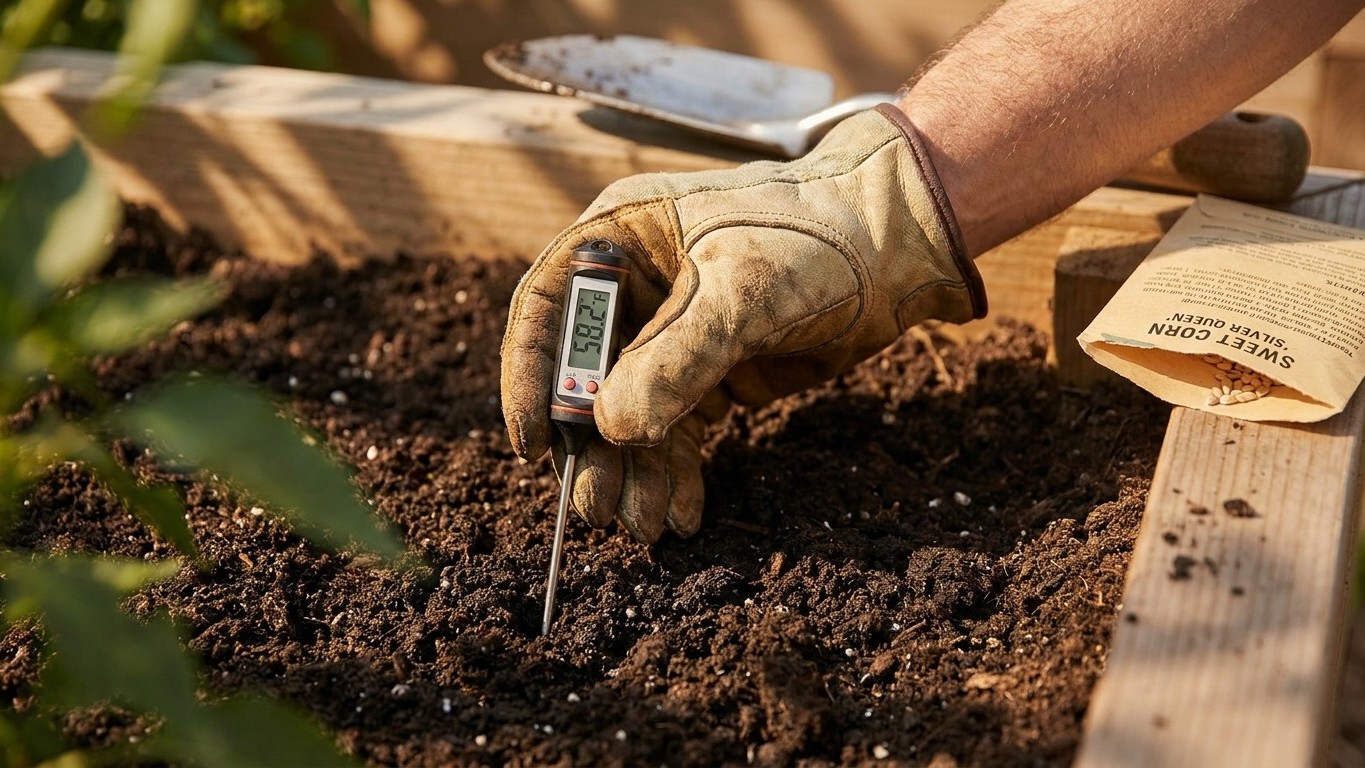

In Nunavut, sweet corn sits right at the edge of what’s realistic outdoors. The mean frost-free stretch runs from June 19 to September 13 at the Rankin Inlet reference station, and sweet corn needs two things before that window even starts to count: soil warmer than 60 F, and 60 to 90 days from planting to harvest. The soil threshold lands weeks after the last frost, not on it. That gap is what decides whether this crop has any real chance here.
The short answer
Start with the mechanism, because it changes everything. The mean last spring frost at Rankin Inlet falls on June 19. Sweet corn seed, though, doesn’t germinate reliably in cold ground, and Utah State University Extension’s benchmark for the crop is soil above 60 F, not simply frost-free soil. Those two thresholds are not the same day, and treating them as interchangeable is the single most common way this planting goes wrong in a short-season territory.
Soil warms slowly after a frost, especially in a climate where the mean number of days reaching 90 F a year is 0.0. That figure matters more than it looks. Zero days of real summer heat means the sun never builds the kind of soil warmth that pushes a seedbed past 60 F quickly. In practice, that pushes the earliest safe sowing date well into July in most years, not the third week of June when the frost risk technically clears.
Now count forward from there. The mean first fall frost lands September 13. From June 19 to September 13 is roughly 86 days total, frost to frost. That’s the outer limit of the growing season in an average year, and it already falls short of the 90 days a slower variety needs, before subtracting a single day for the soil-warming lag. Once you account for soil not reaching 60 F until sometime in July, the usable window for actual corn growth shrinks to somewhere near 60 days, maybe less.
That’s the arithmetic in a mean year. Both frost dates published by Environment and Climate Change Canada are averages drawn from the 1981-2010 normals, not guaranteed cutoffs. In one year out of two, the last spring frost lands later than June 19, and the first fall frost can also shift. A grower who plans around the mean date is planning around a coin flip, not a safe margin. The realistic takeaway: only the fastest sweet corn maturity class has any workable path to harvest here, and even that path is tight.
Does a late variety fit here?
Maturity length is the single biggest lever a grower has in a climate like this, and the difference between a 60-day type and a 90-day type is the difference between a crop that might finish and one that mathematically can’t.
A 60-day variety
Run the numbers on a 60-day maturity class. If soil reaches 60 F sometime in July, a 60-day corn planted right at that point would be expected to mature roughly 60 days later, landing somewhere in the second week of September. The mean first fall frost is September 13. That’s a matter of days of margin, not weeks. It’s workable in a favorable year, but it leaves almost no cushion for a cool stretch, a late soil warm-up, or a first frost that arrives earlier than the mean, which happens in half of all years by definition. This is the class worth attempting, but it demands early, attentive management: warming the soil where possible, sowing the moment 60 F is reached, and accepting that the harvest window will be narrow.
A 90-day variety
A 90-day type does not fit. Even using the most generous frame, frost to frost, the total season length averages about 86 days. A 90-day maturity class needs more calendar time than the region offers in an average year, before any allowance is made for the soil-warming lag that delays the actual planting date past the last frost. There is no combination of an early planting and a mild fall that closes a gap this size reliably. For this territory, a 90-day sweet corn should be treated as a non-starter, not a stretch goal.
What goes wrong here
- Soil sown too cold. Seed goes into ground that’s below 60 F because a grower used the last frost date, June 19, as the green light instead of waiting for the soil itself to warm. Cold, wet seed often rots or germinates unevenly, setting the whole planting back further than if it had simply waited. The remedy is to test the soil, not the calendar, and to hold off until it consistently reads above 60 F before sowing.
- A variety too late for the season. A 90-day maturity class planted here runs out of season before it runs out of growth to finish, since the frost-to-frost window averages roughly 86 days and the real growing window is shorter once soil-warming delay is subtracted. The remedy is simple: choose the shortest maturity class available and skip anything advertised as mid- or full-season.
- Sweetness lost to a neighbor, nothing to do with climate. Su, se and sh2 types cross-pollinate if they tassel at the same time, and the result is starchy, disappointing ears even when the growing season itself went fine. Utah State University Extension does not publish a distance to separate these types by, so the fix isn’t measured in feet. It’s measured in timing: stagger plantings so the types don’t tassel together, or grow only one type in a given season. Corn also needs to be planted in blocks of three or more rows rather than a single line, since that shape is what allows the wind-driven pollen to actually reach the ears reliably within one planting.
Common questions
Can sweet corn be started indoors to get ahead of Nunavut’s short season?
The source behind this article’s core figures, Utah State University Extension, addresses outdoor soil temperature and days-to-maturity, not indoor starting methods for this territory. What’s clear from the frost-to-frost math is that any head start on maturity helps, since the season margin here is thin even for a 60-day variety.
Is June 19 a safe date to plant sweet corn seed?
No. June 19 is the mean last spring frost date from Environment and Climate Change Canada’s 1981-2010 normals for the Rankin Inlet station, meaning frost arrives later than that in about half of all years. It’s also not the date soil reaches 60 F, which is the actual benchmark sweet corn needs before sowing.
How do I know when sweet corn is ripe once it does mature?
Look for three signs together: dry, browned silks, husks that are still moist and green, and milky (not clear, not thick) juice from a punctured kernel. One sign alone isn’t a reliable test; all three need to line up.
Why does the source mention 17 to 24 days as well as 60 to 90 days?
These are two different clocks answering two different questions. The 60-to-90-day figure runs from planting and tells you whether the crop fits the season at all. A separate count, 17 to 24 days from when silks first emerge, tells you which week within that season to expect harvest. They should never be added together or confused for one figure.