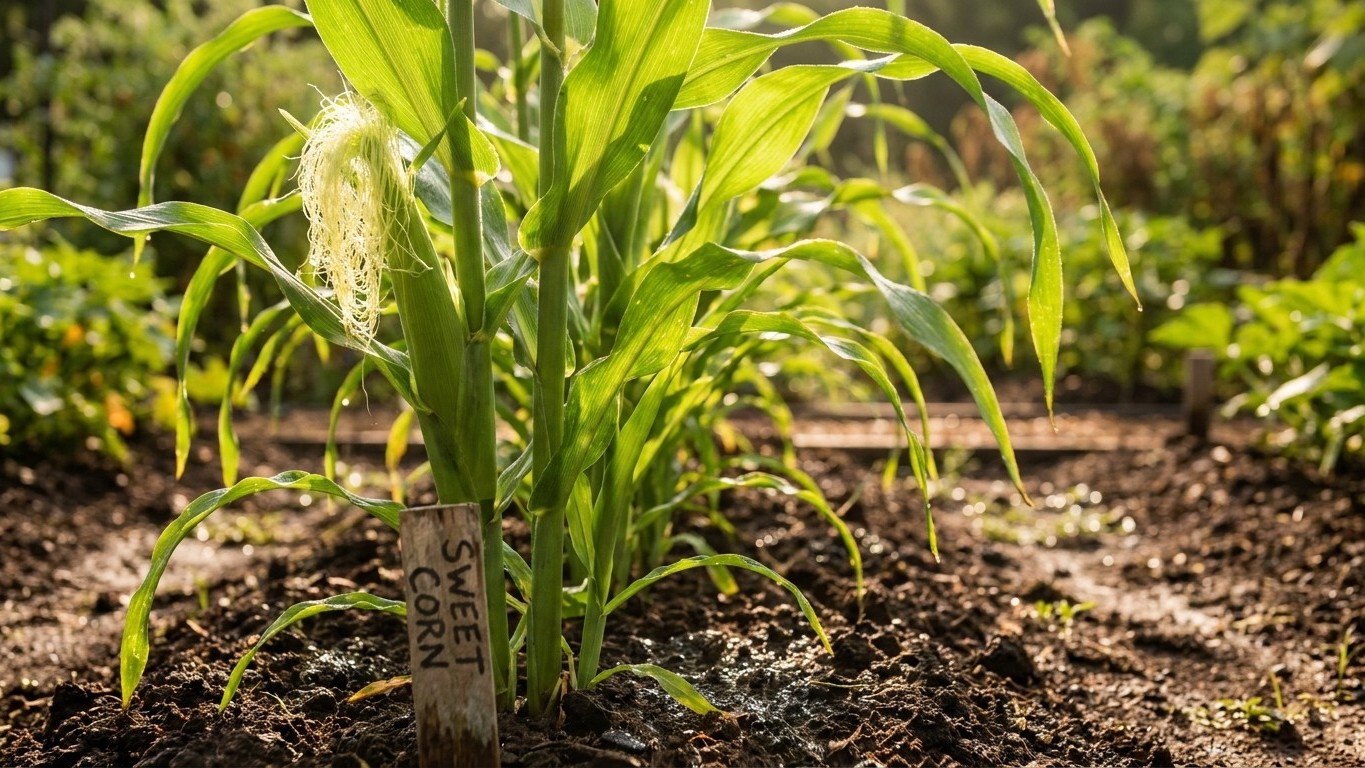

The direct answer is no, not reliably, and not in the open garden. Nunavut’s growing season is too short and too cold for sweet corn to reach the milk stage before frost shuts it down. The math below shows exactly why, using the region’s own climate averages rather than a rule that fits farther south.
The short answer
Sweet corn needs two things before it can even start counting toward harvest: soil warmer than 60°F, and then 60 to 90 frost-free days after that. In Nunavut, using the Rankin Inlet A station as the closest reference point, the average last spring frost falls around June 19. Soil temperature always lags behind air temperature, so the ground doesn’t reach 60°F on that date. It gets there later, sometimes considerably later, which means the real planting window opens well into the second half of June or beyond, not the moment the frost risk clears.
The other end of the calendar is just as unforgiving. The average first fall frost at that same station lands around September 13. Count the days between June 19 and September 13 and you get roughly 86 days total, and that’s before subtracting the extra time the soil needs to warm past 60°F after the frost date passes. Once you take that lag into account, the number of days actually available for a corn plant to grow, tassel, and fill its ears shrinks to something closer to 60 or 65 days in a good year, and less in an average one.
There’s a second problem layered on top of the calendar one: heat. Sweet corn is a warm-season crop that grows fastest when daytime temperatures push into the 80s and 90s, driving rapid cell division and sugar production. The Rankin Inlet average shows 0.0 days a year reaching 90°F. Zero. That’s not a rounding error, it’s the defining feature of the climate. Without that heat load, every stage of the corn’s development, from germination to tasseling to grain fill, runs slower than the seed packet’s day count assumes, because those day counts are built from trial plots in places that do see real summer heat.
Put the two problems together and the picture is clear. The frost-free window is already short at roughly 86 days on paper. Real usable growing days, once you account for the soil-warming lag and the total absence of hot days, run noticeably shorter than that. A crop that needs 60 to 90 days under favorable conditions is being asked to do the same job in a climate that gives it neither the time nor the heat to do it at pace.
Does a late variety fit here?
A 60-day variety
A fast variety maturing in roughly 60 days from planting is the only realistic candidate, and even then it’s a close call rather than a safe bet. If soil reaches 60°F sometime after the June 19 average frost date, say by early to mid July in a typical year, a 60-day clock would put maturity somewhere in the first half of September. That lines up almost exactly with the September 13 average first frost, leaving no cushion at all. Because that frost date is a midpoint rather than a guarantee, roughly half of all years will see frost arrive earlier than average, which means a 60-day planting could be cut short before the ears finish filling. Add the fact that the region logs zero days above 90°F, and even a 60-day variety will likely run slower than its stated clock, since that clock assumes real summer heat pushing growth along. Anyone attempting it should also plant in blocks of three or more short rows rather than one long row, since sweet corn is wind-pollinated and a block shape gets far better pollen coverage per ear in a short, cool season where every ear counts.
A 90-day variety
A slower, later-maturing variety needs 90 days from planting before it’s ready, and here the answer is simple: it does not fit. The frost-free window itself only spans about 86 days on average, before any allowance for the lag between the last frost and the soil actually reaching 60°F. A 90-day requirement already exceeds the full calendar window on paper, and once the real planting date slides into July because the ground needs time to warm, there is no scenario in which a 90-day type reaches maturity before the average September 13 frost arrives. This isn’t a marginal case worth stretching for. A late variety planted in Nunavut is planted to fail, not to ripen late.
What goes wrong here
- Soil sown too cold. Planting on or right after the average June 19 frost date feels intuitive, but the ground hasn’t caught up to 60°F yet at that point. Seed sown into cold soil germinates unevenly or rots before it sprouts. The remedy is patience: check soil temperature directly rather than going by the calendar frost date, and hold off until it’s reliably above 60°F even if that means planting weeks after the last frost.
- A variety too late for the season. A 90-day type simply runs out of calendar before it runs out of growth stages, as the math above shows. The remedy is to not plant one at all in this territory. A fast 60-day type is the only option with any realistic shot, and even that carries real risk in a below-average year.
- Sweetness lost to tasseling overlap, and this one has nothing to do with climate. Standard (su), sugary-enhanced (se), and supersweet (sh2) types of sweet corn cross-pollinate if their tassels release pollen at the same time, and the result is starchy, disappointing ears regardless of how well the season went. No isolation distance is published for this; what matters is timing, not feet or rows apart. The remedy is to grow only one type in a given season, or to stagger plantings so the different types never tassel during the same window.
Common questions
Can starting corn indoors save enough time to make a difference? Corn resents having its roots disturbed, and transplanting it is generally discouraged for that reason. Even where it’s attempted, the bigger constraint in this territory is the near-total absence of days above 90°F, which slows every growth stage regardless of when the seed went into soil or a pot. Indoor starts don’t fix a climate that has no summer heat load to work with.
How do I know when the ears are actually ripe? Look for three signs together, not just one: the silks have turned dry and brown, the husks are still moist and green rather than dried out, and juice squeezed from a punctured kernel runs milky rather than clear or watery. This is a separate clock from the 60-to-90-day planting figure. Once silks emerge, ears are typically ready to pick roughly 17 to 24 days later, a picking window rather than a planting one.
Does the lack of 90°F days really matter that much? Yes. Sweet corn is built to accelerate its growth in genuine summer heat, and a station averaging 0.0 days a year at or above 90°F offers none of that acceleration. Every stage from germination to grain fill runs on the slow end of its potential range, which is part of why even a 60-day variety should be treated as a stretch here rather than a comfortable fit.
Can I grow two sweet corn varieties in the same garden here? Only if they don’t tassel at the same time. The concern is cross-pollination between su, se, and sh2 types, which degrades sweetness rather than affecting whether the plant survives the climate. No specific distance is published for keeping them apart, so the practical approach is to stagger planting dates enough that tasseling windows don’t overlap, or to grow just one type in a season this short.