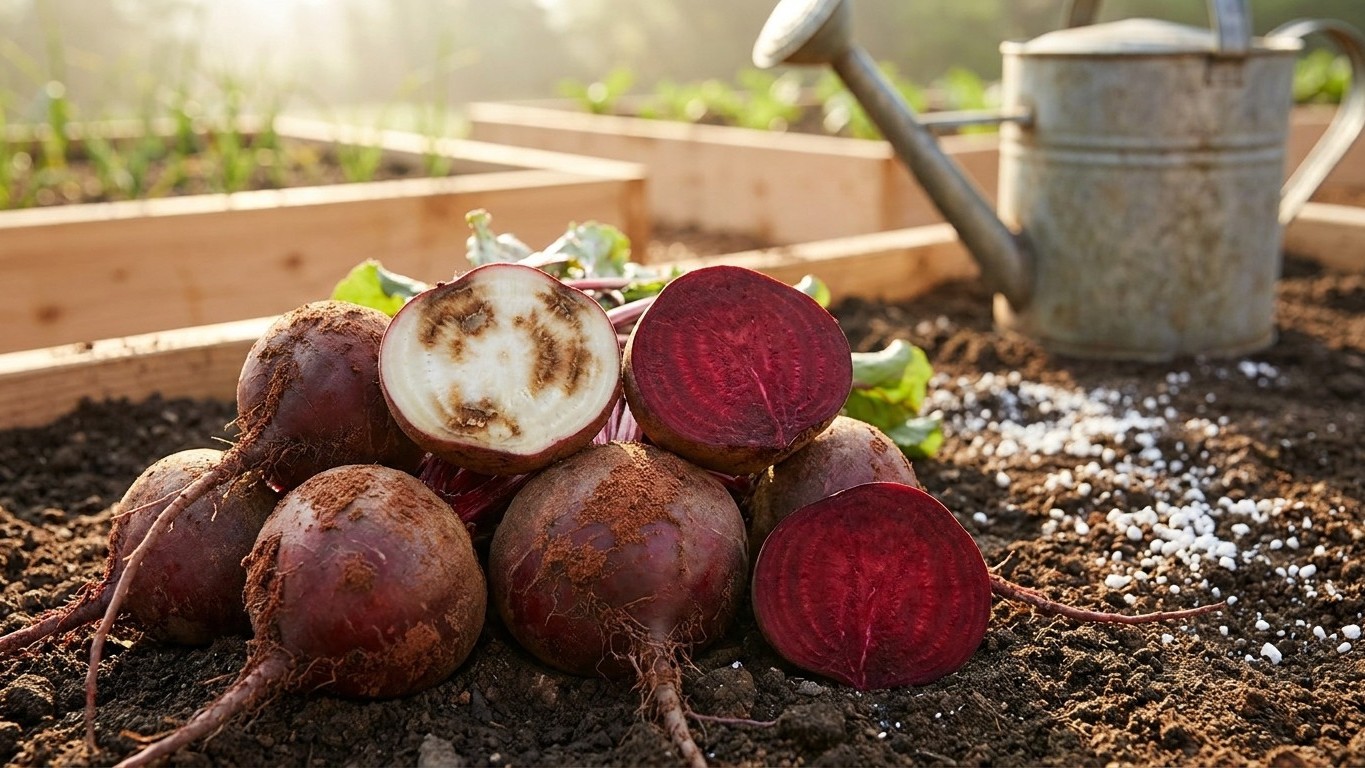

Pull Ohio beets when the roots reach the size you want. For beets sown in place from mid-April to early May, that usually means mid-June through July, 60 to 80 days after seeding. Harvest before summer heat can turn them woody. Storage holds a surprise, too. Beets do not want the coldest spot you have. Topped roots keep best at 33 to 36 F, and the USDA reports more black spot and rot at 32 to 34 F.
The short answer
Ohio’s state soil is the Miamian series, an Alfisol, a forest soil of moderate fertility that holds nutrients reasonably well. USDA records for its surface layer, drawn from 401 mapped components of the series, show 26 percent sand, 20 percent clay and 53 percent silt. That is a loam to silt texture. Organic matter sits at about 2.0 percent, surface pH at about 6.5 (slightly acid), and the drainage class is well drained.
Treat that as a starting point and nothing more. A state spans hundreds of soil series, and Miamian is the one chosen to represent Ohio, not the one under your tomatoes. River bottoms, hill country and any lot a builder scraped or filled will behave differently. The pH above is a mapped value, not yours. A soil test gives you the real number, and Beet Soil in Ohio: What the Root Will Meet walks through what the root meets once you have it.
Set that against what beets ask for. Utah State University Extension describes deep, sandy, well-drained soil rich in organic matter, amended with no more than 1 inch of composted organic matter per 100 sq ft. Miamian gets the drainage right. It misses on sand, with only 26 percent against 53 percent silt. A silty loam generally holds water longer than sand does, which helps in a dry spell. But a bed at 2.0 percent organic matter has less cushion than the rich soil in that description. Water still matters, and the next section shows when.
Then there is heat. Utah State Extension says heat above 85 F combined with water stress makes the root woody. How many days a year Ohio’s reference city passes 90 F is not published in the figures behind this page, so I won’t guess at a count. The 85 F line sits below 90 F anyway, so a stretch of upper-80s afternoons over a dry bed is enough to cause trouble.
Woodiness is a late failure. It hits roots that stay in the ground as summer heat arrives. That is the reason to pull on the early side of the window when a hot, dry week is coming. Count the days from seeding, because beets are sown in place and there is no transplant date to count from.
The six weeks that decide it here
Ohio State University Extension’s Ohio Gardening Calendar puts the last spring frost at May 5 to May 15 for zone 6a. Sow beets 2 to 3 weeks ahead of that and you are seeding between roughly April 14 and May 1. The first six weeks of those beets then run from mid-April into late May, or from the start of May into mid-June. Those weeks decide whether a planting bolts.
Utah State Extension is specific about the mechanism. Water stress in the first 6 weeks causes premature flowering. That is bolting, and it is a separate failure from the woodiness described above. Early thirst sends the plant toward seed. Later heat over a dry bed toughens a root that was growing fine. One needs a dry stretch in spring, the other a hot one in summer, and watering well in May does not protect you from the second.
What does an Ohio spring usually do? It swings. Cold, wet weeks give way to warm, breezy, dry days, then back again, and the pattern rarely holds for long. A planting can sit in saturated ground in late April and face a thirsty week in late May. So the bolting risk here is less a drought lasting all spring than a dry spell after a wet start, when seedlings have small roots and the surface has dried while the bed feels fine in your memory of last week’s rain.
The practical habit is to check the soil, not the forecast. Push a finger a couple of inches down. A silt-heavy loam can crust and look dry on top while holding moisture below, or the reverse after a few breezy days. Soak deeply when it’s dry rather than sprinkling daily. If you want the full season plan around these weeks, Growing Beets in Ohio lays it out.
Run the arithmetic forward and the harvest window appears. Sowing on April 14 and counting 60 to 80 days lands between mid-June and the start of July. Sowing on May 1 lands from the end of June to about July 20. These are my calculations from the frost range, not measured harvest dates, so let the roots themselves have the final say.
What goes wrong here
- Bolting in the first six weeks. Early water stress sends seedlings toward flowers. Watch for dry stretches in May, even after a wet April, and soak the bed deeply when the top few inches go dry. Do not wait for the plants to wilt.
- Woody roots in summer. Heat above 85 F with water stress toughens the root. Pull on the early side of the 60 to 80 day window if a hot, dry week is on the way, and keep the bed evenly moist until you do.
- Over-amending the bed. Rich soil is the goal, but Utah State Extension caps composted organic matter at 1 inch per 100 sq ft. More is not better. Test first, because your bed may already differ from the 2.0 percent organic matter in the mapped Miamian surface.
- Storing at the coldest setting. This is the one that surprises people. Between 32 and 34 F, the USDA reports more black spot and rot than at slightly warmer temperatures. Aim for 33 to 36 F at 98 percent humidity for topped roots. In a pit or cellar, stay between 31 and 41 F, never lower or higher.
- Storing them with the leaves on. Bunched beets last only about 10 to 14 days, at 32 F and above 98 percent humidity. Top them first, then store the roots. Greens you want to eat should go in the kitchen within that window, and What Eats Beet in Ohio, and When covers who else may be after them.
- Keeping the small roots. Large roots keep much better than small ones because they lose water and shrivel more slowly. Eat the small ones first and put the big ones away for later.
Common questions
How do I know when to start pulling beets?
Count from seeding, since beets are sown in place. Roots usually take 60 to 80 days from seeding to reach harvest size, so mark your sowing date. Then brush the soil from a shoulder or two and pull what has reached the size you want. If heat above 85 F is arriving over a dry bed, favor the early end of the window.
Can I leave beets in the ground through summer?
It is a gamble. Utah State Extension links heat above 85 F with water stress to woody roots. Ohio’s own count of days above 90 F is not published here, so the safest approach is to pull mature roots before the hottest weeks and move them into storage rather than leaving them to bake.
How cold should my cellar or fridge be for beets?
For topped roots, aim for 33 to 36 F and about 98 percent humidity, per the USDA’s Agricultural Handbook 66. Pits and cellars should stay between 31 and 41 F. Running at 32 to 34 F brings more black spot and rot, so going colder than that range works against you.
Why do my beets shrivel in storage?
Small roots lose water faster than large ones, so they shrivel first. Dry air makes it worse, which is why the USDA target is around 98 percent humidity. Keep the large roots for storage, eat the small ones in the first weeks, and cut the tops off before putting any root away.