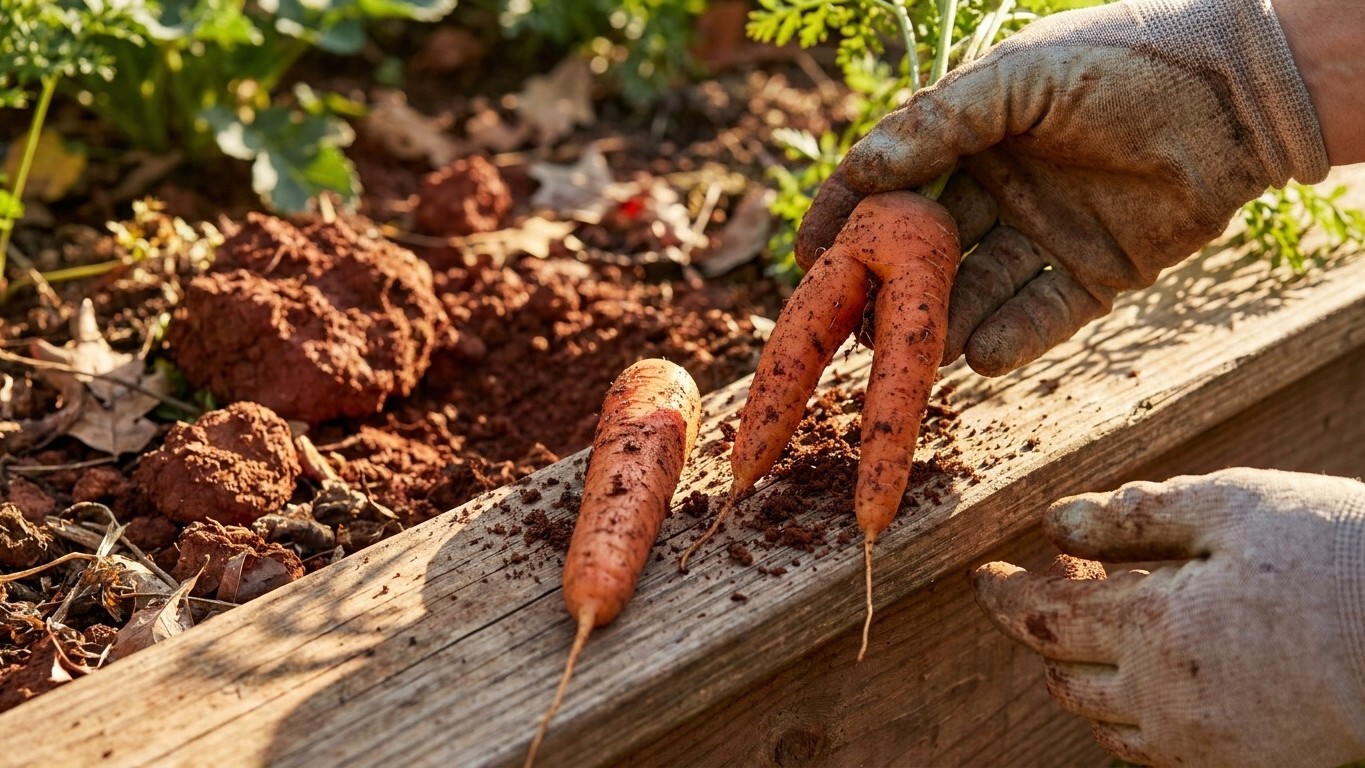

Ohio’s representative soil, the Miamian series, is a well-drained silt loam with only moderate clay. That combination means most garden beds built on it are unlikely to twist a carrot root into a fork, but the state soil is not your soil, and a compacted or rocky patch just a few feet away can fork every root you pull.
The short answer
The soil USDA lists as representative of Ohio is the Miamian series, an Alfisol formed under forest cover. It’s a soil of moderate natural fertility, with a surface texture that runs 26 percent sand, 20 percent clay and 53 percent silt, putting it in loam-to-silt loam territory. Surface pH sits around 6.5, slightly acid, and organic matter in the mapped surface horizon comes in around 2.0 percent. Drainage is classed as well drained.
Carrots, according to Utah State University Extension, want deep, sandy, well-drained soil that’s rich in organic matter. Heavy or rocky ground is what makes a root fork, because the tip hits resistance and splits around it instead of pushing straight down. At 20 percent clay, the Miamian series isn’t the heavy clay that causes the worst forking. It’s a loam, and a well-drained one at that, so on paper it leans toward the kind of ground carrots can work with rather than fight.
The catch is that 53 percent silt figure. Silt-heavy surfaces are prone to crusting and surface compaction after a hard rain, and a cultivated garden bed rarely holds onto the full 2.0 percent organic matter that the mapped natural surface carries, since tilling and cropping burn through organic matter faster than it’s replaced. A bed that starts as loam can behave like something denser by midsummer if it’s never amended. So the plain answer is: this soil, as mapped, is not the heavy, rocky ground that guarantees forked roots, but it’s also not automatically carrot-perfect ground either. It sits in the middle, and what tips it one way or the other is what you do to it before you sow.
Utah State’s fix for heavy soil is straightforward: work in plenty of compost and double dig the bed, breaking up compaction below the depth a shovel normally reaches. On ground that’s shallow over a compacted layer, or wherever drainage is questionable, a raised bed sidesteps the problem completely by giving roots a full column of loose, amended soil to grow into.
None of this is a diagnosis of your yard. Ohio spans hundreds of mapped soil series, not one. The Miamian series is simply the one USDA has designated as representative of the state under its State Soils program, built from data on 401 sampled components of that series. River bottoms, hill country, and any lot that’s been graded, filled, or stripped by a builder can carry soil that looks nothing like this profile. Treat the numbers above as a regional tendency, not a soil test result for your own backyard.
The test that settles it in your own garden
State-level data can only tell you what the ground tends to do across a wide area. Your carrot bed is a few dozen square feet, and the only way to know what it will do to a root is to look at it directly.
- Pick the spot where you plan to sow, and dig a hole roughly a foot deep with a shovel or spade, keeping the sides as straight as you can so you can see the soil in profile.
- Note where the loose, diggable soil ends. If you hit dense clay, a hardpan, or a shelf of rock well before a foot down, that’s the depth a carrot root will also hit, and it will fork or stop there rather than growing past it.
- Pull out a handful of soil from partway down the hole, not just the surface, and check it for stones, gravel, or construction rubble. Buried debris is one of the most common causes of forked and twisted roots in home gardens, and it doesn’t show up until you dig.
- Moisten a small handful of that soil and rub it between your fingers. Soil that feels gritty leans sandy, soil that feels sticky and holds a ribbon shape when pressed leans clay, and soil that feels smooth and almost floury leans silty. This rough texture check tells you more about your actual bed than any regional average can.
- Refill the hole with water and watch how it drains. Water that sits for a long stretch points to poor drainage and a soil that compacts easily, both of which raise the odds of forking and rot. Water that disappears quickly suggests a looser, better-drained profile closer to what carrots prefer.
- Compare what you found against the standard Utah State University Extension lays out: deep, sandy, well-drained soil rich in organic matter. The bigger the gap between that description and what’s in your hole, the more compost, double digging, or raised-bed building your carrot patch needs before you sow a single seed.
What goes wrong here
- Forking in heavy or compacted ground. Any bed where clay content runs higher than the state average, or where years of foot traffic or machinery have packed the subsoil, gives a carrot root something to deflect around instead of growing straight through. The remedy is the one Utah State University Extension recommends for heavy soil generally: work in generous amounts of compost and double dig the bed to loosen soil well below normal digging depth, or skip the problem layer entirely with a raised bed filled with loose, amended soil.
- Poor germination when a hot, dry spell hits right after sowing. A silt-dominant surface, and the state soil’s surface runs 53 percent silt, can crust over as it dries, forming a thin, hard cap that a tiny carrot seedling struggles to push through. The fix is keeping the seedbed consistently moist with light, frequent watering until seedlings emerge, and a thin mulch layer over the row helps the surface stay soft instead of baking into a crust.
- Splitting from uneven watering. Carrots that go through a dry stretch and then get soaked, whether from a heavy rain or a catch-up watering session, tend to split as the root swells faster than its skin can stretch. Since carrots are sown directly in place and spend their whole 70 to 100 days growing where they were seeded, there’s no transplant shock to blame; the split traces straight back to an irregular watering schedule. Steady, even moisture from seeding through harvest, backed up by mulch to buffer swings between wet and dry, keeps the root growing at a consistent rate instead of lurching.
Common questions
Does Ohio soil naturally cause carrots to fork?
Not as a rule. The state’s representative soil, the Miamian series, is a well-drained loam with moderate clay, which is far from the heavy, rocky ground Utah State University Extension points to as the main cause of forking. Forking is much more likely to come from a compacted layer, buried rubble, or rock in your specific bed than from the soil type Ohio is known for overall.
What’s the best fix for heavy or compacted soil when growing carrots?
Utah State University Extension recommends working in plenty of compost and double digging the bed, which loosens soil to a greater depth than a single pass with a shovel or tiller. Where the compacted layer is shallow or drainage is poor, a raised bed filled with loose soil avoids the issue entirely.
How do I know if my garden’s soil is different from the state’s representative soil?
Dig a hole, check the texture by feel, look for stones or a hard layer at depth, and watch how quickly standing water drains away. Any state can hold hundreds of mapped soil series, and yard grading, fill dirt, or a spot near a creek can put soil in your yard that looks nothing like the state’s official representative series.
Should I build a raised bed for carrots in Ohio?
It depends on what your own soil test turns up. If your dig-test shows loose, stone-free soil to a foot or more with decent drainage, an amended in-ground bed can work fine. If you hit compaction, rock, or standing water early, a raised bed filled with loose, sandy, compost-rich soil sidesteps the problem without waiting on months of soil-building.