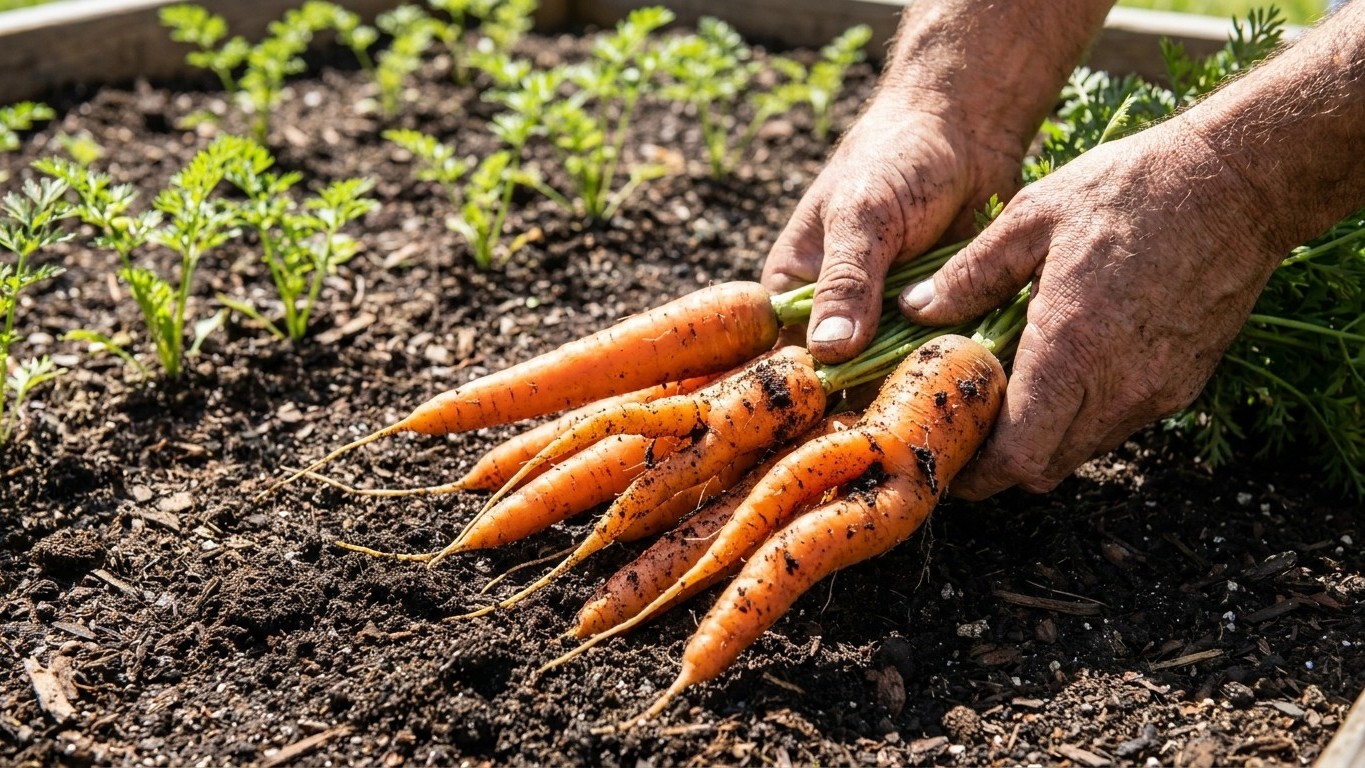

Ohio gardeners typically slide carrot seed into the ground anywhere from several weeks before the average last spring frost through early summer, since the crop germinates slowly in cool soil and tolerates a light frost without damage. But the calendar is only half the story. Ohio’s benchmark soil runs heavy enough on clay that timing alone, without addressing the ground first, can still leave you pulling short, forked roots.
The short answer
The soil most often used to represent Ohio is the Miamian series, an Alfisol, the kind of forest-derived soil that holds nutrients reasonably well without being especially rich. Its surface horizon runs about 26 percent sand, 20 percent clay and 53 percent silt, which puts it in the silt loam family, with a surface pH around 6.5 (slightly acid) and organic matter near 2.0 percent. Drainage is classed as well drained. On paper, that’s a workable starting point for a root crop.
Carrots want deep, sandy, well-drained ground rich in organic matter, according to Utah State University Extension. Heavy or rocky soil is what makes the root fork, split, or stall halfway down instead of growing long and straight. At 20 percent clay, Miamian soil isn’t the sandy ideal, but it isn’t the dense, sticky clay that ruins a carrot bed outright either. The bigger risk is what sits underneath and around the mapped surface, not what the surface percentages alone suggest. Any compaction below the topsoil, any buried stone, any patch where a builder or previous owner regraded the yard, and that “well drained, moderate clay” description stops applying.
For a bed that fits this general profile, the fix Utah State names is straightforward: work in plenty of compost and double dig the bed, loosening and enriching the soil well below where the fork or spade normally reaches, so the root has an unbroken column of soft ground to grow through. Where the ground is heavier than this, wetter, or full of construction fill, a raised bed filled with a loose, sandy mix sidesteps the problem entirely rather than fighting it season after season.
None of this should be read as a soil report for your particular yard. Ohio spans hundreds of mapped soil series, and the Miamian profile is simply the one USDA lists as representative of the state as a whole under its State Soils program. A river-bottom garden, a hillside plot, or a lot where the topsoil was scraped off during construction can differ from this description completely, in texture, in drainage, and in what’s buried a foot down. Treat the numbers above as a reason to check your own ground, not a substitute for checking it.
The test that settles it in your own garden
The only way to know what your carrots are actually growing into is to look at the dirt yourself, in the bed where the seed will go. None of the numbers above tell you that.
- Dig a hole in the exact spot you plan to sow, going down as far as you can push a spade or trowel, and note whether the soil changes color, gets noticeably harder, or hits solid rock or a compacted layer before you’d want the root to stop.
- Pull out a handful from that depth and check it for stones and gravel. Carrots fork around obstructions, so a bed peppered with small rocks will produce forked or stubby roots regardless of what the texture feels like otherwise.
- Rub a moist handful between your fingers. Gritty and loose suggests sand; smooth, sticky, and able to hold a ribbon shape suggests clay; a soil that feels somewhere between the two, without either extreme, is closer to the loam a carrot prefers.
- Watch how water behaves in that same hole after a rain, or after you run the hose into it. Water that sits for a long stretch before soaking in points to poor drainage and a compacted or clay-heavy subsoil; water that vanishes almost immediately points to a sandier, faster-draining profile.
- Compare what you find against the general Miamian description above, not as a verdict but as a reference point. If your dig turns up rock, standing water, or dense clay well before the depth you’d want a carrot to reach, that’s your answer, and it points straight to compost, double digging, or a raised bed rather than a different sowing date.
What goes wrong here
- Forking in heavy ground. Where clay content runs higher than the state’s benchmark loam, or where a compacted layer sits under the topsoil, the taproot hits resistance and splits into two or more legs instead of growing straight down. Utah State University Extension names heavy and rocky soil as the direct cause. The fix is the same one that applies to the soil itself: work in compost, double dig the bed to loosen the ground well below the surface, or move the crop to a raised bed filled with a loose, sandy mix.
- Poor germination in a hot spell. Carrot seed is slow to sprout under the best conditions, and a stretch of hot, drying weather right after sowing can crust the soil surface and stop germination before it starts. Keeping the seedbed consistently moist during that window, rather than letting it dry and crust between waterings, gives the slow-germinating seed the steady conditions it needs.
- Splitting from uneven water. A root that grows steadily through a dry stretch and then gets hit with a heavy soaking can split from the inside out, since the outer root can’t expand fast enough to match the sudden intake. Even, regular watering through the growing season, rather than long dry spells followed by a heavy drink, keeps the root growing at a steady pace and avoids the splitting.
Common questions
Do I need to know the exact last frost date to sow carrots in Ohio?
A precise, county-level last frost date isn’t published in this article. Carrots tolerate cool soil and a light frost during germination, so exact timing matters less than getting the soil itself right first; check a local, dated frost record for your county before you count back a specific number of weeks.
Is Ohio’s soil good for carrots without any amendment?
The state’s benchmark Miamian soil is a silt loam, well drained, with moderate clay, which is workable but not the sandy ideal Utah State University Extension describes for carrots. Most beds benefit from added compost and thorough loosening before sowing, and that’s true even where the ground broadly matches this profile.
What does “double digging” actually mean for a carrot bed?
It means loosening and enriching the soil well below the depth a spade or fork normally reaches, so the root has soft, unbroken ground the whole way down instead of hitting compacted soil partway through its growth. Utah State University Extension names this, alongside added compost, as the standard fix for heavy ground.
Are the 70 to 100 days to maturity counted from sowing or from transplanting?
From sowing. Carrots are sown directly in place and are never transplanted, so every day of that maturity window runs from the date the seed goes into the ground, not from any later transplant date.