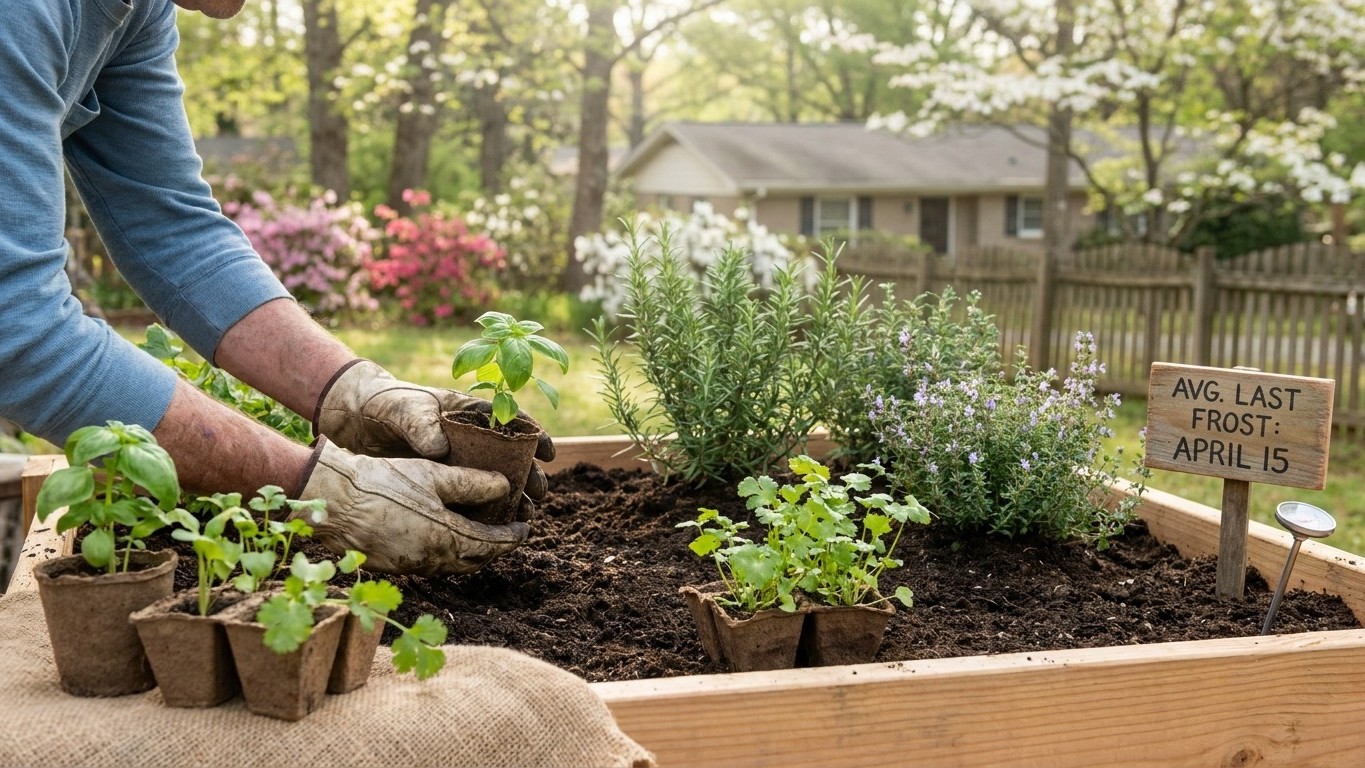

In Ohio, most herbs go into the ground only after the last spring frost passes, which falls between May 5 and May 15 for the state’s coldest zone. Hardy herbs can go earlier under cover; tender ones like basil wait until the risk is fully gone.
The short answer for Ohio
The Ohio State University Extension’s Ohio Gardening Calendar puts the last spring frost between May 5 and May 15 for zone 6a, and the first fall frost between October 5 and October 15. Those two windows are not fixed calendar days. They’re the range in which frost has historically occurred with enough regularity that OSU treats them as the safe planting boundary, meaning a gardener who plants tender herbs on May 1 is betting against roughly a decade or more of recorded cold snaps landing exactly in that stretch.
For hardy perennial herbs, that boundary matters less. Chives, thyme, sage, oregano, and parsley tolerate a light frost and can go into the ground two to three weeks ahead of the May 5 to May 15 window, especially if the soil has been warming under black plastic or a cold frame. These are herbs that evolved in climates with real winters, so a 30-degree night in late April rarely sets them back.
Tender annual herbs are a different story. Basil, in particular, sulks or dies outright below 50 degrees, so waiting until the tail end of the frost window, closer to May 15 than May 5, is the safer bet for most of the state. Cilantro and dill sit somewhere in between: they’ll survive a light frost but bolt fast once summer heat arrives, so many Ohio gardeners sow them twice, once in early spring and again in late summer for a fall crop.
On the back end, the first fall frost date matters just as much. Tender herbs need to be harvested, potted up and brought indoors, or written off by early October in the northern parts of the frost window, and by mid-October where the local pattern runs later. Hardy perennials, meanwhile, don’t need rescuing. They’ll go dormant on their own schedule and come back the following spring, provided the winter cold doesn’t drop past what their roots can handle, which is really a separate question from frost dates and depends on the mean winter minimum discussed below.
What will not work here
The biggest mismatch in Ohio herb gardens isn’t frost timing. It’s winter survival for herbs that people assume are perennial because a garden center label says so. NOAA’s 1991-2020 climate normals for the Columbus reference station put the average daily minimum temperature for the coldest month at 22 degrees Fahrenheit. That’s not the record low, it’s the typical overnight floor during the coldest stretch of a normal winter, and it’s cold enough to kill rosemary and bay laurel left outdoors without protection almost every year. Gardeners who plant rosemary as if it were a permanent fixture, the way it behaves in a Mediterranean climate, are setting themselves up to replant every spring or bring pots indoors every fall.
Ohio’s humid continental summers create a second failure point that has nothing to do with cold. Mediterranean herbs like rosemary, lavender, and thyme evolved in dry, well-drained soil and resent consistent moisture around their roots. A gardener who waters on a fixed weekly schedule, the way you might for tomatoes, will often drown these herbs in Ohio’s clay-heavy soils long before winter cold becomes an issue. Root rot from soggy soil kills more Mediterranean herbs in this state than frost does.
Humidity and spacing
The same humidity that stresses Mediterranean herbs also punishes tight spacing. Basil and oregano planted at the density shown on a seed packet grown for a drier climate will trap moisture between leaves in Ohio’s humid July and August air, inviting powdery mildew and fungal leaf spot. Wider spacing than the package suggests, plus morning watering instead of evening, cuts that risk considerably.
None of this means these herbs can’t be grown in Ohio. It means treating rosemary, lavender, and bay as annuals or container plants that overwinter indoors, and treating basil and oregano’s spacing as a humidity problem rather than a real-estate problem, is what actually works here.
What changes across Ohio
Ohio isn’t a single climate. The USDA Plant Hardiness Zone Map, built from 1991-2020 average annual extreme minimum temperatures, places the state across a 5b to 6b range. That spread matters more than it sounds like on paper: it’s the difference between a garden that regularly sees winter lows near minus 15 and one that rarely drops below 0.
A gardener near Lake Erie in the northern part of the state, sitting in the colder end of that range, should generally push both the spring planting date later and the fall protection date earlier than someone in the southern part of Ohio near the Ohio River, who sits in the warmer end. The practical effect is that hardy perennial herbs surviving unprotected through winter in the south may need mulch, a cold frame, or a move indoors in the north, even though both gardeners are technically in the same state and following the same OSU calendar.
Elevation and local terrain add another layer that a statewide zone map can’t capture. Low-lying areas and valley bottoms trap cold air and frost longer into spring than a slope or hilltop just a few miles away, a phenomenon gardeners sometimes call a frost pocket. A backyard tucked into a river valley in an otherwise 6a zone can behave more like a 5b garden on any given spring morning.
Because the state spans that 5b to 6b range, there is no single answer to “when should I plant” that applies evenly from the Michigan border to the Ohio River. The right move is checking where a specific property falls on the USDA hardiness zone map rather than assuming the statewide range describes any one backyard. This page can describe the spread; it can’t tell an individual reader which end of it they’re standing on.
Where to check this for your own county
The Ohio State University Extension, at extension.osu.edu, is the authority behind the frost dates and gardening calendar cited throughout this page, and it’s also the place to go for anything more specific than a statewide range. Extension offices exist in every Ohio county, and each one tracks conditions that never make it into a state-level calendar.
Two things are worth looking for specifically on a county extension page. The first is the local planting calendar, which will often narrow the broad May 5 to May 15 last-frost window down to a tighter date range based on that county’s actual weather station records rather than the statewide 6a zone average used here. The second is the list of herb and vegetable varieties that county’s extension office has trialled in demonstration gardens, which tells you what actually performs well in that specific soil and microclimate rather than what performs well in Ohio generally.
A county recommendation will almost always beat a state one, for the simple reason that it’s built on data closer to the reader’s own backyard. This page works from statewide frost dates and a Columbus reference station because that’s the best data available at the state level, but a gardener in Ashtabula County and a gardener in Scioto County are working with different realities even though both fall somewhere inside Ohio’s 5b to 6b hardiness range. The county extension office is where that gap gets closed.
If you follow the almanac, here is when to plant herbs by the moon. It is a tradition, not a proven method.
Checking this against your own garden
Every date on this page is a historical average, not a forecast for this particular year. The garden itself will tell a more accurate story than any calendar, and it does so through a few signs that don’t require any equipment beyond attention.
Soil warmth by feel is the first and most reliable check. Pushing a finger a couple inches into the planting bed on a sunny mid-morning gives a rough sense of whether the ground has actually warmed enough for seeds to germinate, regardless of what the calendar says the date is. Cold, damp soil that feels close to refrigerator temperature means seeds will sit and rot rather than sprout, even past the official last-frost date.
The second sign is how quickly new growth appears on hardy perennial herbs already in the ground, like chives or established sage. A strong flush of new leaves is a sign the soil and air have both crossed the threshold these plants need to actively grow, which is a more direct signal than a frost date on a calendar built from a different location’s weather records.
The third is watching for the first true leaves on any seedlings started indoors or direct-sown outside. The first true leaves, the ones that look like the mature plant’s actual foliage rather than the rounded seed leaves that emerge first, are the signal that a seedling has enough root and leaf structure to handle transplanting or thinning. Waiting for that stage, rather than a specific day on the calendar, tends to produce sturdier plants regardless of which side of Ohio’s frost window this particular spring happens to land on.