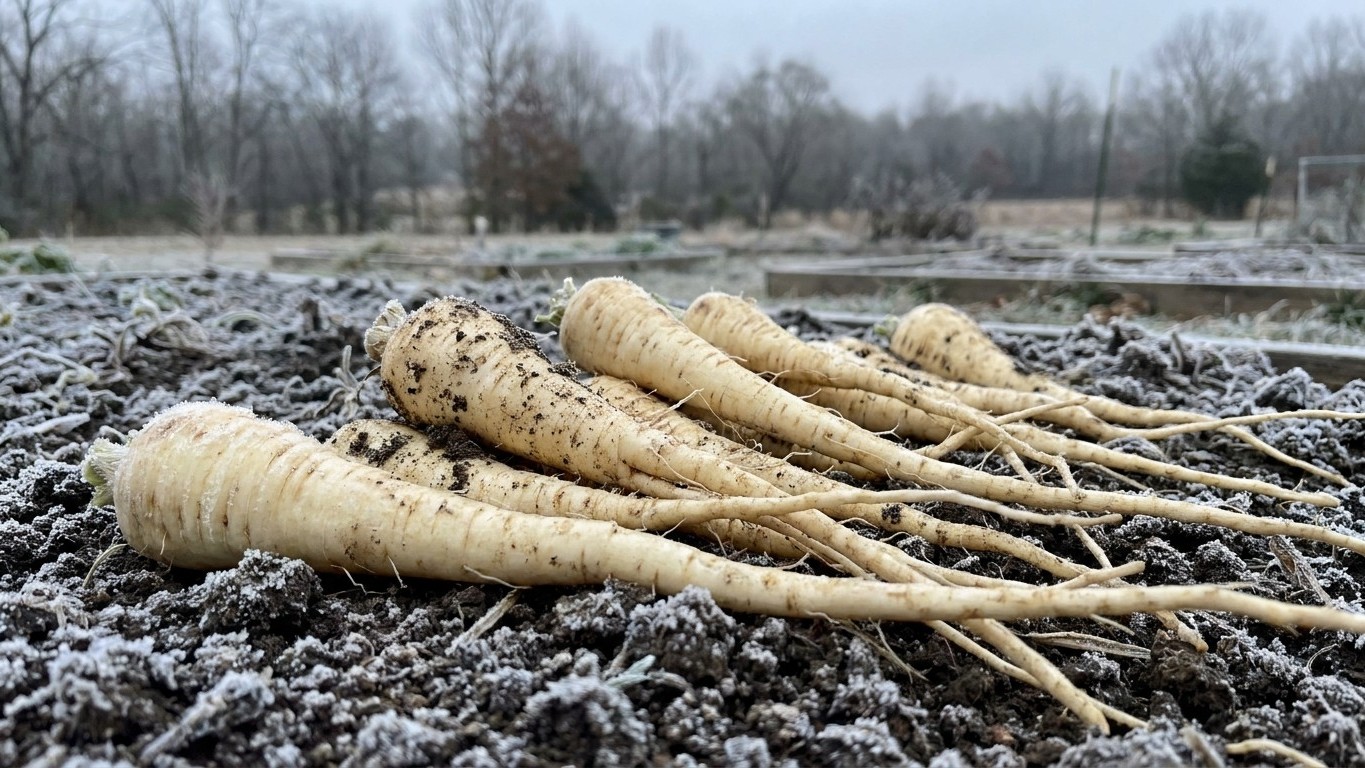

Yes, Ohio’s parsnips will sweeten. The state’s winters bring the sustained cold parsnips need to convert their stored starch into sugar, and the growing season leaves enough runway to size up roots before that cold arrives. The catch is that sweetening depends on frost actually reaching the roots, not on a hardiness zone label. Get the timing right and a parsnip pulled from Ohio ground after a stretch of frosty weather will taste noticeably sweeter than one dug the day it matures.
The short answer
Does the Columbus area deliver the several frosty weeks a parsnip needs to turn starch into sugar? The mean daily minimum for the coldest month, based on NOAA NCEI Climate Normals for 1991-2020 at the Columbus reference station, is 22.0°F. That’s not a record low or a one-night dip. It’s the average low across the coldest month, which means freezing and near-freezing nights repeat over and over rather than showing up once and disappearing.
That repetition is what matters biologically. A parsnip root stores its sugar as starch through the growing season, and it only starts breaking that starch down into simple sugars once enzymes in the root respond to sustained cold. One overnight frost doesn’t do it. Weeks of cold, with the root sitting in ground that stays near or below freezing, is what triggers the conversion Utah State University Extension describes when it says parsnips taste best after several weeks of cool, frosty weather. Ohio’s 22.0°F average minimum for its coldest month is squarely in that range. A parsnip left in Ohio soil through a normal winter stretch gets exactly the exposure the crop is built to use.
What could change that answer is not the zone number on a map but the microclimate around a specific bed. A raised bed tucked against a south-facing foundation wall, heavily mulched, or set in a city lot with a lot of surrounding pavement can run several degrees warmer than the open-field average NOAA measures. In a spot like that, a gardener could grow a fine-looking parsnip that never truly sweetens, not because the region is too mild, but because that one bed never lets frost reach the root the way the regional average suggests it will. The fix isn’t moving to a different zone. It’s leaving mulch light enough, or removing it late in the season, so the cold the region already provides actually gets to the soil.
Does the season fit?
Parsnips are sown directly in place, never transplanted, and the clock for the 100 to 120 days Utah State University Extension calls for starts the day seed goes into the ground, not the day seedlings appear. Here’s how that timeline lines up against Ohio’s frost dates from Ohio State University Extension’s Ohio Gardening Calendar, which puts the state in zone 6a with a last spring frost between May 5 and May 15 and a first fall frost between October 5 and October 15.
- Sowing happens 2 to 3 weeks before the last spring frost, which puts the seeding window in the Columbus area somewhere in mid-to-late April.
- Germination is slow. Parsnip seed takes 14 to 21 days to show green, so a gardener who sows in mid-April shouldn’t expect to see rows until early May, and shouldn’t re-sow bare-looking soil before that three-week mark passes.
- From that same seeding date, 100 to 120 days brings the roots to harvestable maturity sometime between late July and mid-August.
- Ohio’s first fall frost doesn’t arrive until October 5 to October 15, which leaves roughly eight to eleven weeks between maturity and the first real cold snap.
- That gap is the buffer. It covers a late sowing, a slow germination stretch, or a cool spring that pushes maturity back a couple of weeks, without threatening to run the crop past frost.
- After the first frost, there’s still room before deep winter locks the ground, giving the several weeks of cold exposure the sweetening process needs before digging.
Taken together, the season fits comfortably in most of Ohio, with slack built into both ends of the calendar rather than a schedule that has to run perfectly.
What goes wrong here
- Forked roots in heavy or stony ground: Ohio’s clay-heavy soils split a taproot around rocks and dense clods rather than letting it drive straight down. Utah State University Extension recommends deep sandy soil for this reason, and says heavy soil must be double dug before sowing. If double digging isn’t practical, working several inches of sand or compost into the top foot of soil gives the root a straighter path.
- Forked roots from overwatering: this is a separate cause from soil texture, not a variation of it. Inconsistent, heavy watering encourages a root to branch as it searches for moisture rather than growing as one clean taproot. Steady, even moisture, rather than a deep soak followed by dry stretches, keeps the root growing straight.
- Digging before the cold has done its work: even where the regional climate gets plenty cold, pulling roots the day they hit size, in late July or August, skips the frost exposure that builds sugar. The remedy is patience: leave mature roots in the ground through the first frosts of October before harvesting, rather than harvesting on the calendar alone.
- A season that runs short: sowing outside the 2 to 3 week window before last frost, especially sowing late, pushes the 100 to 120 day maturity date closer to the first fall frost and leaves little cushion. Sowing promptly in the recommended window, rather than waiting for warmer soil, protects that margin.
A safety warning before you harvest
North Carolina Extension Gardener Plant Toolbox states it plainly: “All parts of this plant contain furocoumarins which can make skin sensitive to light causing burns so be sure to wear gloves, long sleeves and long pants when dealing with it.” That’s not limited to the foliage. Roots, stems, and leaves all carry the compound.
The mechanism is what makes this catch people off guard. The burn doesn’t come from the sap alone. It takes sap on the skin plus sunlight hitting that same skin to trigger the reaction, which is why the injury shows up hours after a bright afternoon spent pulling tops or handling roots at harvest, not immediately at contact. Because sunlight has to be part of the equation, washing exposed skin afterward doesn’t undo the exposure that already happened in daylight. The protection that actually works is preventing the sap from reaching skin in the first place, meaning gloves, long sleeves, and long pants whenever handling the plant, especially on a clear, sunny day.
Checking this against your own county
The 22.0°F figure and the May and October frost dates cited here come from a Columbus reference station and a statewide zone 6a calendar. Both are regional averages, and Ohio’s frost timing shifts across the state, with the Lake Erie shoreline and the hill country of the southeast running on different calendars than central Ohio. Before locking in a sowing date, check those specifics with Ohio State University Extension at extension.osu.edu, which maintains county offices with local frost date records, soil testing services, and planting calendars tuned to each part of the state. A county-level check is the fastest way to confirm whether the numbers here match the ground actually being planted.
Common questions
How long before parsnip seeds actually sprout?
Fourteen to 21 days, according to Utah State University Extension. That’s slow compared to most garden seed, and it’s long enough that impatient re-sowing of a bed that looks bare is one of the most common mistakes with this crop.
Does Ohio’s hardiness zone tell me whether parsnips will sweeten?
No. The hardiness zone describes what plants survive winter here, not how much frost exposure a root gets in a particular bed. The figure that actually matters is the coldest month’s mean minimum, 22.0°F for the Columbus reference station, and even that can be blocked by a warm microclimate in a specific spot.
When should parsnips be dug for the best flavor?
After roots reach maturity, around 100 to 120 days from seeding, and after several weeks of frosty weather have passed over them in place. Digging at first maturity, before the cold arrives, skips the starch-to-sugar conversion entirely.
Is it only the leaves that cause skin burns?
No. North Carolina Extension Gardener Plant Toolbox specifies all parts of the plant contain the compound responsible, which includes the roots and stems along with the foliage. Gloves and covered skin matter at every stage of handling, not just when trimming tops.