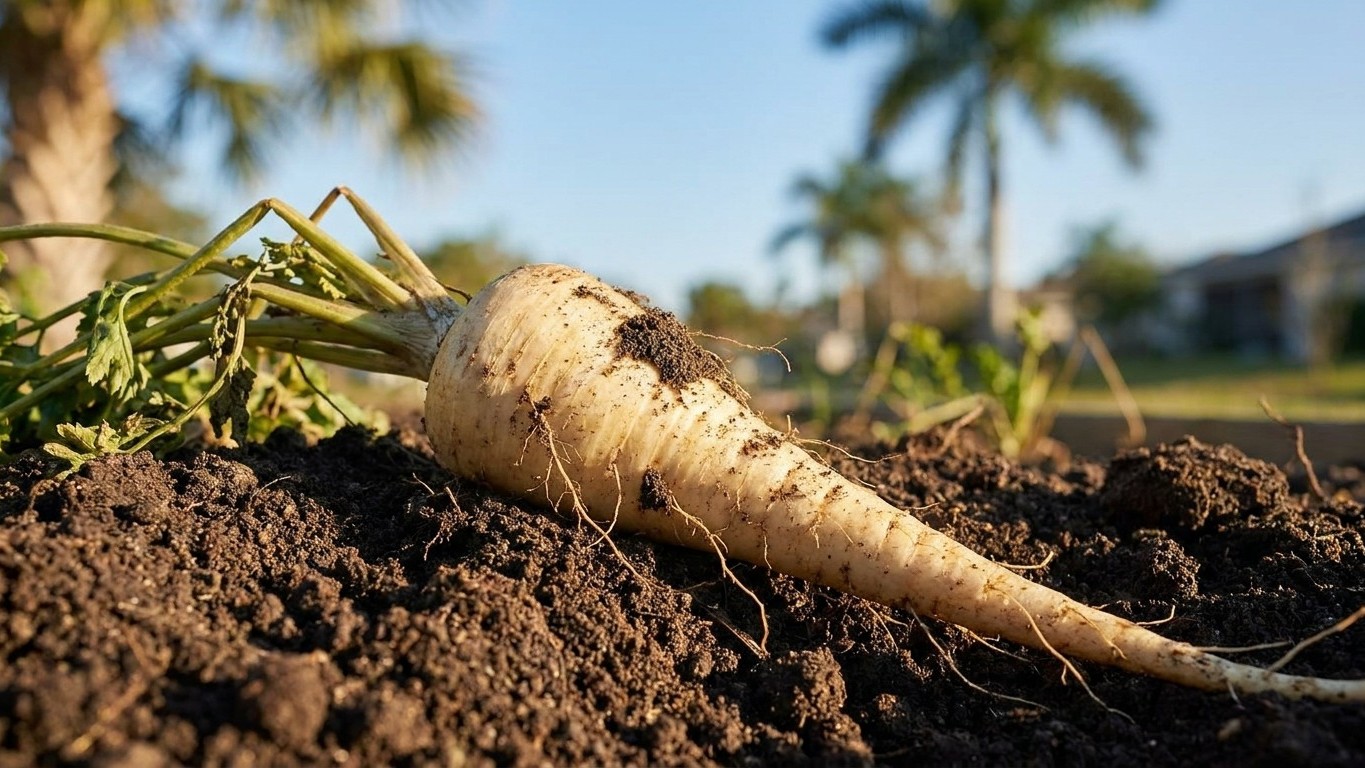

Florida’s answer is mostly no. The state’s coldest month rarely delivers the sustained frosty stretch a parsnip needs to convert its starch to sugar, and in north Florida, the reference point for this page, the mean minimum in the coldest month sits well above freezing. A parsnip will grow here. Whether it sweetens is a different question, and the climate record leans against it.
The short answer
Start with the number that actually decides this: 42.9°F. That’s the mean daily minimum for the coldest month at the Jacksonville reference station, drawn from NOAA’s 1991-2020 Climate Normals. Not the record low for the season, not an average across the whole month, but the typical overnight low during the coldest stretch of the year. And 42.9°F is more than ten degrees above the 32°F line that actually matters for a parsnip.
That distance matters more than it looks. Parsnips don’t sweeten because a calendar says “winter.” They sweeten because a period of real cold forces the root to break down stored starch into sugars, a survival response that happens over several consecutive frosty weeks, not from one overnight dip. A single cold snap that touches freezing and then retreats doesn’t do the job. Utah State University Extension is specific about this: the flavor payoff comes after several weeks of cool, frosty weather.
North Florida, where Jacksonville sits, does get frost. The frost dates further down this page prove that. But a mean minimum of 42.9°F in the coldest month tells you that frost is the exception on any given night, not the rule. Most nights in the coldest month stay above freezing. The freezing nights that do happen are scattered, brief, and interspersed with much warmer stretches, which is a very different pattern from the sustained, repeated cold that pushes sugar conversion in a parsnip root.
South and central Florida make the picture even more lopsided. Those regions are effectively frost-free, and the whole growing calendar there flips: winter becomes the main growing season, and summer heat is the obstacle gardeners fight. None of the frost-window figures on this page apply south of north Florida, and a gardener in Orlando or Miami shouldn’t borrow them.
So here’s the practical read for anyone in north Florida. A parsnip planted and grown correctly will size up. The root will store starch, take shape in the soil, and be perfectly edible. But without several consecutive frosty weeks while that root sits in the ground, the sugar conversion that makes a parsnip taste like a parsnip, rather than a bland, starchy carrot substitute, mostly won’t happen. You’ll harvest a root vegetable. You may not harvest the flavor gardeners in colder states talk about.
Does the season fit?
The season length itself isn’t the problem in Florida. It’s the timing of when that length lands relative to any cold at all. Walk through the arithmetic.
- Germination first. Parsnip seed is sown directly in place, since the taproot doesn’t transplant well, and it takes 14 to 21 days to come up. Anyone who doesn’t see seedlings in the first week and starts digging around is disturbing a bed that just needs more patience.
- Standard sowing window. The usual advice is to sow 2 to 3 weeks before the last spring frost. For the Jacksonville reference station, that last frost falls somewhere between February 16 and March 7. Working back 2 to 3 weeks puts sowing in late January through mid-February.
- Maturity, 100 to 120 days out. Count forward from that sowing window and the roots reach maturity anywhere from early May into late June, depending on exactly when the seed went in and how the season runs.
- Where that maturity date lands. Early May through late June in north Florida is not cold. It’s the ramp-up into summer heat, months away from the next frost, which the record puts between November 26 and December 13.
- The mismatch. The growing season is long enough, without question, to finish a 100-to-120-day crop. What it doesn’t do is deliver that crop into a cold snap. The roots mature and then sit in warming soil, not cooling soil, which is the opposite of what triggers sweetening.
A gardener could try to shift the sowing date later, aiming for the roots to still be in the ground when the first fall frost arrives in late November or early December. That means backdating a sowing to sometime in late July or August, squarely in Florida’s hottest stretch, which works against germination and early root development far more than a slightly early spring sowing does. Neither direction lines up cleanly. The season fits on paper. It doesn’t fit the way a parsnip actually wants to be grown.
What goes wrong here
- Forked roots from heavy or stony ground. A parsnip’s taproot wants to drive straight down through loose, fine material. Florida soils vary a lot by county, but wherever the bed has clay pans, compacted fill, or buried rock and roots, the tip splits and forks around the obstruction. Utah State University Extension calls for deep sandy soil, and where the native ground is heavy, double digging to break up that resistance before sowing.
- Forked roots from overwatering. This is a separate cause from soil texture, not a variation on it. Too much water, especially inconsistent watering that swings from soggy to dry, encourages the root to branch rather than push straight down. Keep the moisture even through the growing season instead of drenching and letting the bed dry out between waterings.
- Germination struggles in warm soil. Parsnip seed germinates slowly even under good conditions, 14 to 21 days, and heat makes that slower and less reliable. Sowing during Florida’s cooler weeks, and keeping the seed bed consistently moist with a light mulch, gives germination a better shot than sowing into soil that’s already warming toward summer.
- A winter too mild to finish the job. This is the one no amount of soil prep fixes. Even a well-grown, unforked, properly sized root can sit through north Florida’s coldest month and never get the sustained frost exposure that converts starch to sugar. The root is still worth harvesting. It just may never taste like the sweetened parsnip that colder-climate gardeners describe.
Every part of a parsnip plant, not just the leafy top, carries a compound that can turn a sunny afternoon in the garden into a burn later that evening. NC State Extension puts it plainly: “All parts of this plant contain furocoumarins which can make skin sensitive to light causing burns so be sure to wear gloves, long sleeves and long pants when dealing with it.”
What makes this catch people off guard is the mechanism. The sap alone doesn’t burn skin. It takes sap and sunlight together, a reaction that needs UV exposure to activate. That’s why the injury shows up on a bright day of harvest, or when someone’s yanking foliage and stems bare-handed in full sun, and why the redness or blistering often doesn’t appear until hours after the contact, not right away. By the time it shows up, a person has usually forgotten the moment the sap touched their skin.
Because the reaction depends on sunlight, not on how long the sap sits on skin, washing up afterward doesn’t undo the exposure the way it would with a simple irritant. The real protection is clothing, worn before you touch the plant, not a rinse applied after. Gloves, long sleeves, and long pants for the whole job, root to leaf, cover the exposure that matters.
Checking this against your own county
Everything above uses Jacksonville as the reference point, and Florida’s frost pattern shifts fast as you move south. A county an hour inland can run several degrees colder than a coastal one at the same latitude, and central and south Florida counties may see close to no frost most years. Before committing a bed to parsnips, it’s worth checking local frost data and soil guidance against your own county rather than the Jacksonville numbers used here.
The University of Florida’s IFAS Extension network runs an office in nearly every county, and it’s the right first call for anything specific to local soil, local frost history, or timing that fits your address rather than a reference station. You can find your county office through UF/IFAS Extension’s statewide directory at sfyl.ifas.ufl.edu.
Common questions
Can parsnips grow in Florida at all, even if they won’t sweeten?
Yes. The roots will germinate, size up, and mature in Florida soil with the sowing and season timing discussed above. What’s uncertain is the flavor payoff that comes from sustained frost exposure, not whether the plant survives.
Should I transplant parsnip seedlings instead of direct sowing to save time?
No. Parsnips are sown in place because the developing taproot doesn’t tolerate the disturbance of transplanting well. The 100-to-120-day timeline starts from seeding, not from setting out a seedling.
Why do parsnips sometimes come up forked or split?
Two separate causes, not one. Heavy, stony, or compacted soil deflects the taproot as it tries to grow straight down, while overwatering, especially uneven watering, encourages the root to branch. Deep sandy soil, or a double-dug bed where the native ground is heavy, addresses the first cause; even, consistent watering addresses the second.
Is it dangerous to handle parsnip foliage while weeding or harvesting?
Every part of the plant contains furocoumarins that sensitize skin to sunlight, per NC State Extension, and the reaction needs both sap contact and sun exposure to cause a burn. Gloves, long sleeves, and long pants during handling are the protection that matters, since the reaction can show up hours after contact.