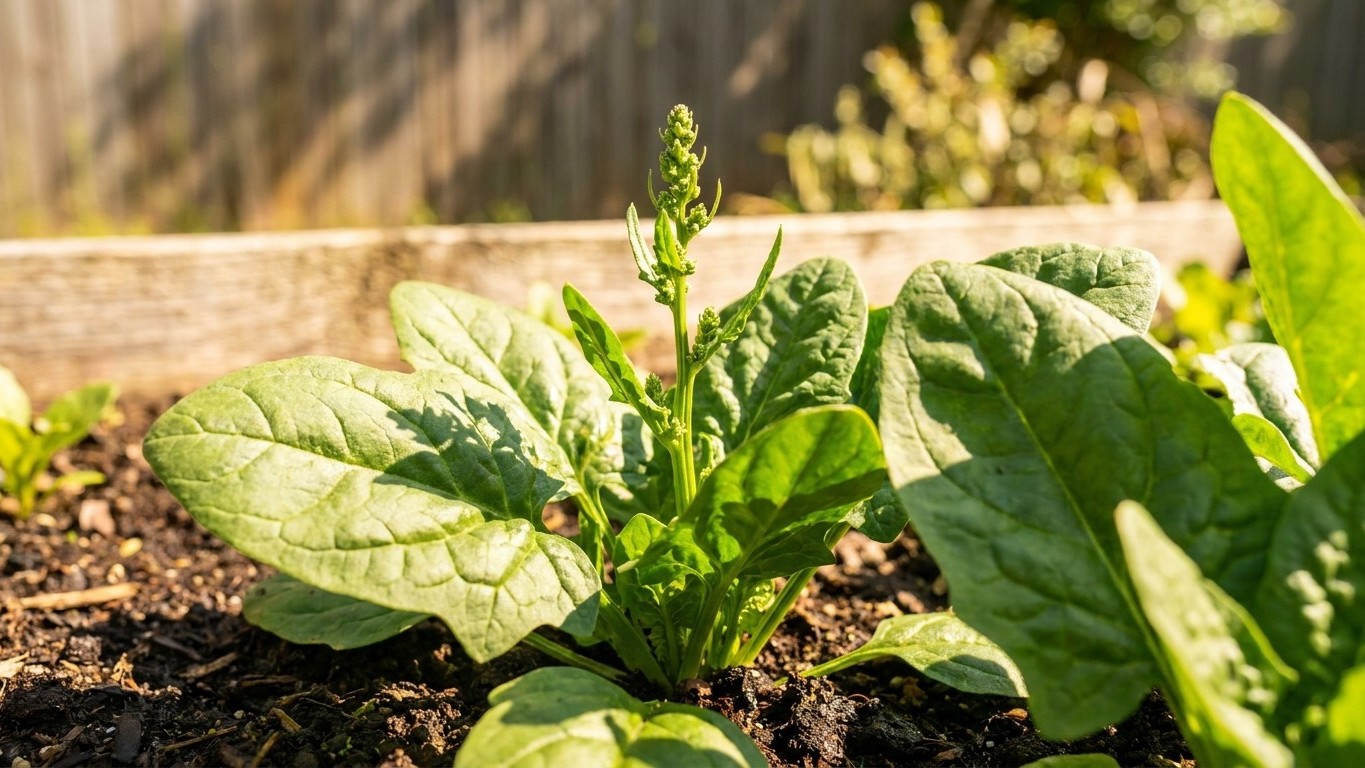

Ohio spinach is ready to cut when the outer leaves reach a usable size, four to six true leaves on a plant grown from a spring sowing, and before the center of the rosette starts pushing up a pointed new leaf that signals bolting has started. That signal matters more than any date on a calendar, because spinach in Ohio’s spring window only has a few weeks before lengthening days push it toward flower. Cut the outer leaves first, working from the base of the plant, and check twice a week once the weather turns warm.
When spinach is ready in Ohio
Look at the plant before you look at the date. A spinach plant that is still making flat, rounded leaves close to the ground is still in its eating phase. Once the center sends up a narrower, pointed leaf on a stem that’s visibly stretching upward, that plant has begun bolting and the remaining leaves will turn bitter fast. Cut what you can use the same day you see that shift start, not the week after.
The window itself runs off this territory’s frost dates. Ohio State University Extension’s Ohio Gardening Calendar puts the last spring frost at Columbus at May 5 to May 15, and spinach sown weeks ahead of that date needs to size up and get cut before the days grow long enough, and warm enough, to trigger flowering. Utah State University Extension notes that spinach grows best where temperatures stay under 75°F, and that same 75°F is the point where leaves start turning bitter as the plant redirects energy toward a flower stalk. Columbus averages 15.3 days a year at or above 90°F, according to NOAA’s 1991-2020 climate normals, so once the frost-free stretch begins, that heat tends to arrive quickly and close the spring cutting window in a hurry. Gardeners near Cincinnati or along Lake Erie will see this same signal land at a different point on their own calendar, since both the frost dates and the summer heat load shift across the state. If you haven’t gotten a crop started yet, Growing Spinach in Ohio walks through sowing timing in more detail.
The fall crop runs on the same signal, different direction
Utah State University Extension publishes no days-to-maturity figure for spinach. For a fall crop, its only guidance is to plant 50 to 75 days before the date you want to harvest. The extension service names four varieties, Bloomsdale, Melody, Teton, and Olympia, without giving maturity data for any of them, so treat those names as options to look up rather than a shortcut around the math. Fall sowing waits on warm soil, not on cold. Germination drops once soil passes 80°F, so the planting window opens as soil temperatures fall through late summer, and the crop should reach cutting size before Ohio State University Extension’s first fall frost window of October 5 to October 15 at Columbus. As days shorten going into autumn, the bolting risk that dominates spring largely disappears, which is why fall spinach is the more forgiving of Ohio’s two seasons for it. For more on the bolting mechanism itself, see Will Spinach Bolt Early in Ohio?
Keeping it, and for how long
The UC Davis Postharvest Technology Center puts spinach’s optimum storage condition at 32°F with 95 to 98 percent relative humidity. Under those exact conditions, the same source states plainly that spinach will not hold good quality for more than two weeks, and that wilting, yellowing, and decay are likely to show up once storage passes 10 to 14 days. That number is a ceiling reached under near-perfect cold storage, not a promise for a bag left in a home kitchen.
UC Davis also notes that at 41 to 50°F, a range it describes as common at ordinary distribution conditions, the same decline happens noticeably faster. That range is close to what most home refrigerators actually run, which means the two-week figure almost never applies once spinach leaves a commercial cold chain. A bag that looks fine on the day you cut it can go slimy within days rather than weeks.
Watch for these signs that a batch has passed its useful window:
- Leaves going limp and losing their upright snap
- Yellowing starting at the leaf edges or stem base
- A sour or sulfurous smell when you open the bag
- Slick or slimy patches on the leaf surface
Plan around the low end of that range. Treat anything past a week in a home fridge as a bonus, not an expectation, and eat or cook the bulk of a harvest early rather than letting it ride out the full ceiling UC Davis describes.
Where in the house that actually is
A home refrigerator does not run at 32°F throughout, and it is not built to. The coldest, most stable spot is usually the back of the bottom shelf, near the rear wall where cold air from the compressor settles, not the door shelves, which swing through a much wider temperature range every time the door opens. Put cut spinach there, as far back as it will fit without touching the rear panel and freezing against it.
Translating the humidity figure
UC Davis’s 95 to 98 percent relative humidity figure means the leaves should never be allowed to dry out in storage. In practice that means a perforated plastic bag, not an open bowl, or a loose wrap in a barely damp paper towel inside a container with the lid slightly cracked. Some gardeners stand freshly cut spinach stems in a half inch of water in a jar, the way you’d hold cut flowers, then drop a loose bag over the leaves. Either method keeps the leaf surface from drying out faster than the cold slows it down.
Skip the humidity step and the leaves will wilt visibly within a day, well before the temperature-driven decline UC Davis describes even gets started. Cold storage and humid storage are doing two separate jobs, and spinach needs both at once to get anywhere near the outer edge of its storage life.
What goes wrong here
Ohio’s spinach window gets squeezed from both directions. Early in spring, a late frost inside the May 5 to May 15 window at Columbus can nip young seedlings, though established spinach plants tolerate cold fairly well on their own. The bigger risk runs the other way: once temperatures climb past the 75°F ceiling that Utah State University Extension sets for good growth, and Columbus racks up an average of 15.3 days a year at or above 90°F according to NOAA’s 1991-2020 climate normals, spinach bolts and turns bitter within days rather than weeks. Cut before that shift starts, not after, since bitterness in the leaf doesn’t reverse once heat and long days have triggered it.
Pest pressure adds a second failure point. Ohio State University Extension documents aphids and slugs among the pests that show up on garden crops in this territory, and either can strip or foul a stand of spinach fast enough to force an early, undersized harvest. Checking plants for both while the leaves are still small buys time to act before a cutting gets ruined. For a fuller rundown of timing against pest pressure, see What Eats Spinach in Ohio, and When.
The last common failure is simpler: harvesting on a fixed date instead of watching the plant. A gardener who waits for “the third week of May” regardless of what the rosette is doing will sometimes cut too early and lose yield, and other times cut too late into a bolt that’s already underway. The leaf is the more reliable clock than the calendar in both directions.
Common questions
Can I still eat spinach after it starts to bolt?
Yes, but expect a noticeably more bitter, tougher leaf once the center stem has clearly started stretching upward. Cutting the outer leaves the moment you see that shift begin gives you the last decent harvest before flavor drops off.
Does washing spinach before storing it help it keep longer?
No, and it usually does the opposite. Excess moisture sitting against the leaf in a closed bag speeds decay, so store spinach unwashed and rinse it just before cooking.
Is spinach in a sealed bag from the grocery store held to the same storage limits?
The UC Davis figures describe spinach in general and apply to bagged, packaged spinach as much as to home-grown. A bag that has already spent time in transit and on a store shelf has less of that window left by the time it reaches your fridge, so treat the “best by” date as closer to the real ceiling than a home harvest would need.
Can I freeze spinach instead of keeping it in the fridge?
Freezing extends storage well past the two-week ceiling UC Davis describes for fresh spinach, though this page covers fresh storage only. If a harvest is coming in faster than you can use it fresh within that window, freezing is the standard next step rather than pushing fridge storage past its limit.