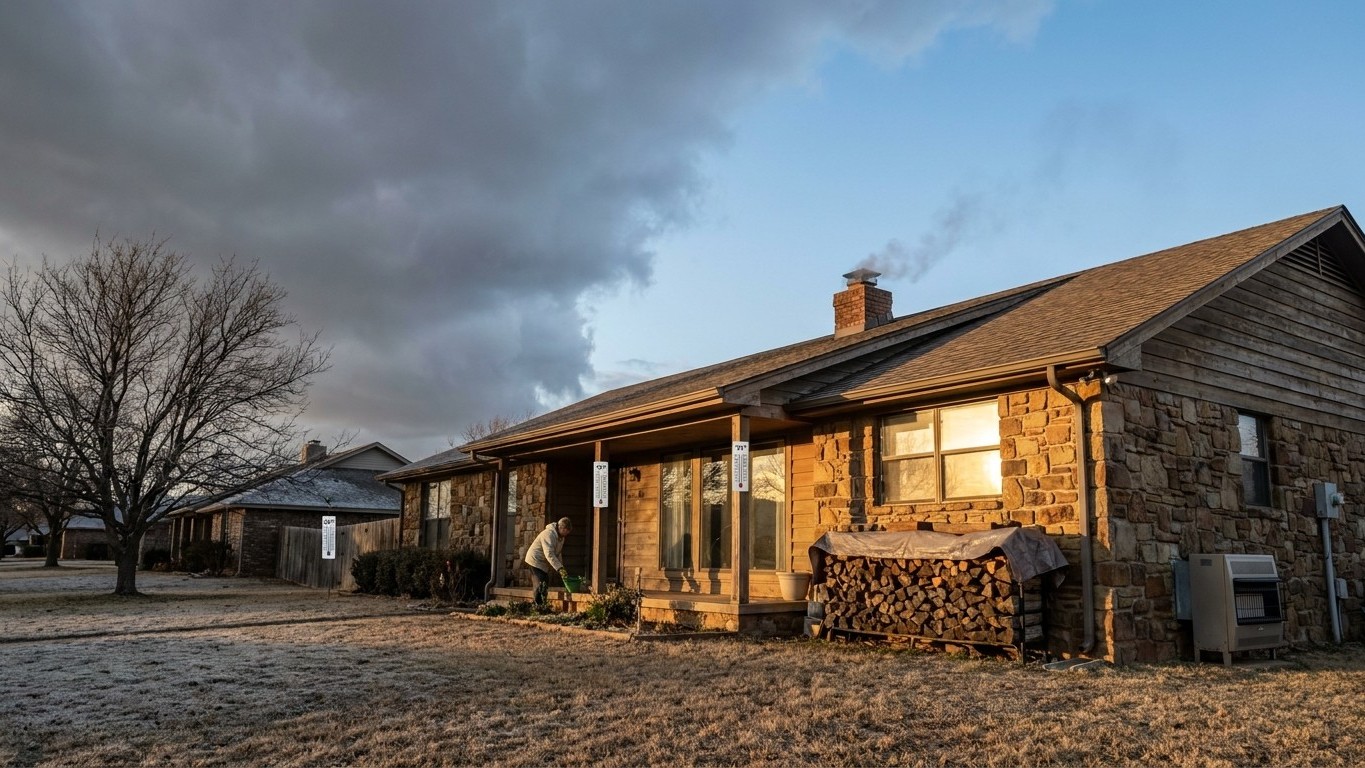

Winter in Oklahoma doesn’t linger like it does in the Upper Midwest, but it hits hard enough in short bursts to matter for anyone planning a heating budget. Here’s what the cold season actually demands from a house here, and what a cord of firewood is really worth once you do the math.
How cold it gets, and for how long

The coldest month in Oklahoma City averages a daily minimum of 27.0°F, according to NOAA’s 1991-2020 Climate Normals. That’s the number that matters for a furnace or a wood stove, not the record low that shows up in a news headline every few years. A single-digit night makes for a dramatic story, but it’s the routine 27-degree mornings, night after night, that run up the heating bill.
That figure puts Oklahoma in an odd middle zone. It’s colder than the Gulf Coast, where furnaces barely get exercised, but nowhere near the sustained deep freeze of Minnesota or North Dakota, where the coldest-month minimum can sit well below zero. A house here doesn’t need equipment sized for months of brutal cold. It needs equipment that can respond fast to sharp swings, because Oklahoma weather doesn’t ease into winter, it lurches.
That lurching matters more than the average suggests. A 70-degree afternoon can flip into a 20-degree night within 24 hours when a cold front rolls down from the Panhandle. Furnaces and wood stoves alike get asked to go from idle to full output with no warm-up period. A heating system, or a woodpile, that sits ready rather than one that’s scrambled together in November tends to perform better when that first hard front actually arrives.
The heating season itself runs roughly from late November through February, with the sharpest demand concentrated in January. That’s a shorter window than in northern states, which is exactly why some Oklahoma households underestimate what a cold snap costs them. Four months of moderate demand is a very different equation than four months of month a Minnesota winter, but it’s still four months, and the equipment still has to be ready on day one, not day thirty.
What a cord of wood is worth here
A cord is a volume, not a weight, and that distinction is where most firewood buyers get taken advantage of. The standard measure is a stack 4 feet by 4 feet by 8 feet, which works out to 128 cubic feet. Anything sold as a “cord” that doesn’t stack out to those dimensions isn’t a full cord, no matter what the seller calls it.
What that stack delivers in heat
Michigan State University Extension puts the energy content of a full cord of well-seasoned hardwood at about 20 million BTU. That’s an average, not a guarantee for any given load, since species and moisture content swing it considerably. But it’s a useful anchor: MSU frames it as roughly the heat equivalent of 145 gallons of #2 fuel oil, or 215 gallons of LP gas.
| Measurement | Value |
|---|---|
| Cord dimensions | 4 ft x 4 ft x 8 ft |
| Volume | 128 cubic feet |
| Heat content (seasoned hardwood) | about 20 million BTU |
| Fuel oil equivalent | roughly 145 gallons |
| LP gas equivalent | roughly 215 gallons |
Given a four-month heating season with moderate demand rather than sustained deep cold, a household leaning on wood as a primary or supplemental source in Oklahoma typically works through somewhere in the range of two to four cords over a winter, depending on the house, the stove, and how much of the load wood is actually carrying. The exact number depends on insulation, square footage, and whether wood is backup or the main event, so treat that as a planning range, not a rule.
Species density is the variable that changes everything inside that 128 cubic feet. A cord of dense hardwood packs more actual wood mass into the same stack than a cord of a lighter species, which means more fuel, more burn time, and more of that 20 million BTU figure realized rather than left on the table.
How long wood takes to dry in Oklahoma
Seasoning time isn’t a fixed number stamped on every species everywhere. It’s climate-dependent, driven by humidity and summer heat, which is exactly why a drying timeline that works in the Pacific Northwest doesn’t automatically apply here. MSU Extension sets the practical target at 20 percent moisture content or less before burning, down from green wood that can run over 60 percent when it’s first cut.
Split green wood typically reaches that 20 percent mark after one full summer of being stacked so air can move through it. The key words there are split and stacked, not simply cut and left in rounds. Rounds seal in moisture and can sit for years without drying properly, while split and stacked wood exposed to Oklahoma’s hot, often humid summer air gets there in a single season.
Red oak is the notable exception. MSU points out that its cell structure makes it dry more slowly than other hardwoods, so it needs more time than a single summer to hit that 20 percent threshold. Anyone splitting red oak in spring shouldn’t expect it to be ready by the first cold front in November.
Burning before wood reaches that target has real consequences, and none of them are dramatic, just costly. Wet wood spends a chunk of its energy boiling off its own water content before it ever produces usable heat, which means a stove full of green wood puts out noticeably less warmth than the same volume of properly seasoned fuel. It also produces more smoke and more creosote buildup in the flue, which means a chimney needs sweeping sooner and carries a higher risk of a chimney fire. None of that requires panic. It just requires planning a summer ahead, not a month ahead.
Where to check before you buy
Everything above describes Oklahoma City as the reference point, and Oklahoma is a big state with real variation in elevation, exposure, and local climate from the Panhandle to the southeast corner. The numbers here are a starting point, not a substitute for what’s happening on a particular property.
For species availability, local firewood suppliers, and guidance suited to a specific county, the Oklahoma State University Extension service is the resource worth checking before making a firewood purchase or planning a season’s supply.
Burn restrictions are worth a separate check entirely. Many Oklahoma counties and municipalities set their own seasonal burn rules, and those rules can change from year to year based on drought conditions and local air quality. What was allowed last winter isn’t automatically allowed this winter. A quick call to a county extension office or local fire authority before stacking wood for the season, or before lighting the first fire of the year, avoids running into a restriction after the fact.