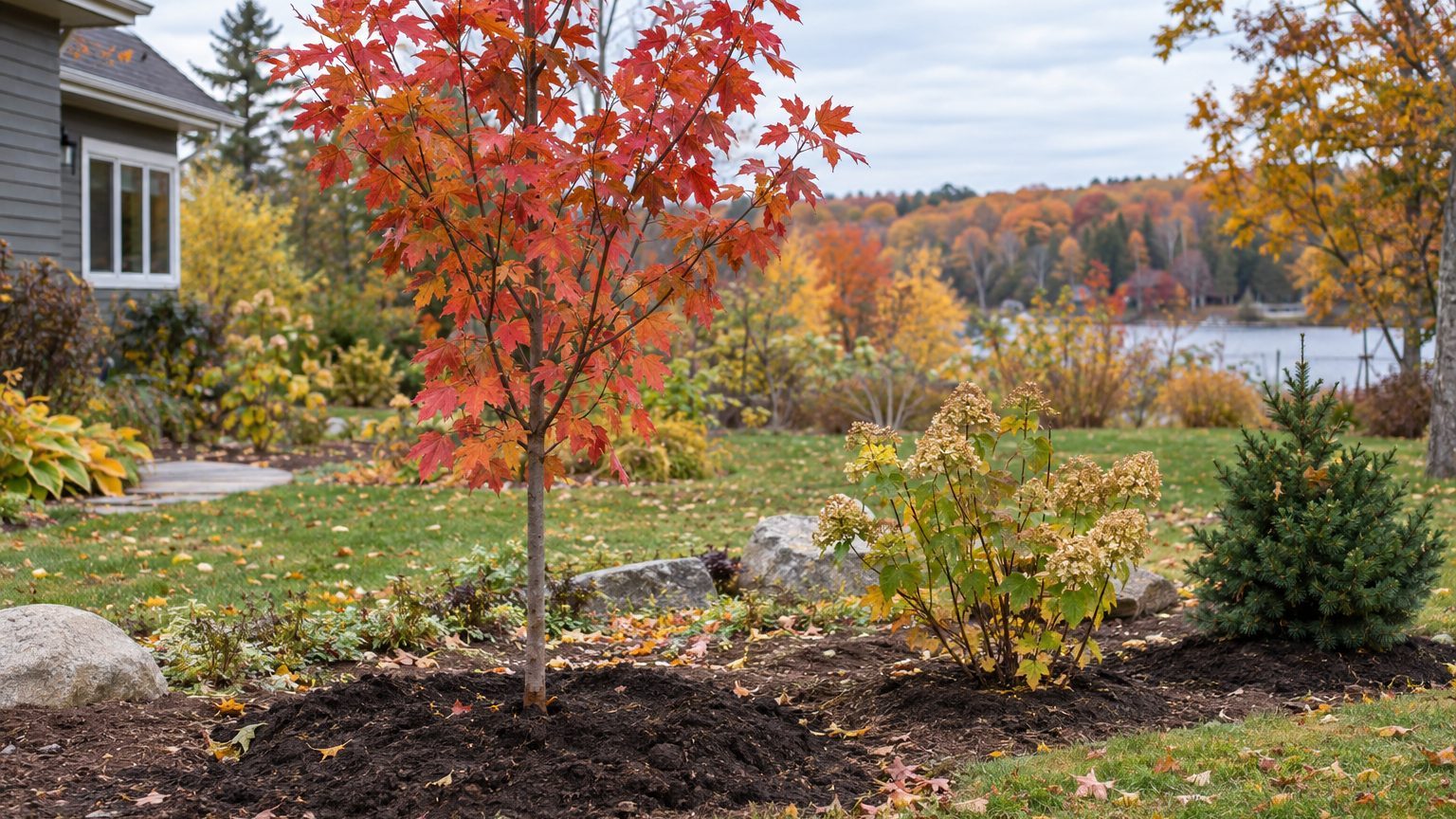

The conservative deadline for planting trees and shrubs in fall around Oklahoma City is September 17 to September 27, which is six weeks before the first fall frost. That is the safe target, not the hard stop. Roots keep working in cool soil well after the first frost, so a planting in October or even early November can still succeed with the right plant and good watering. If you’re reading this in early October, the safe window has just closed. The real limit is still ahead.
The deadline in Oklahoma
Roots don’t care what the air is doing. They keep growing as long as the soil is workable and above freezing, and soil cools far more slowly than air. A frosty morning in early November can sit on top of ground that is still warm enough to push out new root tips. Planting deadlines are built around that lag. The practical cutoff is several weeks before the ground freezes, which in Oklahoma usually means a good while after the first frost.
Working back from the first frost
For a reference point, NOAA’s NCEI U.S. Climate Normals for 1991 to 2020 put the first fall frost at the Oklahoma City airport station between October 29 and November 8. That range comes from the 30 to 70 percent band of 32°F freeze probabilities. It’s a range because no two years behave alike. Some falls hold off past the early part of November, others deliver a hard freeze before Halloween.
Cornell Cooperative Extension states the standard rule this way: “Fall is an excellent time for transplanting, provided you get them to their new home at least 6 weeks before the ground freezes, allowing them time to establish roots before winter dormancy.” Count six weeks back from the first frost range above and you land on September 17 to September 27. Write that down as the safe target for Oklahoma City.
Cornell’s rule actually counts from frozen ground, and the ground freezes later than the air does. So the safe date builds in extra margin. A tree planted a week or two after that window isn’t doomed. It just has less cushion, and the cushion matters more for some plants than others (more on that below).
Why your own garden may run earlier
The frost range above comes from an airport weather station, which sits in open, flat, heat-holding terrain. Suburban and rural gardens typically see the first fall frost earlier than the airport does, often by one to two weeks, and more at higher elevation. Within Oklahoma, the colder parts of the state (farther north, higher up) reach frost sooner, so their planting deadlines move earlier too, not later. Treat the dates here as the Oklahoma City reference, not a statewide guarantee, and check the frost dates for your own county. Our rundown of First and Last Frost Dates in Oklahoma is a good place to start.
Winter cold in the reference city is real. NOAA’s 1991-2020 normals show a mean daily minimum of 27.0°F in the coldest month, which is below freezing, so the ground here does freeze at times and the six-week logic applies. The USDA Plant Hardiness Zone Map (2023 edition) places Oklahoma across zones 6a to 8a, a wide spread, so the zone on your plant tag should be checked against your own location rather than assumed. Other states run on their own calendars, as the guide on How Late Can You Plant Trees and Shrubs in Fall in North Carolina? shows. For everything else in this state, the Oklahoma guides cover the local specifics.
What to plant late, and what to wait on
The calendar matters less than the plant. A container-grown or balled-and-burlapped tree that is fully hardy for your zone will usually establish fine after the safe date, because its root system arrives mostly intact and the cool soil does the rest. The risk climbs with plants that are borderline for your winters, and with evergreens that keep losing water through their needles or leaves all winter while the roots sit in cold ground and can’t replace it.
Good candidates after the safe window
Deciduous trees and shrubs are the easiest. They drop their leaves, so they stop losing water almost entirely. Eastern redbud, oaks and other natives bred by Oklahoma’s own swings between heat and cold are the sort of plants that settle in well when planted in the cooler, damper stretch of fall. Hardy perennials also do well, as long as they go in early enough to root before the soil gets cold.
Look at the tag. If the plant is rated for a zone colder than or equal to yours, it’s fully hardy and a late-fall planting is a reasonable bet. Remember that the USDA system is built on one variable, the average annual extreme minimum temperature. A plant rated for your zone can still struggle if the site is windy and exposed, or if the soil stays soggy.
Plants to hold until spring
Evergreens are the group to be careful with. Broadleaf evergreens and needled conifers both transpire through the winter, and Oklahoma winters are often dry and windy. Newly planted ones have little root mass to keep up. The same goes for any shrub that sits at the cold edge of its hardiness range. Plants that are marginal for your zone get through a normal winter once they’re established, but a fresh planting has less stored energy and fewer roots to cope with a hard cold snap. For these, wait until spring and let the plant go in while the soil warms.
| Plant type | Planting after the safe window | Why |
|---|---|---|
| Hardy deciduous trees and shrubs, container or balled | Reasonable, if the soil is workable | No leaves to lose water; roots keep growing in cool soil |
| Hardy perennials | Fine if planted early enough to root | Small root systems adjust quickly |
| Evergreens, needled or broadleaf | Risky; spring is safer | They lose water all winter while roots can’t take it up |
| Borderline plants for your zone | Wait for spring | A first winter with a small root system is the hardest test |
| Bare-root plants | Only while fully dormant and soil is workable | No soil ball to buffer the roots |
For the basic mechanics of getting any of these into the ground (hole shape, root flare, backfill), the Planting and Caring for Trees, Shrubs and Perennials guide covers the full process. The timing question here simply decides whether you start now or in a few months.
Watering and mulch until the ground freezes
The first winter is about roots, not growth. Above ground, a newly planted tree may look like it’s doing nothing, and that’s what you want. Underneath, it’s replacing the roots it lost at the nursery or in the digging, and every bit of energy and moisture goes there. Any push of tender new top growth in fall is wasted at best and frost-killed at worst, which is a good reason to skip fertilizer at planting.
Water until freeze-up
Water deeply, then let the top of the soil dry slightly before you water again. A slow soak that reaches the full root zone does more than daily sprinkling, which keeps moisture near the surface and encourages shallow roots. Oklahoma falls are often dry and breezy, and a new root ball can dry out faster than the surrounding soil. Check by pushing a finger or a trowel into the soil beside the root ball. If it’s dry down there, water.
Keep going until the ground freezes. A planting that goes dry in November heads into winter stressed, and dry evergreens are the ones that turn brown by February. In a mild, dry stretch in December, one more good watering is cheap insurance.
Mulch in a ring, not a volcano
Mulch holds moisture and evens out soil temperature around the roots, which is exactly what a new planting needs. The NC State Extension Gardener Handbook gives the depth plainly: “A 2-inch to 3-inch layer of mulch suppresses most annual weed seeds and makes it easy to hand-pull any that do germinate.” On trees specifically, it says to “Provide a 3-inch layer of mulch to reduce water loss and maintain uniform soil moisture and temperature around roots.” The two statements serve different purposes and land on the same order of depth. A 2-inch to 3-inch layer of mulch is the target. More is not better.
Shape it like a doughnut. Spread the mulch in a wide ring around the plant and pull it back from the trunk so the base of the tree stays visible. A mound piled against the bark holds moisture against it, invites rot and gives rodents a sheltered place to nest. The full details are in Mulching Without Killing the Plant.
What goes wrong
Most late-fall failures trace back to four causes, and they’re all preventable. The first is planting too late for the local climate. A tree that goes in with very little time before the ground freezes may not grow enough roots to anchor itself or draw water. In the colder parts of Oklahoma, where frost arrives sooner than at the Oklahoma City airport, the margin shrinks faster. Stop planting evergreens and borderline shrubs once the safe window closes, and shift those to spring.
The second is winter burn. Evergreens keep losing water through their foliage on sunny, windy days while frozen or cold soil stops the roots from replacing it. The leaves or needles brown from the tips and edges, often appearing in late winter. Well-watered plants with a good mulch ring handle it better, and a planting site sheltered from the prevailing wind helps too.
Heaving is the third. Alternating freeze and thaw can push shallow root balls up out of the soil, exposing roots to drying air. It happens most with small or recently planted stock, and it’s why a mulch layer matters. Check new plantings after a thaw and press any lifted root ball gently back down, adding soil if the roots are showing.
The fourth is a dry fall. Oklahoma can go weeks in autumn with little rain, and a newly planted tree that isn’t watered goes into winter with dry roots. If you can’t remember the last time it rained, check the soil, not the sky.
Common questions
Can I still plant a tree in November in Oklahoma?
Often, yes, if the plant is a hardy deciduous tree or shrub and the soil is workable, meaning it isn’t frozen. Oklahoma City’s first fall frost falls between October 29 and November 8 according to NOAA’s 1991-2020 normals, and the ground generally freezes later than that. The odds of success are lower than for a September planting, so water carefully, mulch, and skip evergreens and borderline plants until spring.
Does the September 17 to 27 date apply everywhere in Oklahoma?
No. It is calculated for Oklahoma City, using six weeks before the first fall frost of October 29 to November 8. Suburban and rural gardens often see frost one to two weeks earlier, and colder or higher parts of the state see it earlier still. Check the frost dates for your county and count back from there.
Should I fertilize a new fall planting?
Skip it at planting time. The goal for the first winter is root growth, and fertilizer pushes leafy top growth that the cold can kill. Good soil contact, steady watering and a mulch ring do far more for a new planting than nutrients do.
Is spring planting safer than fall?
Spring planting is the safer choice for evergreens and for plants at the cold edge of their range. For hardy deciduous plants, fall has an edge in Oklahoma because roots grow in cool soil without the heat of summer pressing on a plant that hasn’t yet rooted. A spring planting still faces its first summer, and a fall planting gets a head start by the time the heat arrives.