
Most Ontario apples come off the tree between late August and mid-October, with the exact date set by variety and by how close the season is to the region’s frost dates rather than by a fixed spot on the calendar. Early apples barely last past the fruit bowl. Late-season varieties, picked and stored right, can hold from four to six months or longer. Getting the timing and the storage right depends on reading the tree, not the date.
When apples are ready to pick in Ontario
The calendar alone tells you almost nothing useful here. What actually sets the picking window is the tree’s stage, and that stage is bounded by two dates: an average last spring frost of April 30 and an average first fall frost of October 16, both measured at the Toronto Lester B. Pearson station under Environment and Climate Change Canada’s 1981-2010 climate normals. Those are averages, not guarantees. In roughly half of all years, frost arrives later than either date, and bloom timing follows the spring figure while harvest timing is bounded by the fall one.
A tree in full bloom during a warm mid-April spell sits exposed if frost follows, which is the trade-off that comes with Ontario’s milder pockets near the Great Lakes. Orchards close to the Lake Ontario and Lake Erie shorelines, especially through the Niagara Peninsula, rarely see winters as cold as the Toronto reference figures, which flatters early-flowering trees without protecting them from a frost that lands after bloom has already opened. Further inland, in eastern Ontario or on higher ground north of Toronto, spring holds cooler longer, bloom lags behind the shoreline orchards by a week or more, and the growing season runs shorter overall.
Hardiness and winter chill answer two separate questions, and a grower needs both settled before picking a variety. Hardiness is about survival: the mean daily minimum of Toronto’s coldest month sits at -10.2°C (13.6°F), and inland or northern parts of the province regularly run colder than that reference figure, which is what actually damages wood and fruit buds over winter. Winter chill is about flowering: apple trees need a set number of hours below roughly 7°C to break dormancy properly, and Ontario’s winters, cold as they are, generally supply chill in surplus rather than short supply. The chill filter is rarely the limiting factor here. Cold survival is.
Reading the fruit itself settles the picking date better than any wall calendar. Background skin color shifting from green to yellow, seeds turning brown instead of white, and fruit that separates from the spur with a gentle twist rather than a hard tug are the three signs worth checking, and they line up differently for every variety and every season. Early varieties can be ready before the end of August, mid-season varieties come off through September, and the latest keepers are often left as close to the average October 16 frost date as the weather allows, since a light frost on the tree does little harm to a genuinely late apple. For a variety-by-variety breakdown of typical picking windows, the seasonal harvest calendar goes further than general season groups can.
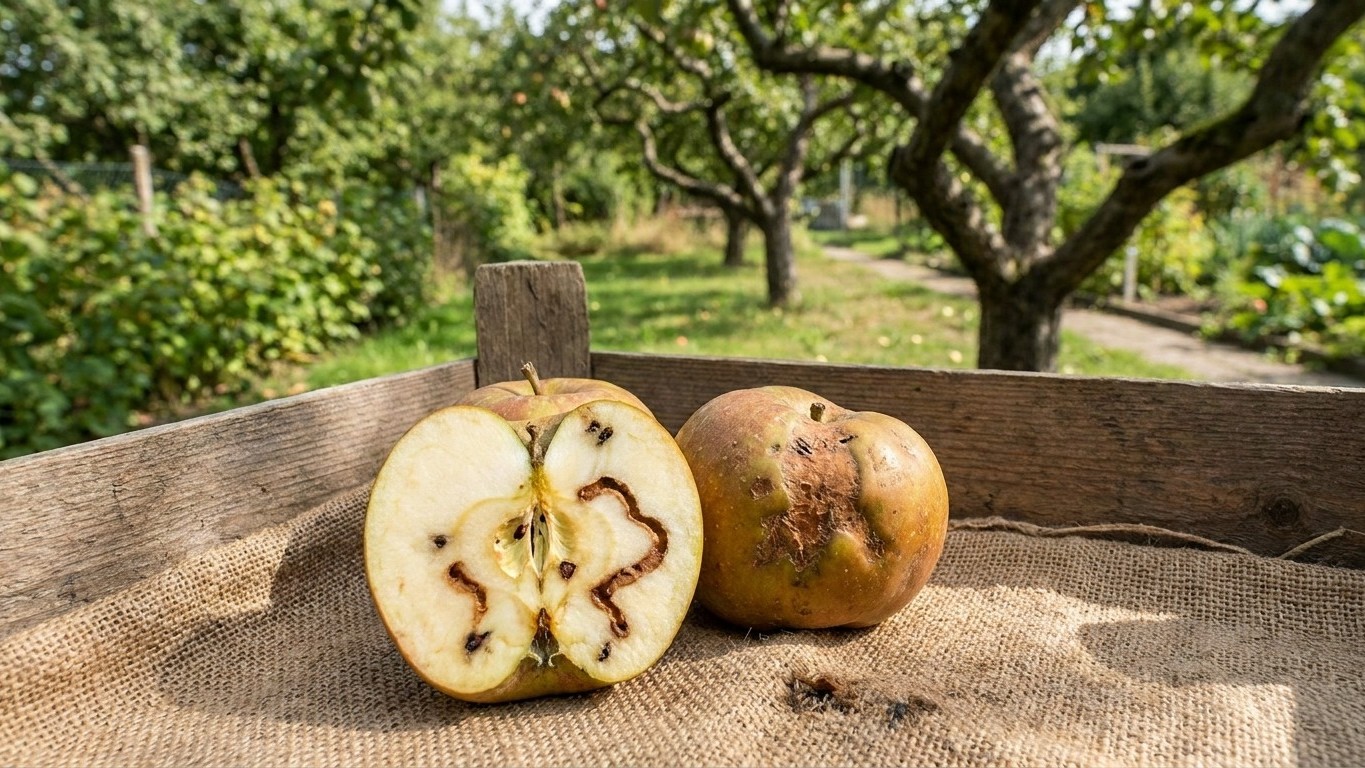
Quick check before you pick: cut one apple open and look at the seeds. Brown, fully colored seeds mean the fruit is close to ripe. Pale or white seeds mean it needs more time on the tree, whatever the date says.
Which ones keep, and which must be eaten
Not every apple is grown to sit in a box until January. Some varieties turn mealy within two weeks of picking no matter how carefully they’re stored, while others are still crisp deep into winter. The dividing line mostly comes down to when in the season a variety ripens, since early apples tend to have thinner skin, softer flesh, and a higher respiration rate that burns through stored sugars fast.
Early-season apples, picked from late August into early September, are built for eating fresh. Their cell structure breaks down quickly once off the tree, and refrigeration buys a few extra weeks at best, not months. Mid-season varieties, harvested through September, hold longer in a cold fridge or an unheated porch, often two to three months if kept cool and away from bruising. Late-season varieties, the ones picked closest to Ontario’s average October 16 frost date, are the true keepers: dense flesh, thick skin, and slow respiration let some hold for four to six months in proper cold storage, occasionally longer.
| Harvest group | Typical picking window | Storage life, kept cold |
|---|---|---|
| Early-season | Late August to early September | 1 to 3 weeks |
| Mid-season | September | 6 to 12 weeks |
| Late-season | Late September to mid-October | 4 to 6+ months |
None of these windows are fixed to paper. They shift with the season, with the site’s exposure, and with how close an orchard sits to a lake’s moderating effect. A grower on the Niagara Peninsula can often push a late variety a week or two past what an eastern Ontario orchard manages, simply because frost arrives later there. For a breakdown of which named varieties fall into which group and how they actually perform under Ontario conditions, the variety guide covers ground this season-based grouping can’t.
One rule holds regardless of variety: a bruised or punctured apple ripens and rots faster than the fruit around it, and it releases ethylene gas that pushes its neighbors along with it. Sorting out damaged fruit before it goes into storage does more for keeping quality than almost any other single step.
Storing them through a Ontario winter
Once fruit is off the tree, storage is a fight against two things: warmth and moisture loss. Apples kept at room temperature soften and lose flavor within days, since ripening keeps running at full speed above about 20°C. Dropping the fruit close to freezing, without actually freezing it, slows that process to a crawl.
A target near 0°C to 2°C, held steady, with humidity kept high enough that the skin doesn’t shrivel, is the range most growers and home keepers aim for. An unheated but insulated space, such as a cold cellar, a moderate attached garage, or a spare refrigerator set cool, usually gets closest to that range. A cardboard box lined with a damp towel and tucked into a cold cellar does a reasonable job of holding both temperature and humidity for a home-scale batch.
Ontario’s own winters make an unheated garage or shed a riskier bet than it sounds. The mean daily minimum for the coldest month at the Toronto reference station runs to -10.2°C (13.6°F), and inland areas away from the lakes’ moderating effect see colder minimums still. A structure with no insulation can drop well below freezing on a clear January night, and apples held much below 0°C will freeze, turning the flesh mealy and brown once thawed. A true root cellar, dug partly into the ground or built against a foundation wall, buffers against that swing far better than an above-ground shed does.
Checking stored fruit every couple of weeks matters more than any single storage trick. Pulling out anything gone soft or spotted keeps a slow rot from spreading through the whole box, and apples stored alongside potatoes or onions tend to pick up off flavors, so keeping fruit and root vegetables in separate containers, even within the same cold room, is worth the extra bin. Ontario’s provincial ministry publishes general growing and food guidance through its agriculture and food portal, though a detailed variety-by-variety home storage chart isn’t something that page spells out.
What goes wrong here
The most common mistake is picking by date instead of by stage. An apple pulled two weeks early, going by a calendar reminder rather than the fruit’s own signs, stays starchy and never develops full sugar, and it won’t ripen further once off the tree the way a peach or pear does. Apples ripen almost entirely on the branch. Picked too soon, that’s the ceiling for flavor.
Picking too late carries its own risk. Fruit left on the tree past its stage turns mealy fast in storage and drops readily in wind, bruising on impact even in soft grass. Waiting for a variety to hang until right before the average October 16 frost works for genuinely late keepers, but pushing an early or mid-season apple that long usually means fighting rot within weeks rather than gaining any real reward.
Storage failures tend to trace back to temperature swings rather than one bad decision. A fridge opened constantly, a cellar backed against a furnace wall, or a garage that freezes solid on the coldest nights can undo weeks of careful picking in a single stretch of bad weather. With Ontario’s coldest month averaging a daily minimum of -10.2°C at the Toronto reference point, and colder still away from the lakes, an unheated space needs some insulation or it will freeze fruit outright rather than merely chilling it.
Frost timing catches people out on both ends of the season. A late spring frost arriving well after the average April 30 date, which happens in roughly half of all years, can wipe out a season’s blossoms before any storage planning becomes relevant at all. Anyone weighing which varieties to plant in the first place, rather than just when to pick what’s already in the ground, is better served starting from the Ontario apple growing guide and working forward from there.
Common questions
How do I know an apple is ripe without cutting it open?
Check the background skin color behind any red blush. It should be shifting from green toward yellow or cream. Then lift the fruit and give it a gentle twist rather than a pull. Ripe apples separate easily from the spur; unripe ones hang on.
Can apples ripen after picking?
Not in any meaningful way. Apples develop their sugar and color almost entirely while still on the tree. Picked early, they may soften slightly in storage, but the flavor stays flat compared to fruit left to finish naturally.
What’s the best temperature for storing apples through winter?
A steady range near 0°C to 2°C with high humidity is the general target for home storage. Above that range, fruit softens and loses flavor faster. Below freezing, the flesh turns mealy and brown once thawed.
Do frost dates apply the same way across Ontario?
No. The April 30 and October 16 averages come from the Toronto Lester B. Pearson station and describe conditions near the Lake Ontario shoreline. Areas farther inland, at higher elevation, or further north see frost arrive earlier in fall and linger later in spring, which shortens the practical harvest window there.