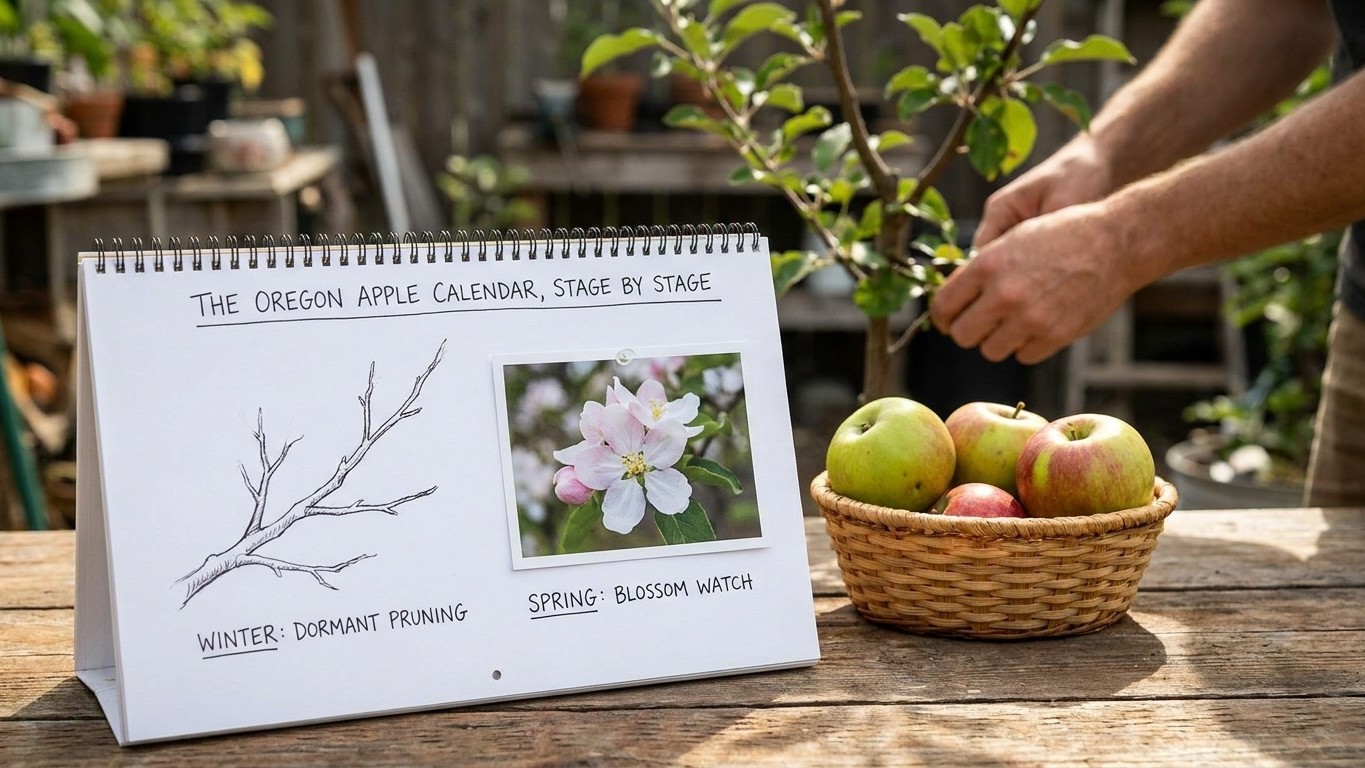

Oregon apple timing runs on tree stage, not on a date. In the Portland area, NOAA’s 1991-2020 climate normals put the last spring freeze at March 6 to March 21 and the first fall freeze at November 11 to November 27, and every stage between dormancy and harvest gets judged against that window. Before you spray, thin, or panic over a forecast frost, check what stage your tree is actually in: a tree still at green tip shrugs off cold that would wreck an open bloom.
The short answer for Oregon
A Hood River bloom caught by a frost that the calendar said couldn’t happen — that’s what comes of trusting a date instead of a bud. Growers who spray, thin, or protect on the strength of “mid-April” rather than what the cluster is actually doing lose fruit they didn’t need to lose, because a cultivar in the Gorge and the same cultivar in the Willamette Valley can sit two full weeks apart on the same tree stage. The frost record fools people; the bud never does.
That answer depends on three things: how far your orchard sits from Portland, which variety you planted, and how much winter chill the tree actually banked. NOAA’s Portland station reports a mean daily minimum of 35.2°F in the coldest month, mild enough that most apple cultivars break dormancy without trouble, but that figure describes Portland specifically, not the Coast Range, the high Cascades, or the desert east of the mountains, where winters run colder and springs run later.
The variety matters as much as the frost dates do. A cultivar that blooms early gambles a bigger share of its flower cluster against the tail end of that spring frost window, while a later-blooming cultivar gives up growing season at the other end instead. The right choice is read off your own frost record, not off a national planting chart, and it should account for both timing and how much cold the tree needs to flower well, not just how much cold it can survive.
Working through it

Each stage below is defined by what the buds are doing, not by a date on the wall. Use Portland’s own frost record, from NOAA’s 1991-2020 normals, as the yardstick: the closer a stage sits to that spring window, the more attention it needs.
Dormancy

The tree is bare, the buds are tight and covered in scale, and cold does no damage no matter how far it drops. This stage runs through the heart of winter, past the point where most of Oregon’s occasional deep freezes happen, and it is the safest point in the whole calendar. Pruning belongs here, while the branch structure is visible and before sap starts moving.
Green tip

Buds swell and a sliver of green leaf tissue pushes through the scales. This usually lines up with the weeks running into NOAA’s March 6 to March 21 last-frost window for Portland, so a tree at green tip still has a fair buffer: green tip tissue tolerates cold that would kill an open flower. Dormant oil sprays for scale insects only work before this stage, so it marks a real deadline for that job.
Pink

The flower buds show color before they open, a warning that bloom is close and the frost buffer is shrinking fast. If a late freeze inside the NOAA window still hangs over the forecast, pink is the stage to have frost cloth or a plan for wind protection ready, because the next stage has almost no cold tolerance left.
Bloom

Open flowers are the least frost-hardy point in the whole calendar. A freeze landing at or after the tail end of the NOAA last-frost window can wipe out a bloom that opened early, which is exactly why an early-blooming cultivar carries real risk in a year when frost runs late. This stage also decides the crop through pollination, so bees need to be flying, not sheltering from cold rain.
Petal fall

Petals brown and drop, leaving a small green fruitlet at the base of each flower cluster. Frost risk drops sharply here, since a fruitlet tolerates more cold than the flower it replaced, but it is not zero, and a hard freeze this late in the NOAA window can still thin a crop without anyone noticing until harvest.
Fruit set

Fruitlets that survive petal fall swell to about pea size, and the tree sheds a portion of them on its own in a normal event called June drop. By this point frost is no longer the concern; thinning the remaining fruit by hand is, since crowded apples come off smaller and later than a thinned crop.
Harvest
Fruit reaches full size and its variety’s mature color, and harvest timing runs off the cultivar, not the frost calendar. The first fall freeze at November 11 to November 27, by NOAA’s Portland record, is a backstop, not a target, since most apples come off well before it. Waiting past a hard freeze risks fruit that has gone soft or bruised and will not keep in storage.
What changes across Oregon
The NOAA frost dates and the 35.2°F coldest-month minimum both come from the Portland station, and they describe the low, marine-influenced floor of the Willamette Valley, not the rest of the state. Elevation and distance from the coast move both frost dates in opposite directions, and an orchard a few hundred feet higher than Portland, or a valley floor that pools cold air overnight, can run a week or two behind the reference window at either end of the season.
The Oregon coast, moderated by the Pacific, tends to see a milder and later-arriving hard freeze than inland valleys at the same latitude. No NOAA station in this record covers the coast directly, so treat that as a general pattern to confirm locally rather than a number to plan an orchard around.
Central and eastern Oregon are a different climate entirely. This is high desert country, and NOAA’s own caution on the Portland normals notes that the region east of the Cascades has a far shorter growing season than the Willamette Valley, with frost arriving earlier in fall and lingering later in spring. A grower near Bend or in the Columbia Basin should not borrow the Portland window at all, and should instead pull a normals record for a station closer to home, or ask the local extension office for one.
The Columbia Gorge adds another variable on top of elevation. It acts as a wind corridor, and cold air draining east to west through it in winter can expose orchards on either end of the Gorge to conditions their surrounding valley never sees. None of this reduces to a single figure, which is exactly why a grower outside the Portland area needs a station closer to home rather than this one.
The mistakes this climate punishes
An early-blooming cultivar planted without checking the frost record is the most common loss in this climate. If a variety flowers ahead of most others and a given spring’s freeze lands at the back end of NOAA’s March 6 to March 21 window for Portland, that bloom takes the hit while a later-blooming cultivar in the next row is still at pink and comes through fine. This shows up as a thin or missing crop with no other symptom, discovered only at harvest when fruit that should have set never did.
A high-chill variety planted where winters run mild is a slower, quieter failure. Trees that need a long stretch of cold to break dormancy properly can leaf out unevenly or skip flowering in a mild year, and near Portland, where NOAA’s normals put the coldest month’s mean minimum at only 35.2°F, that risk is real for cultivars bred for colder regions. It shows up in spring as patchy bloom, some branches flowering weeks apart from others on the same tree.
Feeding nitrogen late in the season is a mistake that surfaces months later, at the first fall freeze. A tree pushed into soft, late growth by a summer feeding has not hardened that new wood by the time NOAA’s November 11 to November 27 window for Portland arrives, and that soft tissue is what dies back first. The fix is timing, not avoiding nitrogen altogether: feed early enough in the season that growth stops and hardens well before the fall freeze window opens.
Planting in a known frost pocket, a low spot where cold air settles overnight, punishes every stage from pink onward regardless of variety. This is a site problem, not a plant problem, and it will not improve with a different cultivar. The tell is a bloom that fails in one corner of the yard while the same variety on higher ground, in a neighbor’s yard or elsewhere on the same property, sets fruit normally.
Checking this against your county
Every figure above comes from a single NOAA station near Portland, and the only way to know your own frost window is to check a station closer to your orchard. Oregon State University Extension Service keeps county offices that can point you to a nearer weather station and to local notes on how a given variety actually performs in your microclimate.
If you have not settled on which apple to plant, work out the frost picture for your county first, then match it against bloom time and chill need. That order avoids a wasted planting, and the groundwork in Growing Apples in Oregon along with the cultivar comparisons in The Best Apple Varieties for Oregon both assume you have done that check first.
Common questions
Can I grow apples on the Oregon coast?
Yes, apples grow along the coast, and the Pacific’s moderating effect tends to soften the hardest freezes compared with inland valleys at the same latitude. No NOAA station in this record covers the coast directly, so check with a coastal county office of Oregon State University Extension Service for the frost dates that actually apply to your stretch of shoreline.
What do I do if frost is forecast while my tree is in bloom?
Cover a small tree with frost cloth overnight and remove it once temperatures climb back above freezing in the morning. Larger orchard operations sometimes run wind machines or overhead irrigation to keep bud temperatures from dropping as far, but for a backyard tree, cloth and a planting site off the low ground do most of the work.
How many chill hours does an apple tree need in Oregon?
It depends on the cultivar, and the published figure on the tag or in the catalog listing is the one to check before you buy, since it varies by variety rather than by state. Winter chill and cold hardiness are separate questions: hardiness is whether the wood survives a freeze, chill is whether the tree flowers evenly the following spring, and a tree can pass one test and fail the other.
My apple tree bloomed but set almost no fruit. What happened?
A late frost during or just after bloom is the most common cause in this climate, but poor pollination from cold, wet weather that kept bees from flying can produce the same result with no frost involved at all. Check whether a nearby tree of a different, compatible variety was blooming at the same time, since many apple cultivars need cross pollination to set a full crop.