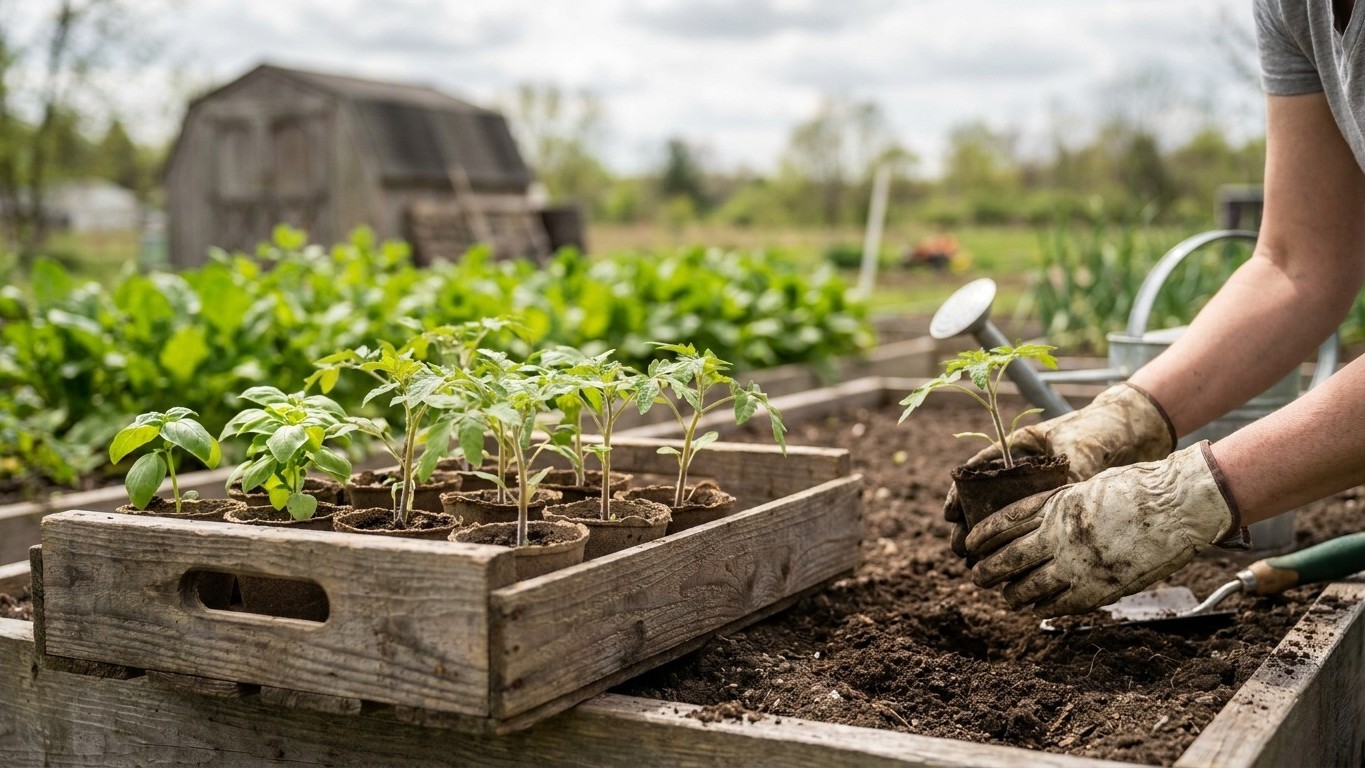

May is the month Ontario gardens shift from cautious to full throttle. The province’s average last spring frost lands April 30, which means most of May sits on the safe side of that line for tender crops, provided the soil has actually warmed up and you treat that date as a midpoint, not a guarantee.
What goes in the ground in May
The April 30 figure from Environment and Climate Change Canada is a mean drawn from the Toronto Lester B. Pearson station over the 1981-2010 period. A mean date carries a blunt statistical truth: in one year out of two, frost arrives later than that. So the first week of May is not a green light so much as a coin flip, and gardeners who plant tender crops the moment the calendar flips into May are gambling on the half of years that go their way.
Soil temperature, not the date on the wall, decides whether seed actually germinates or transplants take hold. Cold, wet soil in early May rots bean seed and stalls tomato roots even when the air feels warm on a sunny afternoon. That gap between air feeling warm and soil being warm is where most spring planting failures happen.
What is genuinely low-risk through May, frost aside, is the hardy crew: peas, spinach, lettuce, arugula, and other salad greens can go direct-sown from the start of the month. Onion sets, shallots, and seed potatoes tolerate a light frost and are traditionally planted early in May across southern Ontario. Brassica transplants (cabbage, broccoli, kale) started indoors earlier can move outside mid-month and shrug off a cool night.
The tender crops (tomatoes, peppers, squash, beans, corn, cucumbers) are the ones to hold back. Pushing these into the ground before the last third of May, and ideally after a stretch of warm nights, is where the frost risk actually bites. If a late-May cold snap is forecast, tender transplants set out early need row cover or they can be lost overnight, undoing weeks of indoor growing.
What to start under cover
Counting backward from the April 30 average frost gives a workable rule of thumb, even though the real date moves. Tomatoes and peppers generally need six to eight weeks indoors before transplanting, which puts their start date in the second half of March for most of southern Ontario, meaning by May those seedlings should already be several inches tall and hardening off, not just germinating.
What still makes sense to start under cover in May is the second wave: cucumbers, melons, squash, and pumpkins only need three to four weeks indoors, so early May sowings line up with a transplant date near the end of the month. Starting these too early backfires just as badly as starting them late. A squash seedling held indoors for six weeks becomes rootbound and leggy, stalling in the pot while its roots circle uselessly, and it rarely catches up once it finally hits open ground.
The opposite failure shows up with anything sown too late for the season it needs. Melons and other long-season vine crops started in late May, then held indoors into June before the soil and nights are reliably warm, can run out of growing season before Ontario’s average first fall frost on October 16 shuts things down. Cold frames and unheated tunnels extend the margin on both ends, letting a gardener start a week or two earlier without the leggy-seedling penalty, since the cooler, brighter conditions outdoors keep growth compact.
Herbs like basil are worth treating on their own timeline. Basil hates cold soil more than almost anything else in the vegetable patch, so even a mid-May indoor start, transplanted only once nights are consistently mild, beats an early sowing that just sits sulking on a windowsill.
What is ready to pick
May is a lean harvest month by Ontario standards, but it isn’t an empty one. Overwintered crops finish their run early in the month: parsnips and any carrots left in the ground under mulch through winter come out sweeter than they’ll ever be again, since cold storage in the soil concentrates their sugars. Perennial rhubarb stalks are usually ready to start cutting from mid-May, and asparagus crowns that are two or more years established begin sending up spears worth harvesting daily while they’re still slender.
Cold-frame and tunnel greens sown back in March or April hit their stride now: spinach, lettuce, and mustard greens planted under cover reach a cut-and-come-again size well before open-ground sowings catch up. Check these beds every few days, because greens that bolt in a sudden warm spell go bitter fast.
Anything still in winter storage deserves a walk-through this month. Stored squash, onions, and potatoes from the previous season are approaching the end of their shelf life by late spring, and the ones starting to soften, sprout heavily, or smell off should be pulled and used or composted before they spread rot to the rest of the bin. A single soft onion left in a mesh bag can take down its neighbors within a week.
The jobs that matter this month
Soil, mulch, and structure
Beds that haven’t been amended yet need it now, before the tender transplants go in later in the month. Working compost into soil that’s finally dry enough to handle without compacting is a one-shot window: work wet clay soil in early May and you’ll be fighting clods all summer. Mulch goes down as soon as soil has warmed, since mulching too early traps cold and slows root growth, but waiting past mid-month lets weeds get a head start that mulch alone won’t smother.
Staking, watering, and succession
Peas and anything vining need stakes or trellis in place before they sprawl, not after. A pea vine that’s already flopped across its neighbors is much harder to lift and support than one trained up from six inches tall. Watering rhythm matters more in May than gardeners expect, since young transplants with shallow roots dry out fast on the first genuinely warm, windy day, and a missed watering at this stage stunts growth in a way the plant rarely fully recovers from.
Succession sowing of lettuce, radish, and spinach every two weeks through May keeps a steady supply coming rather than one glut followed by a gap. Pest scouting starts in earnest now too: flea beetles hit young brassica and radish leaves hard in warm, dry spells, and catching the first shot-holes early lets row cover or a targeted response stop an infestation before it spreads through the whole bed.
None of this is glamorous work, but skipping it in May shows up as a weaker harvest in July, when there’s no going back to fix a bed that should have been prepped weeks earlier.
What not to do in May
The single most common Ontario mistake is planting tomatoes, peppers, and other tender crops the moment a warm stretch hits, without checking that the soil itself has caught up. Air temperature swings fast; soil temperature lags behind by days or weeks, and a transplant set into soil that’s still cold from a wet April sits stalled rather than growing, even if the days that follow are warm.
Uncovering cold frames, row covers, and winter mulch too early after a mild stretch is the second trap. A run of warm days in early May can tempt a gardener to strip protection off hardy greens or newly emerged perennials, only for a cold night, well within normal range given that the frost average sits right at the start of the month, to hit unprotected growth hard.
Feeding nitrogen at the wrong moment causes its own damage. Heavy nitrogen applied to tomatoes and peppers right at transplanting pushes lush leafy growth at the expense of root establishment and, later, fruit set. The better approach is a modest feed at planting, focused on phosphorus for root development, with nitrogen held back until plants are established and growing steadily.
Direct-sowing beans, corn, or squash into soil that hasn’t warmed enough is the last classic error. Seed sitting in cold, wet soil doesn’t just grow slowly, it often rots outright before it germinates, and replanting two weeks later usually beats a stubborn early attempt.
Checking this against your own county
A province-wide frost date is a starting point, not an instruction. Ontario spans Lake Erie shorelines that rarely see a hard frost by early May and northern districts where the ground is still thawing at that point. Elevation, distance from the Great Lakes, and local lake-effect patterns can shift real planting windows by two to three weeks in either direction from the Toronto-area average used here.
For a planting date grounded in local conditions, cross-check against the Ontario Ministry of Agriculture, Food and Rural Affairs, which tracks regional variation across the province, and weigh it against your own observed soil temperature before committing tender transplants to open ground.
Common questions
Is it safe to plant tomatoes outdoors in early May in Ontario?
Not reliably. The average last spring frost is April 30, which means roughly half of years see frost after that date. Waiting until mid to late May, with row cover on hand for a cold snap, is the safer approach for tender crops.
What Canadian hardiness zone covers Ontario?
The reference city used for this page sits in Canadian zone 7a, based on Natural Resources Canada’s 1991-2020 data. This is the Canadian system, built on seven climate variables, and it does not convert directly to a USDA zone, so it shouldn’t be compared on the same scale as US hardiness figures.
Can I still start seeds indoors in May?
Yes, particularly quick-maturing vine crops like cucumbers and squash, which only need three to four weeks indoors before transplanting near the end of the month. Slow growers like tomatoes and peppers should already be well underway by May, not just starting.
What is the first fall frost date for planning a harvest window?
Ontario’s average first fall frost is October 16, again based on the Toronto Lester B. Pearson station data. That gives a working season length from the April 30 average, but both dates are means, and either frost can arrive earlier or later depending on the year and the specific location within the province.