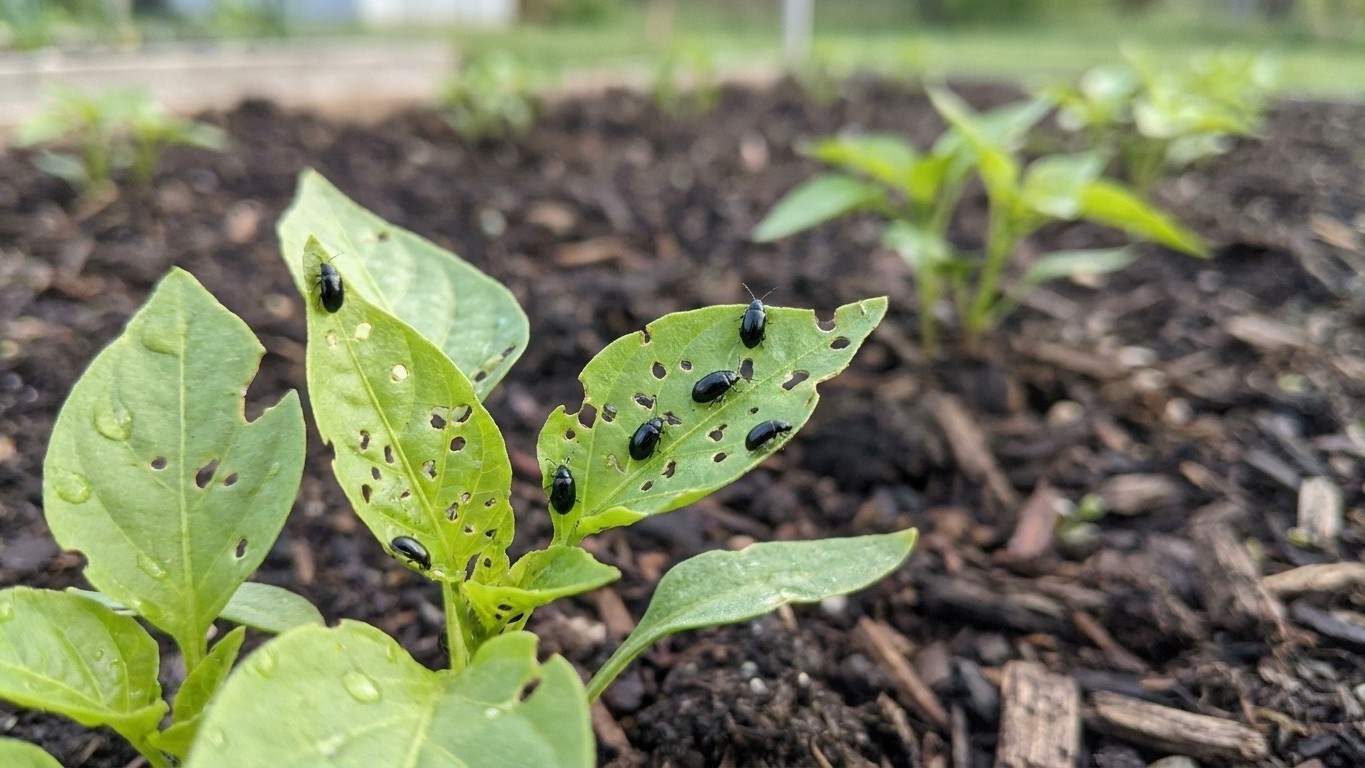

Flea beetles start chewing through Ontario gardens the moment soil temperatures hit roughly 50°F, usually in the first two to three weeks of May, and they keep feeding through early summer before a second wave shows up in late summer. The fastest way to stop them is a floating row cover installed at planting, paired with a trap crop of radish or mustard planted a week or two before your main vegetables go in. Miss that early window and you’re looking at pest control instead of pest prevention.
When Flea Beetles Actually Show Up

These small, dark, jumping beetles overwinter as adults, tucked into leaf litter, hedgerows, and the loose soil at the edge of last year’s garden beds. Ontario’s climate, spanning Canadian plant hardiness zones 4 through 7 depending on how close you are to the Great Lakes, gives them a fairly predictable emergence schedule. Once daytime soil temperatures climb into the low 50s (Fahrenheit) for several consecutive days, adults crawl out and head straight for the nearest tender seedling.
That timing lines up closely with what gardeners in bordering U.S. states like Michigan, New York, and Ohio see in their own beds, since the pest doesn’t recognize a border and the growing degree days are nearly identical across the region. In a mild spring, expect activity by the last week of April in southwestern Ontario (the Windsor and Leamington area tends to warm first). In the Ottawa Valley or along the Georgian Bay shoreline, add another one to two weeks.
Damage peaks in the first month after planting, when cotyledons and first true leaves are thin and can’t outgrow the feeding. A second, often heavier generation appears in late July through August, coinciding with fall brassica plantings and second-round radish or turnip sowings. This is the wave that catches people off guard, because they assume the threat passed once June arrived.
The Shot-Hole Signature
Identification is simple compared to a lot of garden pests. Flea beetles leave small, round or irregular holes across leaf surfaces, described by most extension entomologists as “shot-hole” damage, because the leaf looks like it took a blast of birdshot. Disturb the plant and the beetles jump, not fly, away, which is how they earned the name. A single beetle is easy to overlook, but a population explosion on a young seedling row can shred leaves within 48 hours.
Which Plants Take the Worst Hit
Not every crop is equally at risk, and knowing the hierarchy helps you prioritize protection where it matters most.
- Brassicas top the list: arugula, bok choy, cabbage, kale, radish, and turnip seedlings are magnets for the crucifer flea beetle.
- Eggplant and potato attract a different species (the potato flea beetle and eggplant flea beetle), and both can defoliate transplants within days of setting out.
- Tomatoes, peppers, and beans see occasional feeding but rarely at damaging levels once plants are established.
- Sunflowers and some annual flowers, particularly nasturtium, get hit hard enough that some growers use them deliberately as sacrificial trap crops.
Established plants with several sets of true leaves tolerate flea beetle feeding far better than seedlings. A mature kale plant can shrug off a scattering of holes with no real yield loss; a two-week-old arugula seedling can be wiped out entirely. That distinction is the whole basis for most effective control strategies: protect the vulnerable window, and the problem mostly solves itself once plants size up.
What Actually Stops Flea Beetles
Physical barriers outperform sprays in most home garden situations, mainly because flea beetles move by jumping and short flights rather than long-range migration, so a simple exclusion method keeps them from ever reaching the plant.
Row Covers and Timing
A lightweight floating row cover, sold at most Ontario garden centers as “insect barrier fabric,” laid directly over seedbeds or transplants and sealed at the edges with soil or landscape staples, blocks adult beetles almost completely. The catch is timing: covers need to go on at planting, before beetles find the row, not after damage starts. For brassicas that need pollination (if you’re letting some go to seed) or that flower quickly, covers have to come off before bloom, which is where trap crops fill the gap.
Delaying planting by even two weeks, until soil temperatures are more consistently warm and seedlings can establish faster, cuts damage substantially. Transplants started indoors and set out with several true leaves already formed also fare far better than direct-seeded rows, since the exposed window between germination and true-leaf growth (the most vulnerable stage) happens somewhere other than the open garden.
Trap Crops That Actually Pull Their Weight
Planting a border of radish, mustard, or arugula seven to ten days ahead of the main crop gives flea beetles a preferred target to colonize first. Since these species are highly attractive to the beetles, populations concentrate there instead of spreading through the main planting. The trap crop then gets sacrificed, sometimes pulled and destroyed once beetle counts climb, which resets pressure on the rest of the bed.
Diatomaceous Earth, Neem, and Spinosad
For beetles that get past physical barriers, a few low-toxicity options handle the rest. Food-grade diatomaceous earth dusted on dry foliage damages the beetles’ exoskeletons on contact, though it needs reapplication after rain and works best in dry stretches. Neem oil, applied in early morning or evening to avoid harming pollinators, disrupts feeding and reproduction over repeated applications rather than delivering an instant kill. Spinosad, derived from soil bacteria and approved for organic production, gives a faster knockdown and is often the choice when a population has already caused visible damage and needs quick suppression, but it should be applied in the evening since it carries some risk to bees while still wet.
Straight insecticidal soap has limited effect on flea beetles compared to soft-bodied pests like aphids, mainly because the beetles’ hard shell resists the soap’s mode of action. It’s worth having in a rotation but shouldn’t be the sole strategy.
Preventing Next Season’s Population
Flea beetle numbers build cumulatively across a garden’s history, since adults overwinter close to where they fed the previous fall. A few habits reduce that carryover population before spring even starts.
Clearing brassica and nightshade debris in the fall, rather than leaving spent plants to break down in place, removes both food and shelter for overwintering adults. Rotating crop families so that brassicas or eggplant/potato don’t return to the same bed for at least two to three years disrupts the beetles’ ability to find a reliable host close to their overwintering site. Tilling exposed soil in early spring, before beetles emerge, also destroys some overwintering adults directly and removes the loose mulch layer they favor.
Encouraging natural predators helps too. Ground beetles, parasitic wasps, and some songbirds all feed on flea beetle adults or larvae, and a garden with some undisturbed edge habitat (a strip of native grasses, a brush pile, minimal fall cleanup along fence lines) tends to support a higher baseline predator population than a garden raked bare every October.
Extension research from the University of Minnesota Extension notes that flea beetle pressure drops significantly once host plants reach four to six true leaves, reinforcing why transplants and delayed direct-seeding both work as practical strategies rather than just folk remedies.
One detail that surprises a lot of Ontario gardeners: a dry, warm spring produces noticeably worse flea beetle years than a cool, wet one, since damp soil surfaces slow adult movement and favor fungal pathogens that naturally suppress beetle populations. If the forecast calls for an early, dry spring, that’s the year to get row covers on the day seedlings go in rather than waiting to see how bad it gets.