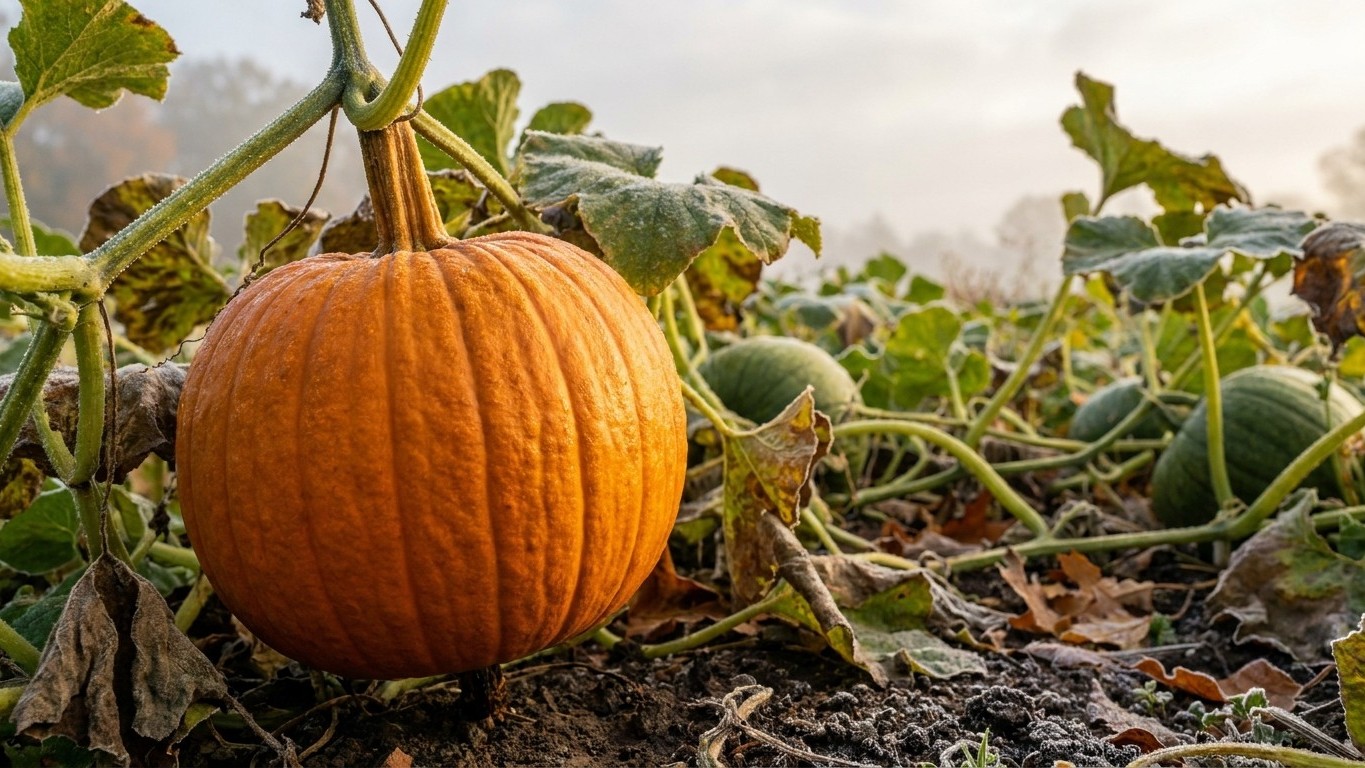

Will Pumpkins Ripen Before Frost in Maine? The answer is yes, but the vine has to flower on time. Coastal Maine’s growing season ends with the first fall frost, arriving somewhere between October 9 and October 21. Count back the 45 to 55 days a pumpkin needs after that first bloom opens, and the safe window for flowering closes surprisingly early in the summer. Miss it, and you end up with a green fruit and a dead vine.
The short answer
Start with the frost date, because everything else in this calculation flows backward from it. NOAA’s 1991-2020 climate normals put coastal Maine’s first fall frost between October 9 and October 21, based on 32-degree freeze probabilities recorded at the Portland station. That’s a 12-day window, not a fixed date, and it matters because a pumpkin vine doesn’t know the calendar. It only knows when the cold actually arrives.
Utah State University Extension, the source most gardeners rely on for pumpkin timing, states that pumpkins take 45 to 55 days to mature after flowering. Not from the day you drop seed in the ground, and not from transplant day if you started indoors. From the day the female flower opens and gets pollinated. That distinction changes the whole calculation, because a pumpkin vine can sit in the ground for weeks putting out leaves and male flowers before a single female flower shows up.
Run the subtraction against the coastal frost window and the picture gets specific fast. Take October 9, the early end of the frost window, and subtract the full 55 days, and you land around August 15. Take October 21, the later end, and subtract just 45 days, and you land closer to September 6. That gives coastal Maine a real window: the last flower with a genuine shot at ripening needs to open somewhere between mid-August and the first week of September, depending on exactly when frost shows up and how fast that particular fruit matures.
A flower that opens after that window doesn’t necessarily die on the vine, but it almost never finishes coloring before the cold shuts things down. The fruit stays green, or it turns an uneven blotchy orange that never fully commits. Growers who push flowering past early September in coastal Maine are, in effect, gambling on a late frost, and the odds aren’t with them most years.
Inland and northern Maine change this math in the wrong direction. Frost arrives earlier there than at the coastal station NOAA used for these normals, which means the safe flowering window closes earlier too. A gardener in Aroostook County working from the coastal figures above is working from numbers that are too generous for their actual growing season.
When to sow here
When to Sow Pumpkins in Maine is not the same conversation as frost date, and treating them as interchangeable is the single most common mistake with pumpkins in Maine. The soil has to warm to 65 degrees before seed goes in, and soil temperature lags well behind the air. Here’s how the timeline actually builds, one step at a time:
- Start from the last spring frost. Coastal Maine’s last spring frost, per the same NOAA 1991-2020 normals, falls between April 22 and May 1.
- Add real time for the soil to catch up. Air temperature crossing above freezing doesn’t mean the ground at planting depth has warmed with it. Soil at a few inches down typically takes several additional weeks past the last frost to climb into the 65-degree range pumpkins need, since dirt holds cold far longer than air does.
- That pushes direct sowing into late spring, not early spring. A gardener who plants the week after the last frost, expecting a head start, is very likely planting into soil that’s still too cold for pumpkin seed to germinate reliably. Seed that sits in cold, damp soil tends to rot before it sprouts rather than wait patiently for warmth.
- Row covers can buy back some of that lost time. Laying row cover over the bed traps daytime heat and can warm the soil enough to move effective sowing roughly two weeks earlier than bare, uncovered ground would allow.
- Work the sowing date backward from the flowering deadline, not forward from the frost date. Since the vine needs weeks of growth before it even produces its first female flower, and that flower has to open by the mid-August to early-September window described above, sowing needs to happen early enough to leave room for all of that growth to happen first.
Gardeners who start seed indoors and transplant can shave time off this sequence, but the 65-degree soil threshold still governs when it’s safe to set transplants outside. A transplant dropped into cold soil stalls just as badly as a seed does.
What goes wrong here
Maine’s compressed season creates a short list of predictable failures, and each one traces back to the same root problem: not enough time between flowering and frost.
- A late flower that never colors. When the first strong female flower doesn’t open until mid-September, the fruit runs out of warm days before it finishes turning orange. The remedy is pushing sowing earlier using the arithmetic above, and pinching off any female flowers that open after the safe window closes so the plant redirects energy into the fruit already set rather than starting new ones destined to fail.
- A fruit caught by frost while still soft. Even a fruit that’s mostly colored can be damaged if a hard freeze hits before the rind toughens. The remedy is watching the forecast closely once the frost window opens in early October and covering vines overnight with blankets or row cover on any night frost is predicted, buying a few extra days for the rind to finish hardening.
- A vine that dies back before the skin hardens. Vine collapse can come from the season simply running out, but it’s also frequently accelerated by pest pressure that this site covers separately, including squash bugs and cucumber beetles, both of which weaken vines faster than a healthy plant would decline on its own. The remedy is managing those pests early in the season, since a vine already stressed by insects has far less reserve to push a fruit through to full ripeness before frost.
Checking this against your own county
Everything above is built on coastal data from the Portland station, and Maine’s climate does not behave the same way forty miles inland or three hours north. Before locking in a sowing date, check the frost and season-length figures for the specific county you’re gardening in through the University of Maine Cooperative Extension. Their local offices track conditions county by county and can confirm whether the coastal window above runs early, late, or roughly on schedule where you actually garden. That single check is the difference between planning around Portland’s climate and planning around your own.
Common questions
Can I still get a ripe pumpkin if my flower opened in mid-September?
It’s a close call. A flower opening in mid-September needs the full 45 days at minimum and a frost that arrives on the later end of the October 9 to October 21 window. It’s possible in a mild year, but it’s not a safe bet to plan around.
Does starting seed indoors solve the timing problem?
It helps, but it doesn’t remove the core constraint. Transplants still can’t go outside until the soil is warm enough, and the 45-to-55-day clock still only starts once the vine actually flowers, not when it was transplanted.
How do I know when to pick, if I’m not sure the fruit finished ripening?
Harvest with the stem attached, and do it before frost hits rather than waiting to see if a couple more warm days help. A fruit that’s mostly colored and cut before a freeze has a far better shot at finishing than one left on a frost-killed vine.
Is there a published storage temperature for keeping harvested pumpkins?
Not in the source this page relies on. Utah State University Extension notes only that pumpkins should be kept somewhere they won’t freeze, without specifying an exact temperature or humidity range.