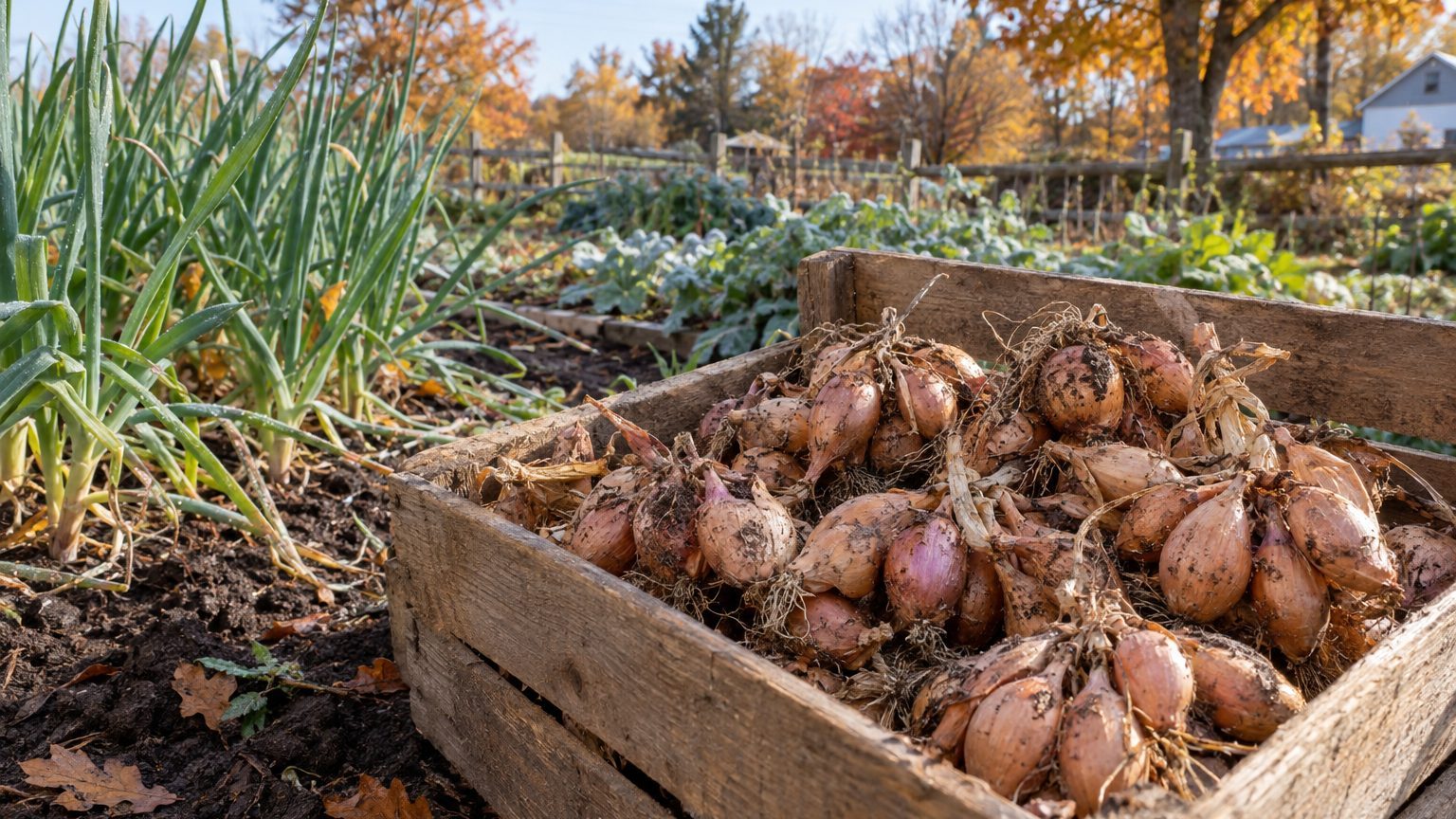

For most Ontario gardens, the best shallots are multiplier types grown from bulbs, planted in fall or as early as the soil allows in spring. Seed-grown shallots can work, but only when started indoors. The type matters more than the cultivar name. A bulb that splits into a cluster makes far better use of this province’s growing season than a seed sown in the ground in May.
The short answer for Ontario
Choose multiplier shallots first, seed-grown shallots second, and treat any variety labelled as slow to mature with suspicion. The numbers behind that advice come from the Toronto Lester B. Pearson station. On average, its last spring frost falls on April 30 and its first fall frost on October 16 (Environment and Climate Change Canada normals, 1981-2010). Those are mean dates. They are not safe dates: in one year out of two, the frost arrives later than the average. Read each as the midpoint of a window, not a deadline.
Multipliers: the safe bet
Between the two mean dates sit about 169 days. That sounds generous until you count what a seed-grown plant has to do in that time: germinate, grow leaves, swell a bulb, then dry down for curing. A multiplier skips the first stage. It starts as a mature bulb, so it can be planted in fall, root before winter, and push green shoots in spring while the soil is still cool. By midsummer it has already done most of its work.
Winter is the other number to respect. The mean daily minimum of the coldest month is -10.2 °C (13.6 °F) at the reference station, and the Canadian hardiness zone for the reference city is 7a (Natural Resources Canada, 1991-2020 normals). That Canadian zone does not convert to a USDA zone, since the two systems are built on different climate variables. Still, a fall-planted shallot with a layer of mulch is a reasonable proposition at those temperatures. For timing, see When to Plant Shallots in Ontario; for the overall picture, Growing Shallots in Ontario.
The decision by type
| Type | Fit with Ontario’s season | Main risk |
|---|---|---|
| Multiplier, fall-planted | Best: uses the cool spring and finishes early | Heaving or winter damage without mulch |
| Multiplier, spring-planted | Good if planted as soon as soil can be worked | Smaller clusters than fall planting |
| Seed-grown, started indoors | Workable, with effort and early indoor sowing | Slow starts, small bulbs, tight curing window |
| Seed-grown, sown outdoors | Poor | Not enough time to size up and cure |
One gap to flag: this page has no variety trial data for Ontario. It cannot rank named cultivars, only types.
What will not work here
Direct-sowing shallot seed outdoors is the clearest loser. Take the Pearson average last frost of April 30 and the average first fall frost of October 16. Even if you sow on the first day, the plant has roughly 24 weeks before the season closes. In half of years, frost comes earlier than the mean date. A seedling that germinates slowly in cool May soil spends its first weeks as a thin green thread. Shallots form bulbs in response to lengthening days, so a plant that is still small at midsummer simply makes a small bulb. The result is a bed of marble-sized shallots that are hard to peel and hard to store.
Planting at the wrong end of fall
Fall planting works, but timing errors cost you. Plant too early and the bulbs send up a lot of green growth that winter then burns back. Plant too late and the roots never anchor, so freeze and thaw cycles push the bulbs up toward the surface. With a coldest-month mean minimum of -10.2 °C (13.6 °F), the soil here does freeze, and a loose, unmulched bed is where heaving happens. A few inches of straw or shredded leaves after the ground chills is cheap insurance. Pull it back in spring when shoots appear.
Crowding in a humid season
The second failure is closer to home for most gardeners. Packing multipliers tightly and keeping the bed damp invites neck rot and other fungal trouble, especially in a wet June or July. This page does not have rainfall or humidity figures for the reference station, so it can’t say how many weeks in a typical year are damp enough to matter. A safer rule is to leave about 6 inches (15 cm) between bulbs, water at the base, and never leave the bed soggy as the tops begin to yellow. Anyone watering on a fixed weekly schedule through a rainy stretch is also asking for rot.
Curing is where the season can finish you off. A wet late summer makes drying bulbs outdoors a gamble. Plan to bring them under cover, in a shed, garage or covered porch with air moving through, rather than leave them in the bed waiting for sun.
What changes across Ontario
The 7a figure belongs to the reference city, not to the province. Ontario is far too large to have one hardiness zone. The Natural Resources Canada map shows a wide spread across the province, and this page does not print the full range, so there is no single answer to give. What can be said is directional: the same type that is easy in the south is a different proposition in the north or on higher ground.
The Pearson frost dates are also a southern reference point. Northern and upland districts run weeks behind that station, and in those places the spring thaw comes later and the fall frost earlier. A reader there should shift every step. Favour multipliers over seed-grown shallots. Plant in fall earlier than a Toronto-area guide suggests, so roots establish before the ground locks. Mulch more heavily, because the winter minimums will be colder than the -10.2 °C (13.6 °F) at the reference station. And be wary of anything that needs a long finishing period in late summer.
One more caution on the numbers. The frost normals cover 1981-2010, while the hardiness zone uses 1991-2020 normals, so they do not describe exactly the same climate window. They were never meant to be combined into one tidy figure.
To find your own zone, use the Natural Resources Canada plant hardiness map and look up your municipality there. Do not take a zone from a seed catalogue or from this page. Zone number in hand, treat it as a clue to winter survival only. It says little about whether your summer is long enough to finish a bulb.
Where to check this for your own county
A county recommendation beats a provincial one, and this page is the provincial one. It rests on one airport station in the south of the province and a single hardiness reference city. Your garden may sit weeks ahead of or behind those figures, and nothing here can tell you which.
The place to start is the Government of Ontario’s agriculture and food pages. This page cannot promise what is currently posted there on shallots, so check for two things in particular. The first is a local planting calendar, ideally one written for your region rather than a province-wide chart. The second is any report on varieties trialled near you. A cultivar that performed well in a Niagara-area trial tells you much less about a garden near Thunder Bay than a trial in your own part of the province would.
If the pages do not list a shallot-specific guide, look for onion or garlic material from your region. Garlic is the closest relative in terms of fall planting and mulching, and its local timing is a useful proxy. Treat it as a proxy only, though, and not as a shallot recommendation.
A local garden club or a nearby farm that grows alliums often knows more about your frost pockets than any table does. Ask when they plant and when they harvest, then compare those dates with what you read here. If their experience differs from this page, trust theirs.
Checking this against your own garden
Your observations outrank every date above. Three of them are worth watching, and none needs equipment.
- Soil warmth by feel. In spring, push your hand into the bed. If the soil is still cold enough to ache after a minute, multipliers will root slowly and seed will sit. Beds that warm early are usually sunny, sloped or sandy; beds that stay cold are low or heavy. That tells you whether to plant first or last in your yard.
- First true leaves and first shoots. When seedlings show true leaves, or multiplier shoots break the surface, note the date. Compare it with a neighbour’s. A week’s gap is common and tells you how far your microclimate sits from the regional average.
- Tops yellowing and falling over. In summer, note when the green tops begin to turn. An early collapse usually means heat or dry stress, a late one means a cool or crowded spot. Either one tells you when to start curing and when to plan next year’s planting.
Write the dates down, even on a garage wall. After two seasons, you will have a calendar more accurate than anything in this article.
Common questions
Should I plant shallots in fall or spring in Ontario?
Fall planting of multipliers suits the climate, with mulch over the winter. Spring planting also works if you get bulbs in as soon as the soil can be worked. Fall tends to give larger clusters, since roots are ready before the spring growth begins.
Can I grow shallots from seed in Ontario?
Yes, but start them indoors. Outdoor sowing leaves too little time for bulbs to size up and cure, given an average last frost of April 30 and first fall frost of October 16 at the reference station.
Do the Toronto frost dates apply to my garden?
Only if you garden near that station. They are mean dates, so frost comes later than April 30 in half of springs and earlier than October 16 in half of falls. Northern and upland areas run weeks behind them.
Does this page name the best shallot varieties?
It names the best types for Ontario’s season, not individual cultivars. It has no Ontario variety trial data. For trialled cultivars, check the Ontario government pages linked above for results from your region.