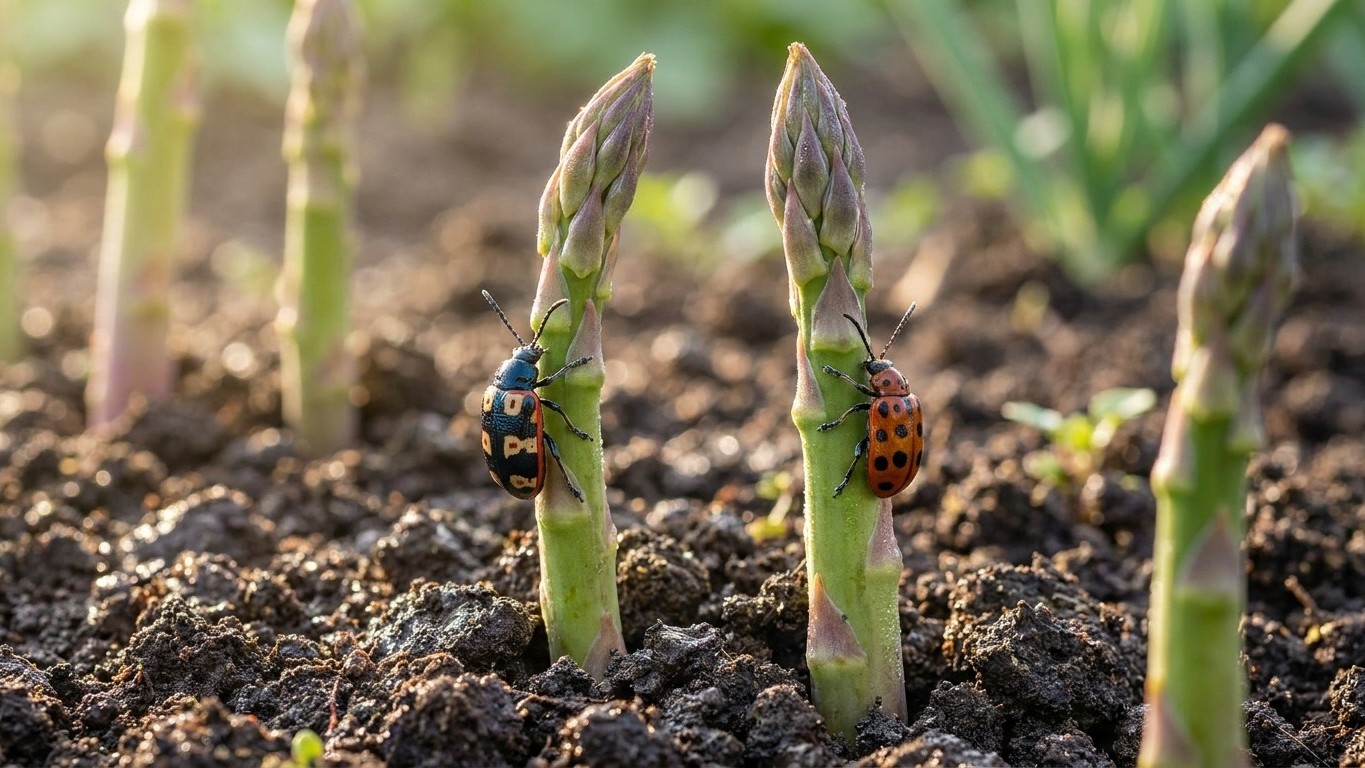

Stop cutting when most of the spears coming up are thinner than a pencil. That is the signal, and it is not a date. The first cutting season comes in year three and lasts 4 weeks, then 6 weeks the next year, then 8. Once cut, spears keep best stood butt-down in water in the refrigerator, where the air sits between 32 and 35°F and stays nearly saturated.
The short answer
A gardener who picks a spot for tomatoes can change their mind next May. Asparagus doesn’t allow that. Crowns go into an 8-inch furrow in early spring, nothing is cut until year 3, and the bed then produces for 10 to 15 years. Utah State University Extension, the source behind this page, has one soil requirement for all that time: the ground has to drain. Most soils will do if it does.
What the state soil suggests
Oregon’s official state soil is the Jory series, named by state law. It is an Ultisol, an old, heavily weathered, leached soil that is naturally acid and low in nutrients. USDA records its surface layer at a pH of about 5.6 (slightly acid), with 14 percent sand, 34 percent clay and 52 percent silt, and about 5.0 percent organic matter. The key word on the record is well drained.
So the answer is yes. The soil that represents Oregon drains well enough for a fifteen-year bed, even though its clay content sounds heavy on paper. The silt makes up more than half of it, and the series is mapped as well drained. Those figures are representative values for the surface layer of the mapped series. They are not a measurement of your worked bed, and the pH is not your pH. The source behind this page is silent on soil pH, so there is no number here to chase.
If your ground does not drain
Oregon spans hundreds of soil series. River bottoms, hill country and any lot a builder has scraped or filled can behave nothing like Jory. A heavy, soggy spot is an annual nuisance with most vegetables. With asparagus it is a decision you live with for a decade or more, so test before you plant. Dig a hole about as deep as the furrow, fill it with water, and see how long it takes to empty. Water still standing hours later is your answer.
If the ground fails that test, you have three honest options. Build a raised bed above the surrounding grade so the crowns sit in ground that sheds water. Move the bed to a better-drained corner of the yard. Or skip asparagus and grow something that tolerates wet feet. A soil test will give you your own numbers. For a closer look at how Oregon ground holds up over the long haul, read Will Oregon Soil Hold an Asparagus Bed for Fifteen Years?
Will the summer here water it for you?
Not by itself. The bed wants 1 to 2 inches every other week for the first two years, then every three weeks after that. Oregon’s summer, at the Portland reference station, falls well short of both schedules.
The arithmetic, month by month
- The ask. June through August covers about 13 weeks. Every other week means six or seven waterings, so roughly 6 to 14 inches over the summer in the first two years. From year three on, every three weeks means about four waterings, or 4 to 8 inches.
- June. The normal is 1.63 inches, the wettest of the three months. It arrives in pieces, and some of it comes before the heat sets in.
- July and August. July averages 0.51 inches and August 0.54. That is barely an inch across two months, against the four or so waterings the bed would want in that stretch.
- The season total. About 2.7 inches fall across June, July and August, out of 36.9 inches for the whole year. Summer delivers roughly 7 percent of Oregon’s annual rain at this station, just when the bed is working hardest.
- The gap. Rain covers a small fraction of the need. In the first two years the gardener supplies most of the water. After that the hose still has to do more than the sky does.
What shifts the numbers
These are normals for one station over the most recent 30-year period. They are not a forecast, and they are not your garden. A slope, a rain shadow or a city lot can change them. Soil matters too. Clay holds an inch of water far longer than sand lets it stay, so a Jory-type soil needs less frequent watering than a sandy yard where the water drains within the day. Hot days and thunderstorms work against you. Evaporation climbs on the hottest afternoons, and a single downpour mostly runs off instead of soaking in.
A rain gauge on your own plot settles the question better than any regional average. Check it against what you apply with the hose, and let the combined total decide your schedule.
When to put the crowns in
Early spring. In Oregon west of the Cascades, that means around the last spring freeze, which NOAA NCEI places between March 6 and March 21 at the Portland reference station. That is the 30 to 70 percent probability band for a 32°F freeze (NOAA NCEI climate normals). A mean frost date is an average, and some years the last freeze comes earlier and some years later.
Planting the crowns
Do not apply that window statewide. Central and eastern Oregon are high desert with a far shorter season. The data behind this page has no frost date for those areas, so check your own county’s last-freeze date before you plant.
Crowns go into furrows 8 inches deep. The furrow is not filled in on day one. Backfill it gradually across the year, about 2 inches every other month, so the growing shoots are never buried all at once. The wider planting picture is in Growing Asparagus in Oregon.
The seed route and the variety question
Starting from seed is the alternative to buying crowns. The source behind this page does not publish a sowing date or a time-to-harvest for seed-grown plants, so check the seed packet and do not assume it matches the crown schedule.
Utah State University Extension names four varieties, and gives only their sex. Jersey Giant and Jersey Knight are all-male. UC 157 F1 and Purple Passion are male and female. Nothing is published there about flavor, yield or any reason to prefer one over another. Any choice among them rests on what a nursery tells you, and I name none.
Common questions
How do I know when to stop cutting for the season?
Look at the spears. When most of them come up thinner than a pencil, stop cutting and let the rest grow. Do not convert that into a week count. The season length is 4 weeks in year three, 6 weeks the next year, then 8, and the pencil test tells you when the bed is spent within that limit.
Can I take a few spears in the first or second year?
No. Nothing is harvested until year 3. The first two years are for the crowns to build up, and taking even a few spears is not part of the schedule.
What is the best way to keep cut spears fresh?
Aim for 32 to 35°F with air at 95 to 100 percent humidity, per the UC Davis Postharvest Technology Center (asparagus fact sheet). The window is narrow on both sides. Above 50°F the spears toughen within hours. At about 31°F or lower they suffer freezing injury, turning water-soaked and collapsing when they thaw. At home, stand the cut ends in water, or wrap them damp, because spears lose moisture through the cut end faster than anywhere else. A refrigerator thermometer will show whether your fridge sits in the window.
What else could threaten a bed I am waiting three years to cut?
Pests are the usual answer. What Eats Asparagus in Oregon, and When covers what turns up and what time of year to watch for it.