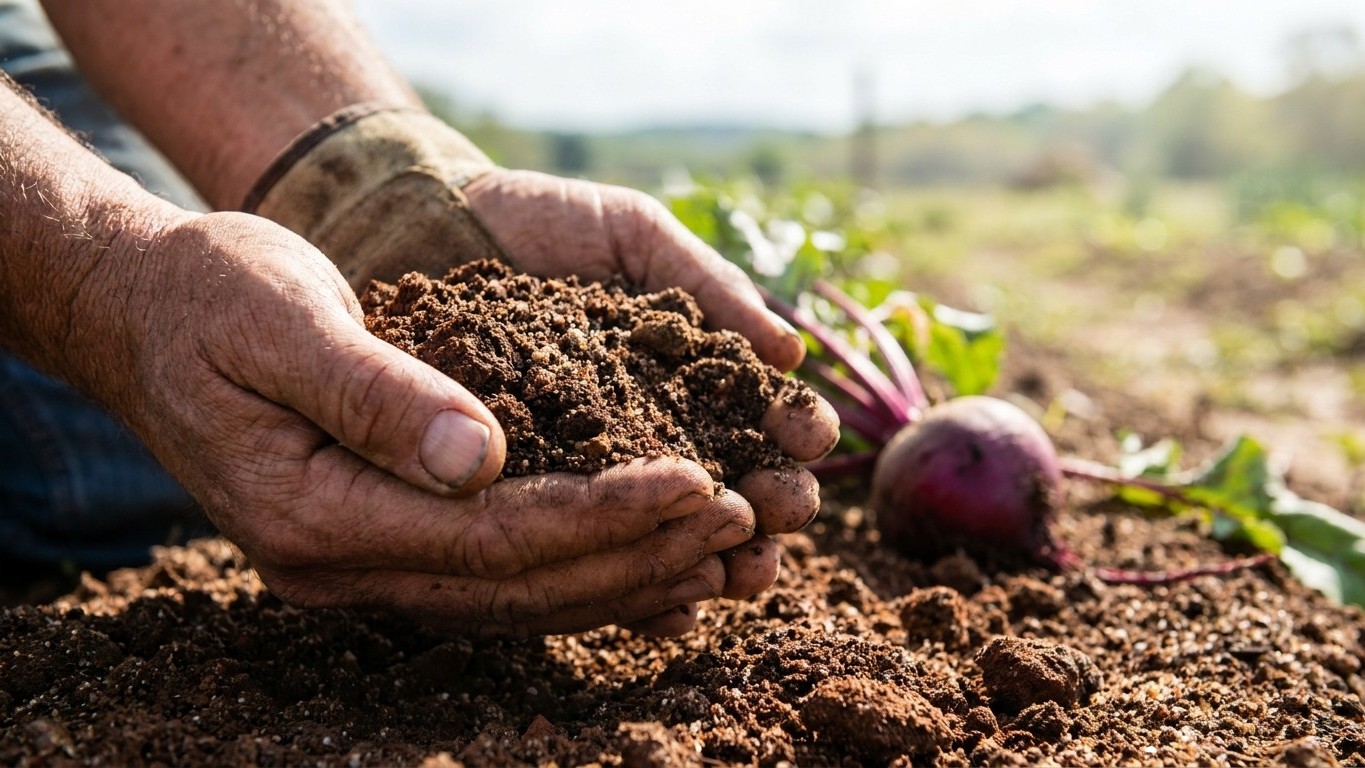

Beets planted in average Oregon ground will run into two different problems depending on where that ground sits. West of the Cascades, the soil the state has adopted as its official symbol, the Jory series, is a heavy, acidic clay loam that beets can tolerate but were never built for. East of the mountains, a shorter frost-free window changes the calculation again. The short version: get a soil test for your own yard, sow early enough to clear the first six weeks of risk, and plan on amending rather than fighting the ground you’ve got.
The short answer
Oregon’s state soil, named by state law in 2011, is the Jory series, an Ultisol, which is the technical term for an old, heavily weathered soil that has had most of its natural fertility leached out over a very long time. The representative surface horizon runs 14 percent sand, 34 percent clay and 52 percent silt, with a pH around 5.6 (slightly acid) and organic matter near 5.0 percent. It’s classified as well drained. None of that is a death sentence for beets, but none of it matches what the crop actually asks for.
Texture the root has to push through
Utah State University Extension is blunt about what beets want: deep, sandy, well-drained soil rich in organic matter. A soil that’s 52 percent silt and 34 percent clay is the near-opposite of sandy. Clay-heavy ground compacts easily, resists the downward push of a swelling root, and tends to hold that root back or split it as it tries to force its way through. The Jory series’ own organic matter figure, around 5.0 percent, is already reasonably generous by garden standards, so a gardener working ground like this doesn’t necessarily need to load up on compost. Utah State’s guidance caps amendment at no more than 1 inch of composted organic matter per 100 square feet; piling on more in soil that’s already clay-dense can make drainage worse, not better, by creating a spongy layer that holds water against the root.
What the marine climate does to summer heat
The reference city for the Willamette Valley side of the state, Portland, sits in a marine-influenced climate that keeps summer heat moderate compared to inland Oregon. An exact count of days above 90 F for that station isn’t part of the sourced data used for this page, so it won’t be guessed at here. What can be said is that the valley’s ocean-tempered pattern generally means fewer extended heat runs than the high desert sees, which matters because Utah State’s research ties woodiness in the root directly to heat above 85 F combined with water stress, not to heat alone. A cooler valley summer lowers that risk somewhat; it doesn’t remove it, especially in a dry August with no supplemental water.
A state spans hundreds of soil series, and Jory is a starting point, not a verdict on any one backyard. River-bottom ground, hill country, and anything a builder has graded or filled can look nothing like the mapped surface horizon above. A home soil test is the only way to know whether your own beet bed leans toward this clay-and-acid profile or away from it.
The six weeks that decide it here
Beets are sown directly in the ground, never transplanted, and the standard advice is to get seed in 2 to 3 weeks ahead of the last spring frost. For the Portland station, NOAA’s 1991-2020 climate normals put that 32 F freeze probability window between March 6 and March 21. That places the first six weeks after sowing, the stretch Utah State University Extension flags as the period when water stress triggers premature flowering, squarely in the Willamette Valley’s classic early spring.
What that spring usually brings
West of the Cascades, spring in Oregon has a reputation for being wet more often than dry, with rain events spread through March and April rather than concentrated drought. That works in the beet grower’s favor for the bolting risk specifically, because a spring that delivers regular moisture on its own reduces the odds of the kind of sustained dry stretch that pushes a young beet toward flowering instead of root growth. It doesn’t eliminate the risk. Late-winter dry spells happen, cold fronts can pass through without much rain attached, and a raised bed or container dries out faster than an in-ground row regardless of what the regional pattern is doing. The bolting risk in this six-week window sits lower here than it would in a drier spring climate, but it isn’t zero, and it isn’t something the calendar guarantees away.
East of the Cascades, this whole picture changes. Central and eastern Oregon sit in high desert conditions with a noticeably shorter frost-free season than the Willamette Valley enjoys, and the March 6 to March 21 window described above applies to the Portland station only. A gardener in Bend or Burns working from that date range would be planting into a false sense of security; the frost calendar on that side of the state runs on its own schedule, and this page doesn’t carry the sourced data to state it precisely.
What goes wrong here
- Forked or hairy roots from clay compaction. The Jory profile’s 34 percent clay content resists a root trying to swell and elongate at the same time, which often produces forking or a mass of fine side roots instead of one clean taproot. Working the bed a full spade deep before sowing, breaking up clumps rather than just turning them, and mixing in that 1-inch-per-100-square-foot allowance of compost gives the root a softer path.
- Bolting from a dry stretch in the first six weeks. Even in a normally wet Willamette Valley spring, a run of dry days during that early window can trigger premature flowering per Utah State University Extension’s findings. Consistent, light watering rather than occasional heavy soaking is the fix, particularly for beds under eaves or in raised planters that miss some rainfall.
- Woody roots from summer heat plus thirst. This is a separate failure from bolting: it happens later, when temperatures push past 85 F and the plant is also short on water. Deep, regular watering through any hot August stretch keeps the root from turning fibrous, even though the valley’s marine climate generally keeps extreme heat runs shorter than in inland Oregon.
- Stunted growth from surface acidity. A pH around 5.6, as recorded for the Jory series surface horizon, sits on the acid side of what most root vegetables prefer. A home soil test that confirms similar acidity in a given bed is reason to consider lime application based on that test’s specific recommendation, not a blanket fix applied without testing first.
- Waterlogging despite a “well drained” classification. Well drained describes the mapped series as a whole, not how a compacted garden bed behaves after a heavy spring rain. Raised rows or beds amended for structure drain faster than flat, worked clay ground, which matters most in that wet Willamette Valley spring described above.
Common questions
Does Oregon’s state soil mean my yard has clay like that?
Not necessarily. The Jory series is the soil chosen to represent the state, mapped across a specific set of locations, mostly in the Willamette Valley foothills. A state contains hundreds of distinct soil series, and gardens on river bottoms, in urban infill, or east of the Cascades can differ completely. Treat the Jory figures as a general regional tendency, then confirm your own bed with a soil test.
How many days does it take beets to reach harvest from seed?
Beets are sown directly where they’ll grow, not started as transplants, and the maturity clock starts at seeding. Because beets aren’t transplanted, gardeners shouldn’t count days from a seedling stage; the full run to harvest begins the day seed goes into the ground.
Is bolting the same problem as a woody root?
No, and treating them as one problem is a common mistake. Bolting is premature flowering triggered by water stress in the first six weeks after sowing. Woodiness is a texture problem that shows up later, caused by heat above 85 F combined with water stress on an already-developing root. They call for the same remedy, consistent watering, but they happen at different stages for different reasons.
Should I add compost if my soil already looks dark and rich?
Be cautious. The Jory series’ surface horizon already carries roughly 5.0 percent organic matter, which is a reasonably fertile starting point. Utah State University Extension caps recommended amendment at no more than 1 inch of composted organic matter per 100 square feet; adding much beyond that in soil that’s already clay-heavy and moderately rich can create drainage problems rather than solve them.