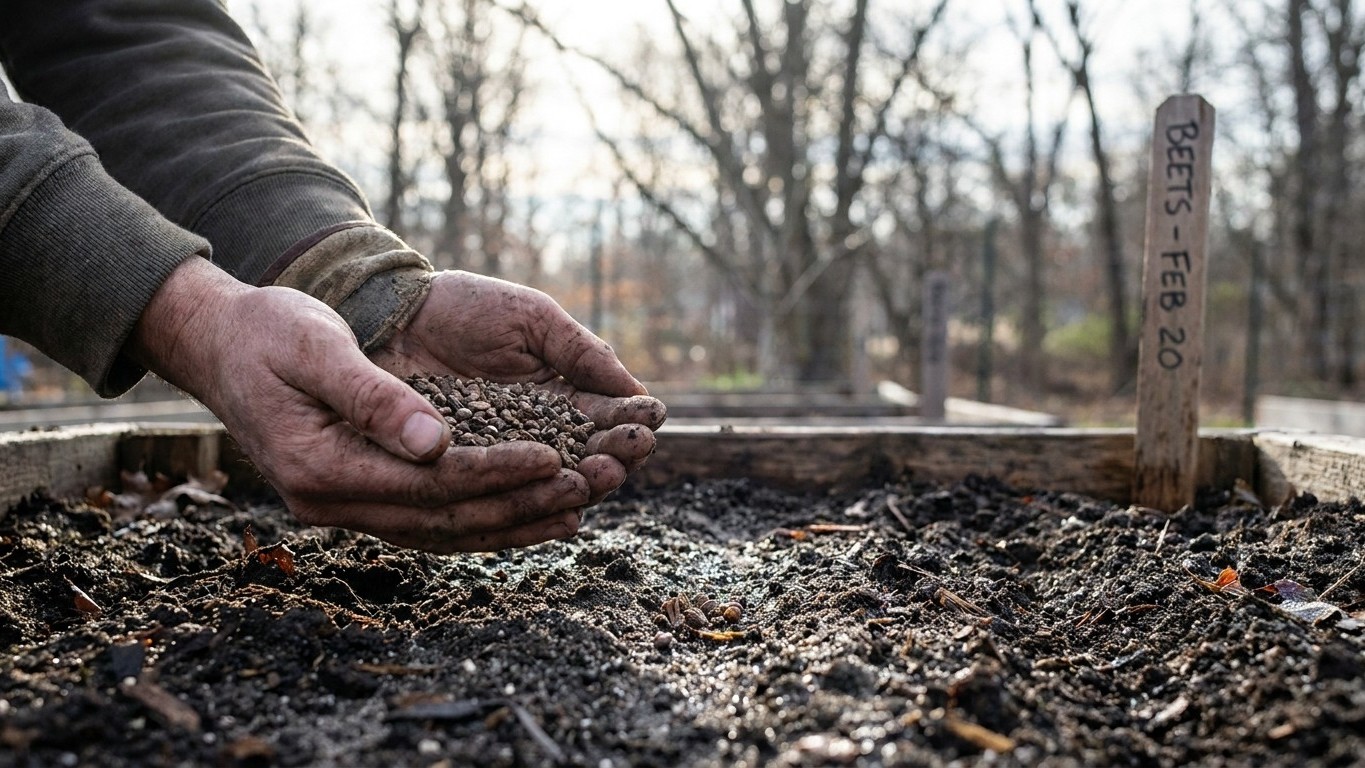

In western Oregon, beets go in the ground roughly two to three weeks before the last spring frost, which at the Portland reference station falls between March 6 and March 21. That puts most sowing dates from late February into early March, though your own yard’s soil and microclimate can shift that by a week or two either way.
The short answer
Oregon’s official state soil, the Jory series, is an Ultisol: old, heavily weathered, naturally acid ground with a surface pH around 5.6. By texture it runs 14 percent sand, 34 percent clay and 52 percent silt, with about 5.0 percent organic matter, and it drains well despite that clay load. Oregon lawmakers named it the state soil in 2011, and USDA NRCS records these figures as representative values for the surface horizon across 119 sampled components of the series.
What does that mean for a beet seed? Beets want deep, sandy, well-drained ground rich in organic matter, according to Utah State University Extension. Jory checks the drainage box but fails the texture test: more than a third clay by weight is a heavier load than a beet root prefers, and that clay fraction can crust over a germinating seed or squeeze a taproot into a forked, stubby shape rather than the long smooth root you want at harvest. The well-drained rating is the saving grace here. It means water moves through rather than sitting and rotting the seed, but it doesn’t soften the clay’s grip on a young root.
The organic matter figure, close to 5 percent, is workable but not generous. Utah State’s guidance caps amendment at 1 inch of composted organic matter per 100 square feet, so there’s a ceiling on how much you can lighten that clay in a single season. Layer it in over a few years rather than trying to fix everything before one planting.
On heat, the specific count of days above 90 F for a reference Oregon city isn’t published in the sources behind this page, so no number appears here. What is documented is the threshold that matters more for beets than any single hot afternoon: once temperatures climb past 85 F while the plant is also short on water, the root turns woody. That combination, heat plus thirst, is the mechanism to watch, not a calendar count of scorching days.
None of this is a verdict on your particular garden. Oregon spans hundreds of soil series, and the Jory profile describes a mapped surface, not a worked garden bed. If your own dirt has more sand, less clay, or an organic-matter reading far above 5 percent (which would actually signal a peaty or forest-litter surface rather than a cultivated bed), your beets will behave differently than this baseline. A basic soil test on your own bed is the only way to know where you actually stand.
The six weeks that decide it here
Sowing two to three weeks ahead of the last frost means the first six weeks of a beet’s life in western Oregon fall somewhere between mid-February and early April, depending on exactly when you plant relative to that March 6 to March 21 window. That stretch is the one Utah State flags as the danger zone for bolting: any real water stress in those first six weeks can push a beet plant to flower prematurely instead of building a root.
West of the Cascades, that early stretch tends to run cool and damp rather than dry, which works in the beet’s favor for this particular failure. A soggy February and a showery early March aren’t usually short on moisture. The risk isn’t zero, though. Western Oregon springs can swing: a run of clear, breezy days in March can dry out the top few inches of a bed fast, especially one built on clay-heavy ground where surface moisture disappears through crusting and cracking rather than slow, even drainage. A gardener who sows into damp soil in late February and then walks away for two weeks during a dry snap is exactly the scenario Utah State’s warning is aimed at.
The practical takeaway is to treat that early moisture as a variable to check, not a given. Because the region usually starts wet, the instinct is to assume the soil will stay wet on its own. It often does. But a dry week inside that six-week window is enough to trigger bolting even if the month as a whole was rainy, so checking soil moisture at the seed depth, not just glancing at the sky, matters more than the regional pattern.
None of this applies past the Cascades. Central and eastern Oregon sit in high desert with a shorter, drier season overall, and the March 6 to March 21 frost window is specific to the Portland-area station. A gardener in Bend or Burns working from that date range would be sowing into a very different spring, and should look at local frost data rather than borrowing the western Oregon figure.
What goes wrong here
- Forked or stunted roots from clay compaction. The Jory series’ 34 percent clay fraction can crust and compact around a young taproot, forcing it to split or stall. Work compost into the top 6 to 8 inches before sowing, keeping to Utah State’s cap of 1 inch per 100 square feet, and avoid tilling the bed while it’s wet, which makes clay compaction worse rather than better.
- Bolting from an early dry spell. A dry stretch inside the first six weeks after sowing, even during an otherwise wet Oregon spring, can trigger premature flowering before a root has formed. Check moisture at seed depth through late February and March rather than assuming regional rainfall is covering it, and water directly if the top few inches have dried out.
- Woody roots from a later hot, dry spell. This is a separate failure from bolting: once beets are established and temperatures push past 85 F, water stress at that stage turns the root fibrous and tough rather than stopping growth outright. Deep, even watering during any hot run, plus a mulch layer to slow evaporation, keeps the root tender through to harvest.
- Slow, uneven germination in cold, wet clay. Sowing purely by calendar date, ignoring how cold and saturated a clay-heavy bed still is in late February, leads to seeds rotting or sitting dormant. Wait until the bed is workable, not muddy, even if that means sowing a few days later than the frost-based target.
- Assuming your garden matches the mapped state soil. The 5.6 pH and 5.0 percent organic matter figures describe the Jory series as mapped, not your bed. A cultivated garden with years of compost added, or one built on fill or river-bottom soil, can read very differently. A soil test is the only way to replace the assumption with an actual number.
Common questions
How many days do beets take to mature from seed in Oregon?
Beets are sown directly in place, not transplanted, and the maturity clock runs from that seeding date. General guidance from Utah State University Extension puts most beet varieties at 60 to 80 days from seed to harvest, though the exact figure depends on the variety and the growing conditions rather than a single fixed number.
Does the Jory soil series mean my beets will struggle in Oregon?
Not necessarily. Jory is the mapped state soil, useful as a general picture of how much of the region’s ground behaves (heavy clay, acid, well drained), but it isn’t a diagnosis of your specific garden bed. Soil that’s been amended for years, or that sits on a different parent material entirely, can be far more hospitable to beets than the raw Jory profile suggests.
Should I sow beets earlier if my soil is sandier than the state average?
Sandier, better-draining soil warms and dries faster in spring, which can let you sow a bit earlier than the frost-based window without the seed sitting cold and wet. It also means you’ll need to watch moisture more closely in that first six weeks, since sandy ground loses water faster than clay and raises the bolting risk if you’re not checking regularly.
Can I fix Jory-type clay soil in one season before sowing beets?
Not fully. Utah State’s amendment guidance caps compost at 1 inch per 100 square feet per application, which improves structure gradually rather than overnight. Treat clay improvement as a multi-season project, adding organic matter each year, rather than something to solve in a single pre-planting pass.