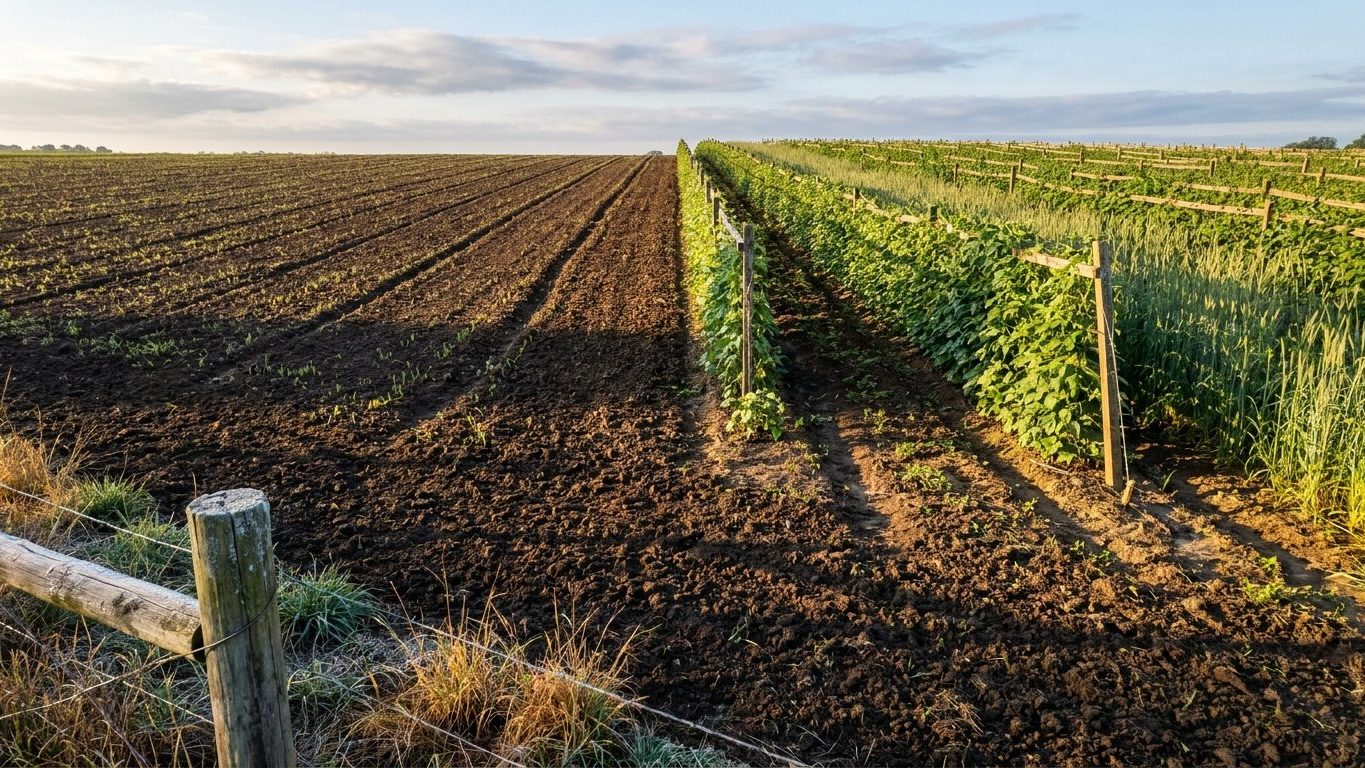

Fall cover crops in western Oregon go into the ground between late August and mid-October, timed to establish before the first fall frost. Spring-sown covers like buckwheat or field peas can follow the last spring freeze, which typically clears by March 21 west of the Cascades. East of the mountains, the window shrinks dramatically, and this page’s numbers do not stretch that far.
The short answer for Oregon
Start with the frost dates themselves, because everything else on this page builds from them. NOAA’s 1991-2020 climate normals put the last spring freeze at the Portland reference station somewhere between March 6 and March 21, and the first fall freeze between November 11 and November 27. Those are not fixed calendar days. They mark the 30 to 70 percent probability band for a 32F freeze, meaning there’s still a real chance of frost on either edge of that window, not a guarantee of safety the day after it closes.
For fall-sown cover crops, that first-frost window is the deadline that matters most. Winter rye, crimson clover, and hairy vetch need roughly four to six weeks of active growth before soil temperatures drop and daylight shortens enough to stall them, so counting backward from November 11 puts the safe sowing cutoff in late September for most of the Willamette Valley. Wait past that and you’re gambling on a mild fall bailing out a crop that hasn’t rooted deep enough to survive winter wet.
Spring sowing works the frost dates from the other direction. Cold-tolerant covers like field peas or oats can go in as soon as soil is workable, sometimes weeks before the March 6 to March 21 band closes, because they tolerate a light frost on emergence. Tender species like buckwheat should wait until the band has fully passed, since a late freeze on the March 21 end of the range will kill seedlings outright.
None of this applies past the Cascades. These frost dates come from a Portland-area station, and Oregon’s high desert regions freeze far earlier in fall and thaw far later in spring. A gardener in Bend or Burns working from this calendar will lose a crop to a frost that arrived a month before this page’s numbers say to expect it.
What will not work here
Warm-season cover crops built for long, hot growing seasons struggle here, and it’s not really about heat extremes. Sorghum-sudangrass and cowpeas, both popular for fast biomass in the Southeast and Midwest, need consistently warm nights to push growth, and western Oregon’s marine air keeps summer nights cool even when afternoons climb. The result is a cover crop that limps along all summer instead of smothering weeds and building the root mass it’s planted for.
Slow-establishing legumes sown too late run into the opposite problem. Hairy vetch and crimson clover both need real time to root before cold slows them down, and pushing sowing into late October, after that four-to-six-week window before the first fall frost has closed, leaves seedlings too shallow to survive a hard freeze. This is the single most common cover crop failure reported by home gardeners west of the Cascades: not a wrong species choice, just a wrong date.
Summer sowing without irrigation is its own trap. Oregon’s Mediterranean climate means the Willamette Valley gets very little rain from June through September, and a cover crop seeded into dry August soil with no supplemental water simply won’t germinate evenly, or will germinate and then die in the first dry stretch. Anyone counting on a quick summer cover between spring and fall vegetable crops needs to plan on watering it in, not on rain showing up.
East of the Cascades, the entire calculus changes because the season itself is shorter. High-desert counties see frost dates that arrive weeks earlier in fall and linger weeks later in spring than the Portland-based numbers here suggest, and a slow cover crop that would finish fine in the valley simply runs out of season before it can do its job. This page’s dates describe west-of-the-Cascades Oregon. Treat them as unreliable anywhere else in the state.
What changes across Oregon
A single hardiness number can’t describe this state, and Oregon proves it better than most. The USDA Plant Hardiness Zone Map puts the state anywhere from 4a to 9b, a spread of five full zones built entirely from average annual extreme minimum temperatures. Zone 4a shows up in high mountain terrain and parts of eastern Oregon, where winters are genuinely harsh. Zone 9b belongs to the mild southern coast, where frost is a rare visitor. Portland, the reference city behind the frost dates on this page, sits closer to the milder end of that range.
That gap matters for timing, not just for which species survive. A gardener working at higher elevation, or well east of the Cascades, should expect both frost dates to move: the last spring freeze arriving later than mid-March, the first fall freeze arriving earlier than mid-November. That compresses the entire fall planting window, sometimes by three or four weeks, which is enough to turn a cover crop that would have established fine in the valley into one that gets caught by an early freeze before it’s rooted.
Coastal and low-valley locations, by contrast, often have room to push sowing later into fall and still beat the frost, since the maritime influence that keeps summers cool also keeps early winter mild. The coldest-month mean minimum of 36.2F recorded at the Portland station reflects that moderating effect. This is a mean daily minimum, not a record low, and it’s the number that actually decides whether a cover crop’s roots survive winter here, but it describes conditions closer to the coast and lower valley, not the mountains or the high desert.
Because the spread runs the full 4a to 9b range, there’s no single sowing date that covers Oregon honestly. Anyone unsure which end of that range their own property falls into should check the USDA hardiness zone map directly rather than guess from a regional description.
Where to check this for your own county
Oregon State University Extension is the source built for the next step down from this page, and it’s worth using it as exactly that. The service runs at https://extension.oregonstate.edu/, and it publishes county-level planting guidance that accounts for elevation, coastal influence, and local microclimate in ways a statewide article can’t.
Two things are worth hunting for once there. The first is a local planting calendar for the specific county, since OSU Extension offices maintain guidance tuned to their own service area rather than the state as a whole, and that calendar will reflect real frost data from a station much closer to the actual garden than the Portland reference figures used here. The second is variety trial information. Extension offices frequently test cover crop species and cultivars under local conditions and report which ones actually performed, which matters more than a general species recommendation when winters, rainfall, and soil type vary as much as they do across Oregon’s counties.
A county-level recommendation will always beat a state-level one, and that’s worth saying plainly rather than glossing over. This page works from frost dates tied to a single Portland station and a hardiness range that spans five zones, which makes it useful for understanding the mechanics of timing but not a substitute for a number pulled from a weather station down the road. Anyone gardening in the Rogue Valley, the high desert, or the coast is working with a genuinely different climate than the one behind these figures, and the county extension office is where that difference gets accounted for.
Checking this against your own garden
Calendar dates are a starting estimate, and the garden itself will always correct them. Three things worth watching tell you more than any frost date on this page.
Soil warmth by hand is the simplest check. Push a finger a couple inches into the bed in early spring; if it feels cold and damp rather than cool and slightly dry, the soil hasn’t warmed enough yet for buckwheat or other tender covers to germinate reliably, whatever the calendar says about the last frost having passed.
Germination speed of the cover crop seed itself is the second signal. Winter rye or clover that sprouts within about a week of sowing is going into soil that’s genuinely ready. Seed that sits for two weeks without emerging is a sign the soil is colder than it looks, often the case in low-lying spots or heavy clay that holds cold longer than the surrounding garden.
The third is watching for a weed flush. Once winter annual weeds start germinating on their own in a bed, it’s a reliable sign the soil has warmed and softened enough for a fall or spring cover crop to take hold too. A garden that’s been sitting bare and weed-free through a mild stretch is often colder at root depth than the air temperature suggests, and that’s the detail a thermometer reading of the air can’t catch but a look at the ground can. The single date to write down from all of this is late September, the practical cutoff for fall sowing west of the Cascades, but the soil in front of you should always get the final vote.