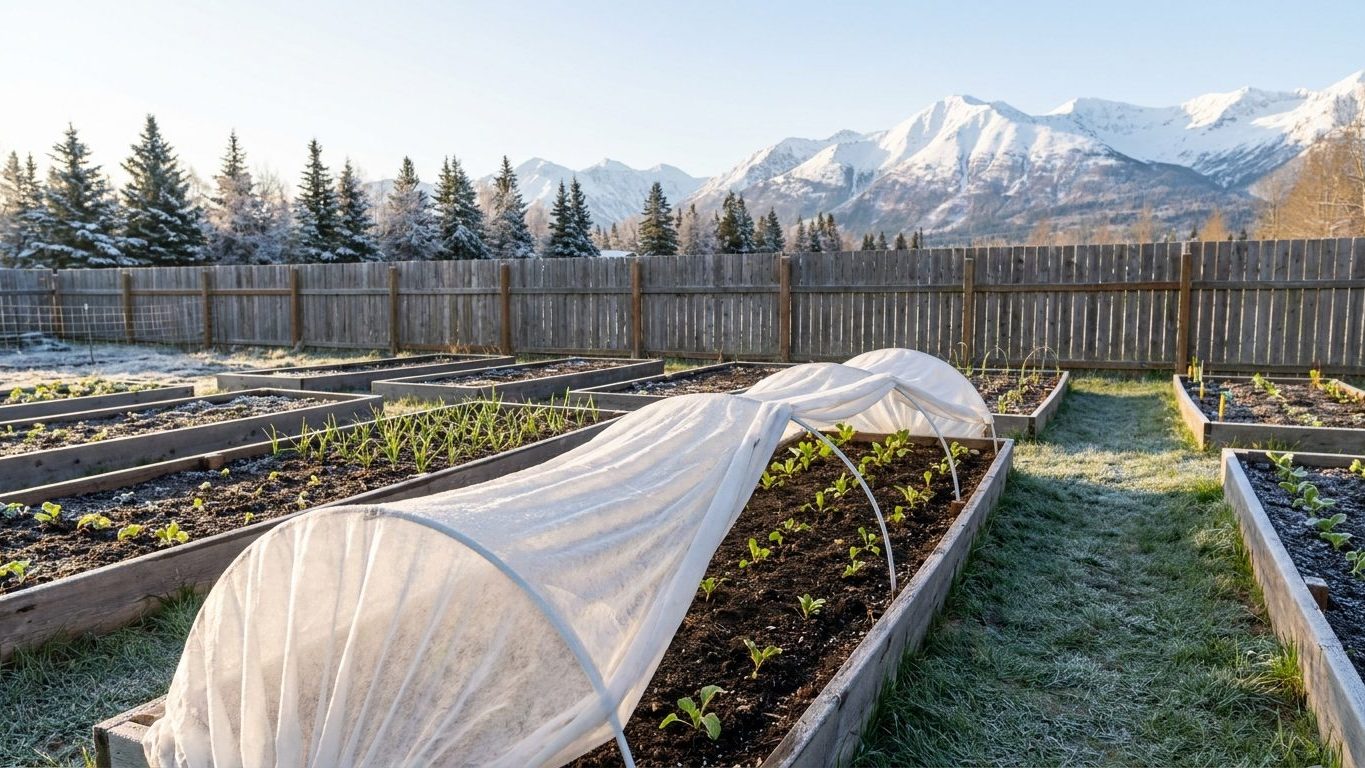

Near Portland, cover tender plants on any night the forecast dips to 32°F. That applies from the first spring plantings through late March, and again from early November on. East of the Cascades the calendar shifts a long way, so the overnight forecast and the plants in your beds matter more than any single date.
The short answer for Oregon
Cover the garden when two things line up: a forecast low at or near freezing, and something tender in the ground. Hardy crops such as kale, leeks, and garlic shrug off most freezes, and a night at 32°F means nothing to them. Tomato transplants, peppers, basil, and squash seedlings are different, and one frosty night can finish them.
The dates behind this advice come from NOAA’s 1991-2020 climate normals for the Portland station. The last spring frost falls between March 6 and March 21. That window is the stretch where the odds of another 32°F freeze sit between 30 and 70 percent. The first fall frost falls between November 11 and November 27, using the same 30-to-70-percent band for the first freeze of the season. Both are middle-of-the-road odds, so a cold year can bring a freeze before the early date or after the late one.
When should you cover plants in spring?
Cover from the day tender transplants go in until the March window has clearly passed. Even at the late edge, around March 21, the odds of a freeze are still near 30 percent, roughly one spring in three. Keep the cloth folded at the end of the bed for a few weeks after that, then put it on whenever a clear, still night is forecast.
When should you cover plants in fall?
Start watching the forecast in late October. A freeze by November 11 happens in about three autumns out of ten, and by November 27 it has happened in about seven out of ten. Peppers and basil complain about cold nights before the first freeze arrives, so cover those earlier than the calendar suggests.
The coldest month at the Portland station has an average overnight low of 36.2°F, which is above freezing. That is why winter greens and garlic can sit through winter under light cover, and why protection matters most on the clear nights that run well below average.
What will not work here
The biggest failure is carrying Portland’s dates to the other side of the mountains. Central and eastern Oregon are high desert with a far shorter season, so both the spring and fall windows above sit in the wrong place there. A gardener in the high desert who waits for March 21 to uncover, or for November 11 to start covering, will lose plants.
Waiting for the fall date is a smaller version of the same mistake, even near Portland. Those dates mark the middle of the odds, and a freeze before November 11 turns up in a meaningful share of years. Treat the date as the start of nightly forecast-checking, with a cover decision made on the day.
Reading 36.2°F as a safe winter number also backfires. It is an average of all nights, and clear, calm nights drop several degrees below it. A bed that sits fine through a cloudy week can take a hit on the first cold, starry night.
Sealed plastic is another trap. West of the Cascades, winters are damp, and a closed tunnel holds humidity around the leaves. Plastic that lies directly on foliage stays wet, which invites gray mold. On a sunny day in the 50s, an unvented tunnel can also overheat. Cloth or a vented hoop with space above the plants avoids both problems, and the choice of material is covered in Which Season Extenders Work in Oregon.
Finally, cover cannot add daylight. Portland sits at 45.59 degrees north, and winter days there are short. Seeds sown under cover in late fall sit nearly still through December and January, because light limits growth, not cold. Crops need to be near full size before the shortest days arrive. After that, cover only holds them in place for harvest.
What changes across Oregon
Oregon spans USDA hardiness zones 4a through 9b on the 2023 USDA Plant Hardiness Zone Map. That is a wide spread of winter cold, so no single cover date fits the state. The zone system rests on one variable, the average annual extreme minimum temperature. It tells you which perennials survive, but it does not give you a frost date.
The Portland figures belong to Portland and the Willamette Valley floor. Readers at altitude, in the Cascade foothills, or in the high desert should expect a later last spring frost and an earlier first fall frost. For them, covering starts sooner in autumn and runs later into spring, and the cloth stays in use for more of the year. Crops that tolerate cold, such as spinach, peas, and carrots, are the safer bet there. Tomatoes and peppers need more help, and sometimes a heated or well-sealed structure.
Latitude shifts the picture too. The 45.59 degrees north figure is Portland’s, not the state’s. Day length at the northern border differs from the southern one, and day length controls bulbing in onions and slows winter growth. A reader near the edge of the state should look up their own latitude before borrowing Portland’s timing.
To find your own zone, use the USDA Plant Hardiness Zone Map and enter your ZIP code. Then compare it to the 4a-9b spread. Neighbors a few miles apart can fall in different zones when there is a ridge, a river canyon, or a change in elevation between them.
Where to check this for your own county
Oregon State University Extension is the state’s land-grant extension service. Start there for local advice. County offices employ horticulture staff and often run Master Gardener programs that know the micro-patterns of the area, such as which valley floors collect cold air.
Two things are worth looking for. The first is a planting calendar for your county, which will give frost dates and sowing windows closer to your actual elevation than a Portland-based estimate. The second is a list of varieties trialed locally. A variety that performs well in a trial a few miles away is a better bet than one that was bred for a different climate.
A county recommendation beats a state one, because the state covers a mountain range, a coast, a valley, and a desert. The guidance in this article is the state-level view, built from one reference city. Use it to understand the logic of covering, then let the county calendar set the dates. The broader picture of how cover fits into a full season is in Extending the Growing Season in Oregon.
Checking this against your own garden
Your own observations outrank every date above. A garden by a south-facing wall, one at the bottom of a slope, and one on an exposed hilltop can run on different schedules. Three things are worth watching, and none needs a gadget.
- Soil warmth by feel. Push your hand a few inches into the bed in the morning. If it feels cold and damp, warm-season transplants will stall, and cover for another week or two helps. Beds that warm early tell you the spot is sheltered and drains well.
- The first male flowers on squash. Squash plants open male blooms before female ones. When they show up, the plant has found enough warmth to settle in. If they appear much later than your neighbors’, your microclimate runs cool.
- First true leaves on seedlings. The first pair are seed leaves. The next pair, the true leaves, show the plant is establishing. Seedlings that hold at the seed-leaf stage under cover are short on light or warmth.
Check frost on the grass or on car windows in the morning as well. If the low corner of your yard is white while the bed near the house is clear, that difference is your cover zone, and it will not be on any map.
Common questions
Do I need to cover plants if the forecast says 34°F?
For tender plants, yes, when the night is clear and still. Forecasts are for the general area, and low spots in a garden often run colder than the official number. Hardy greens will be fine without cover at 34°F.
When should I take the cover off in the morning?
Remove it once temperatures have climbed above freezing and the sun is on the bed, usually mid-morning. Plastic needs earlier venting, since sunlight heats it fast. Cloth can stay a bit longer.
Can I cover too early in fall?
Covering on a mild evening does little harm if the cloth breathes. Sealed plastic left on through warm, damp spells is the risk, since trapped humidity encourages mold. Vent whenever days turn mild.
Do these dates work for eastern Oregon?
They do not. The March and November windows come from Portland, which sits west of the Cascades. Central and eastern Oregon have a much shorter season, so check with your county extension office for local frost dates.