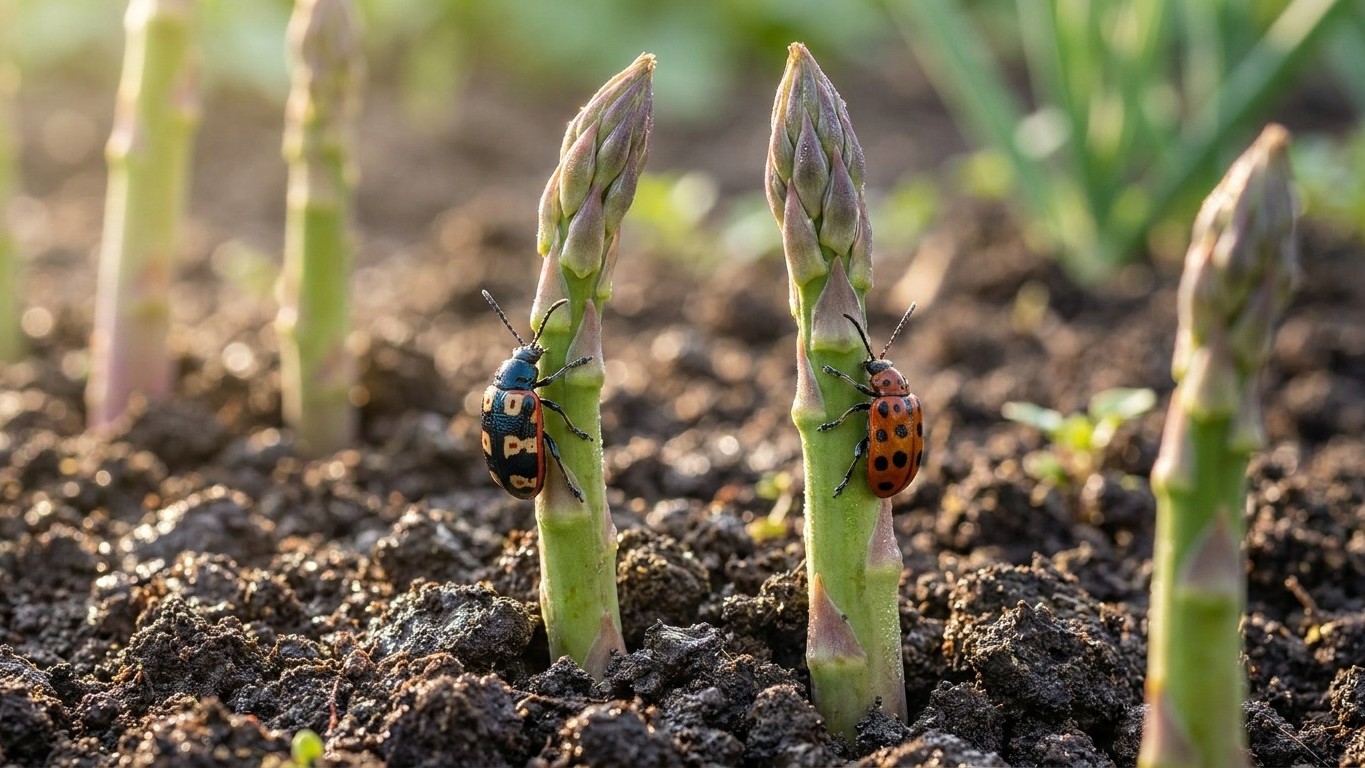

Asparagus gets eaten at three moments: the spears in spring, the ferns through summer, and the crown underground all year. The feeder changes with the stage, and which species is active depends on the county. A symptom on the plant is the starting point. Matching it to an insect takes a sample, a photo and a call to the extension office.
Which pests attack asparagus in Massachusetts
Massachusetts extension specialists sort asparagus trouble by the part of the plant being eaten: the spears, the ferns, or the crown below ground. Species lists for the state are kept by the state extension service and its county offices. The list a gardener actually needs is the short one for their own town, and only an extension office can supply it.
Spear feeders chew the tips or scar the skin of spears as they come up. Fern feeders strip the feathery top growth or suck sap from it, leaving a speckled, pale look. Crown feeders work out of sight, and the only sign is a bed that sends up fewer, thinner spears each spring.
Some pests on state alert lists belong off an asparagus page entirely. Borers and leaf-eaters of shade trees and orchard trees feed on woody tissue and tree foliage, and asparagus is neither. Hunting for them in a fern bed wastes an afternoon and sends the gardener toward the wrong treatment.
Timing makes the damage matter. Asparagus goes in as crowns, set in 8-inch furrows in early spring, and nothing is harvested until year 3. After that the bed produces for 10-15 years. Ferns eaten in the first two seasons cost the crown the food it needs to carry a bed that long. A pest that would be a nuisance on a lettuce row can set an asparagus planting back for good.
When each one shows up, and what it does first
The calendar follows the freeze window, and the window moves with the site. At the Boston reference station (Logan), the mean last spring freeze falls between April 1 and April 8. Logan is a waterfront urban station and the mildest spot in the state. Inland suburbs and the Berkshires freeze later in spring, so everything below shifts later with them. The planting-time guide for asparagus crowns in Massachusetts covers how to set that start date.
Spring: spears breaking the soil
The first sign is on the spear itself. Look for tips that are ragged or nibbled, a rough scarred patch on the skin, or a spear that bends and stunts. Spears that appear before the freeze window closes can also be hit by cold, which looks different (see the next section). Cut spears regularly, because spears left standing give feeders a place to stay.
Summer: the fern stage
Once spears are allowed to open into ferns, the symptom changes. Look for bare stems where the feathery foliage was, patches stripped to the branch, or ferns that go pale and finely speckled. Summer in the state brings about 10.4 inches of rain over June, July and August, with August the driest month at 3.23 inches. A dry August stresses ferns, and stressed ferns are the first to look chewed.
The end-of-harvest rule is a spear: stop picking when most spears come up thinner than a pencil, then let the ferns grow. That stage is when fern feeders do their work.
Late season: the crown
Crown damage shows next spring, not in the season it happens. A bed that was thick last year and sends up thin, scattered spears has lost vigor underground. The cause could be feeders, but it could also be water or drainage trouble, which is why a diagnosis starts with the soil.
Telling the damage apart from everything else
Plenty of things mimic insect damage. Cold, drought, a hoe blade and a nutrient shortfall can all produce a spear or fern that looks eaten. The pattern across the bed settles more than the single plant does. Damage that follows the weather across the whole row points away from insects, and damage that jumps from plant to plant points toward them.
| What you see | Possible cause | What settles it |
|---|---|---|
| Ragged tips, scarred skin, bare fern stems | Insect feeding | Insects, droppings or fresh chew marks on the plant; damage scattered, not uniform |
| Water-soaked, limp tips after a cold night | Frost on emerged spears | Same height across the row, worst in low spots, follows a freeze |
| Yellowing, drooping ferns in late summer | Water shortage | Dig a few inches down: dry soil on a sandy site, which drains fast, points to this |
| Pale, thin ferns across the whole bed | Nutrient shortfall | A soil test from the extension office |
| Clean cuts or snapped spears near the soil line | Mechanical damage | Straight edges, tool marks, damage along paths or edges |
| Spots or sunken lesions on stems | Disease | A sample examined at an extension diagnostic lab |
Cold deserves a second look. Spears frozen on the plant go water-soaked and then collapse, and spears frozen in the refrigerator do the same. Fridge freezing happens at or below 30.9°F. Stored spears hold best at 32 to 35°F, in near-saturated air, with the cut ends standing in water. Above 50°F they toughen within hours.
None of this tells a gardener what their own bed has. It narrows the field. A sample bag and a photo take it the rest of the way at the county office.
What actually works here, and what is a waste of time
On a short northern season, timing does more than a spray. A physical barrier set before the feeding starts, such as row cover over a new bed’s first ferns, keeps insects off at the one stage when they do the most harm. Regular cutting during harvest removes spears before feeders settle in. Walk the bed often enough to catch a problem while it is a few plants, not a whole row.
Water matters in a dry August. The state’s representative soil, the Paxton series, is well drained and sandy: 61 percent sand, 7 percent clay and 32 percent silt. A sandy surface lets rain through within the day, so even a summer with 10.4 inches of rain can leave ferns thirsty. A rain gauge on the plot tells you what actually fell. Good drainage is also what keeps an asparagus bed alive for fifteen years, and the soil and drainage guide for Massachusetts asparagus beds covers whether a particular yard qualifies. That series represents the state, not every yard in it, so a soil test gives the real number.
Furrows are filled in gradually, never all at once. A bed that grows well is a bed that outlasts most feeding damage.
Several habits waste time. Spraying without knowing the cause treats a drought or a frost as if it were an insect. Cutting back ferns early, or harvesting past the pencil-thin point, starves the crown and invites more trouble. Tree-pest advice does not carry over to the bed. Which products are registered in Massachusetts, and at what rate, is a question for the extension service, because that office alone knows what is currently approved in the state. Identify first, treat second.
Where to check this for your own county
The Massachusetts extension service runs a county office that handles garden problems, with staff who identify insects from photos and samples and read soil tests. That office is the right place for the question this article leaves open: what is feeding on asparagus in your part of the state.
Presence varies inside the state. A pest recorded in one county may be absent three towns over, and a statewide record does not say what is in a given garden. Frost and soil vary the same way. Logan’s April 1 to April 8 freeze window is the coastal mildest case, so inland suburbs and the Berkshires start later and face a different set of feeders at different times. The Paxton figures describe a typical mapped surface, and river bottoms, hill country and ground a builder scraped or filled may behave differently.
For the broader picture of growing the crop, see the complete guide to growing asparagus in Massachusetts. When you contact the county office, bring photos, a sealed sample and a note of the date and the pattern, whether it covers the whole row or only a few plants. Add the age of the bed, since a first-year bed and a five-year bed face different stakes. That package gets a real answer the same day you drop it off.
Common questions
Can I harvest asparagus in the first or second year?
No. Nothing is harvested until year 3. Early picking removes the ferns the crown needs to feed itself.
When do I stop picking each season?
Stop when most spears come up thinner than a pencil. After that, let the ferns grow through summer.
Why are my spears limp and water-soaked?
Cold is a common cause, in the garden after a freeze and in the fridge at or below 30.9°F. Insects rarely produce that look. Compare the pattern across the bed, then ask the county extension office.
Does Boston’s frost date apply to my yard?
Only near the coast. Logan’s mean last spring freeze falls between April 1 and April 8, the mildest in the state. Inland suburbs and the Berkshires freeze later in spring, so spear emergence and the first feeding come later too.