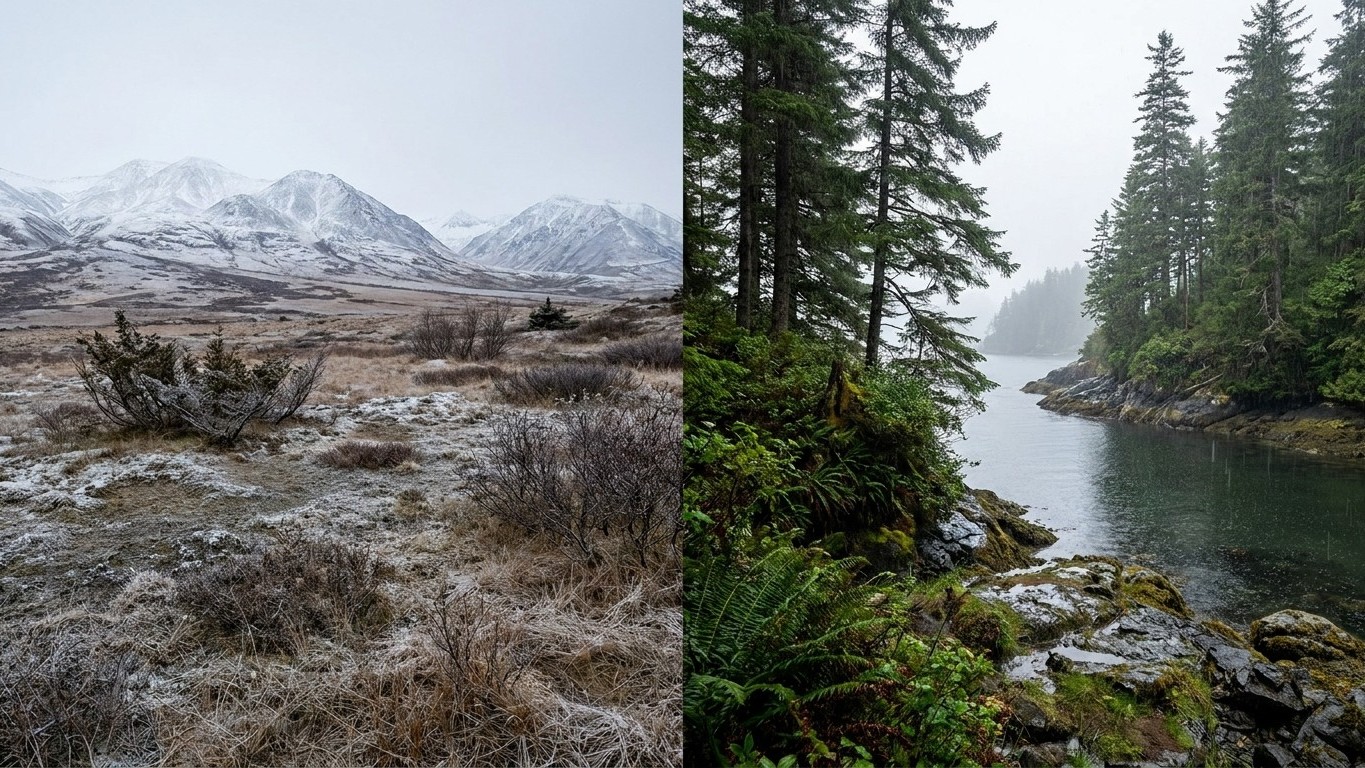

Oregon’s hardiness range stretches from USDA zone 4a in the high desert around Bend to 9b along the southern coast, and that spread decides almost everything on a plant tag. Of the 65 Trees, Shrubs and Perennials tracked on this site, zero fail across the entire state. But 40 fail in part of it, and which part depends entirely on where a reader gardens.
What will not survive a winter in Oregon

The USDA Plant Hardiness Zone Map, built on one measurement (the average annual extreme minimum temperature), places Oregon across a full six-and-a-half zones: 4a to 9b. That’s an unusually wide band for a single state, wider than most of the territories this site covers, and it’s the reason a plant list built for “Oregon” has to do more work than one built for a single-zone state.
Here’s the plain answer to the question this section exists to settle: none of the 65 plants documented on this site fail across the whole of Oregon’s range. Every one of them survives the winter somewhere in the state. That’s a different claim than saying every plant suits every garden here, and it’s worth separating the two. “Hardy” describes survival at the cold end of a plant’s range. It says nothing about whether that same plant is comfortable at the state’s warm end, where the limiting factor often flips from cold to heat. A shrub rated hardy into zone 9 has cleared a cold-tolerance bar, not a heat-comfort one, and gardeners on the warm side of Oregon sometimes find a “hardy” plant sulking through a long dry summer for reasons that have nothing to do with frost.
Because nothing on this list fails outright, the real work of choosing plants in Oregon happens one tier down, in the group that’s hardy across part of the state’s zone range but not all of it. That’s the next section, and it’s the one that actually matters for most Oregon gardens, because a reader in Bend and a reader on the coast are, in USDA terms, gardening in different climates under the same state name.
The plants that work in part of the state and not the rest
Forty of the 65 plants this site documents are hardy somewhere in Oregon’s 4a-9b range but not everywhere in it. The facts don’t say why a given plant drops out at one end or the other, only where it does, so the table below groups them by that location rather than by any assumed cause.
Cold-end and warm-end failures
| Plant | Type | Not hardy in | Where the gap falls |
|---|---|---|---|
| Asimina triloba | fruit | 4a, 4b | cold end |
| Ficus carica | fruit | 4a-6b | cold end |
| Fragaria virginiana | fruit | 4a, 4b | cold end |
| Fragaria x ananassa | fruit | 4a, 4b | cold end |
| Prunus persica | fruit | 4a, 4b | cold end |
| Lavandula angustifolia | perennial | 4a, 4b | cold end |
| Itea virginica | shrub | 4a, 4b | cold end |
| Cornus florida | tree | 4a, 4b | cold end |
| Liquidambar styraciflua | tree | 4a, 4b | cold end |
| Hydrangea macrophylla | shrub | 4a-5b | cold end |
| Lagerstroemia indica | tree | 4a-5b | cold end |
| Magnolia grandiflora | tree | 4a-5b | cold end |
| Aronia melanocarpa | fruit | 9a, 9b | warm end |
| Prunus avium | fruit | 9a, 9b | warm end |
| Pyrus communis | fruit | 9a, 9b | warm end |
| Rubus idaeus | fruit | 9a, 9b | warm end |
| Rubus occidentalis | fruit | 9a, 9b | warm end |
| Sambucus canadensis | fruit | 9a, 9b | warm end |
| Vaccinium angustifolium | fruit | 9a, 9b | warm end |
| Vaccinium corymbosum | fruit | 9a, 9b | warm end |
| Echinacea purpurea | perennial | 9a, 9b | warm end |
| Iris sibirica | perennial | 9a, 9b | warm end |
| Phlox paniculata | perennial | 9a, 9b | warm end |
| Salvia nemorosa | perennial | 9a, 9b | warm end |
| Hydrangea paniculata | shrub | 9a, 9b | warm end |
| Physocarpus opulifolius | shrub | 9a, 9b | warm end |
| Spiraea japonica | shrub | 9a, 9b | warm end |
| Viburnum dentatum | shrub | 9a, 9b | warm end |
| Acer saccharum | tree | 9a, 9b | warm end |
| Pinus strobus | tree | 9a, 9b | warm end |
| Quercus rubra | tree | 9a, 9b | warm end |
| Tilia americana | tree | 9a, 9b | warm end |
| Syringa vulgaris | shrub | 7b-9b | warm end |
| Weigela florida | shrub | 7a, 7b, 9a, 9b | warm end |
| Amelanchier canadensis | tree | 8b, 9a, 9b | warm end |
| Picea abies | tree | 8a-9b | warm end |
| Thuja occidentalis | tree | 8a-9b | warm end |
| Amsonia hubrichtii | perennial | 4a, 4b, 9a, 9b | both ends |
| Buxus sempervirens | shrub | 4a, 4b, 9a, 9b | both ends |
| Fothergilla gardenii | shrub | 4a, 4b, 9a, 9b | both ends |
Twelve of these drop out at the cold end, which in practice means the high desert around Bend and the Blue Mountain country. Twenty-five drop out at the warm end, meaning the mild valleys and southern coast. Three lose ground at both ends and only really work in the middle zones. To find which of those three groups applies, a reader needs their own USDA zone first, not the state’s range, and this site’s insulation guide for Oregon carries the county-level zone picture that answers that.
The soil and the summer they will be planted into
Oregon’s official state soil is the Jory series, an Ultisol: old, heavily weathered, naturally acid, and low in nutrients at the surface, with a pH around 5.6. It runs clayey (34 percent clay, 52 percent silt, just 14 percent sand) with organic matter around 5.0 percent, and it’s classified well drained despite that clay content. For a woody plant, drainage is the detail that matters most. Winter wet, not winter cold, is what actually kills more perennials and shrubs in a mild-winter state like Oregon, because roots sitting in saturated clay through a wet season rot before a frost ever gets the chance to do damage. A clay-heavy, well-drained soil like Jory is a reasonable starting assumption for the state, but it’s a representative value from mapped survey components, not a reading from any one backyard; a builder-scraped lot or a river-bottom garden can behave nothing like it, which is exactly what a home soil test settles.
Summer rainfall backs up why drainage matters more than irrigation math here. Oregon averages about 2.7 inches of rain across June, July and August combined, with July the driest month at just 0.51 inches and August close behind at 0.54. That’s a dry summer by national standards, but the figure doesn’t translate directly into a watering plan, because the same 2.7 inches behaves completely differently depending on what it lands on. On a sandy surface, that rain drains through within a day and a plant is effectively on its own by midsummer. On the clay-heavy Jory-type soil that represents much of the state, moisture lingers longer near the surface, which can buy a young plant a few extra dry days before it needs help. Neither of those facts turns into a schedule on its own; both point to the same practical step, which is checking what’s actually happening a few inches down in a given bed rather than watering by the calendar.
When to plant, here
Oregon’s average last spring frost falls between March 6 and March 21, and the average first fall frost lands between November 11 and November 27, based on the 30-70 percent freeze-probability band at the reference weather station. Those two windows aren’t just calendar markers; they frame how much time a newly planted tree or shrub gets to build roots before it’s asked to either leaf out or sit through a hard freeze.
| Window | Best suited to | Main risk |
|---|---|---|
| Spring (after March 6-21) | Plants that need a full growing season to establish before their first winter, and anything borderline for the local zone | A late frost can still hit newly planted stock before the average date arrives |
| Autumn (before November 11-27) | Most trees and shrubs, since cooling soil and lower demand for leaf growth favor root establishment | Less time to root out before winter arrives, especially at the state’s colder end |
Fall planting generally gives a woody plant a head start, because the tree spends the cool months building roots instead of feeding leaves, and it meets spring already partly established. But that logic weakens toward the cold end of Oregon’s range. In the high desert around Bend, working in zone 4a-4b territory, the gap between the average first frost and true hard winter is much shorter than it is west of the Cascades, leaving less margin for roots to take hold before the ground locks up. And these dates are averages built from a single reference station over three decades; they describe what usually happens, not a guarantee for any given year or any specific property. Whatever a plant’s mature drought tolerance is rated, that rating assumes an established root system. A first-season planting, spring or fall, still needs regular water regardless of what the tag says about the same plant once it’s settled in.
Where to read about each one
The 25 plants hardy across the whole of Oregon’s range are the safest starting list for any garden in the state, whatever zone it falls in. Among the trees: Acer rubrum, Betula nigra, Carpinus caroliniana, Cercis canadensis, Ginkgo biloba, Juniperus virginiana, Nyssa sylvatica, Platanus occidentalis and Quercus alba, alongside fruiting trees Diospyros virginiana, Morus rubra and Prunus domestica. Among the shrubs: Aronia arbutifolia, Clethra alnifolia, Ilex glabra, Ilex verticillata and Kalmia latifolia. And among the perennials: Achillea millefolium, Asclepias tuberosa, Baptisia australis, Anacis verticillata, Heuchera americana, Monarda didyma, Rudbeckia fulgida and Hylotelephium spectabile.
The other 40, listed in the table above, still have a place in an Oregon garden, just not in every part of it. A reader gardening in the middle zones, roughly 5a through 8b, has the widest access to that second group, since most of the failures cluster at the cold or warm extremes of the state’s range rather than the middle. Each of these plants, in both groups, has its own profile page on this site with the specifics that don’t fit into a state-level comparison: mature size, bloom timing, light needs.
All of the hardiness figures used across this page come from the North Carolina Extension Gardener Plant Toolbox, a university extension plant database, crossed against Oregon’s own 4a-9b USDA range. That’s a separate dataset from the apple variety adaptation zones referenced elsewhere on this site; those describe fruit variety adaptation ranges, not woody-plant winter hardiness, and the two shouldn’t be read as the same measurement.