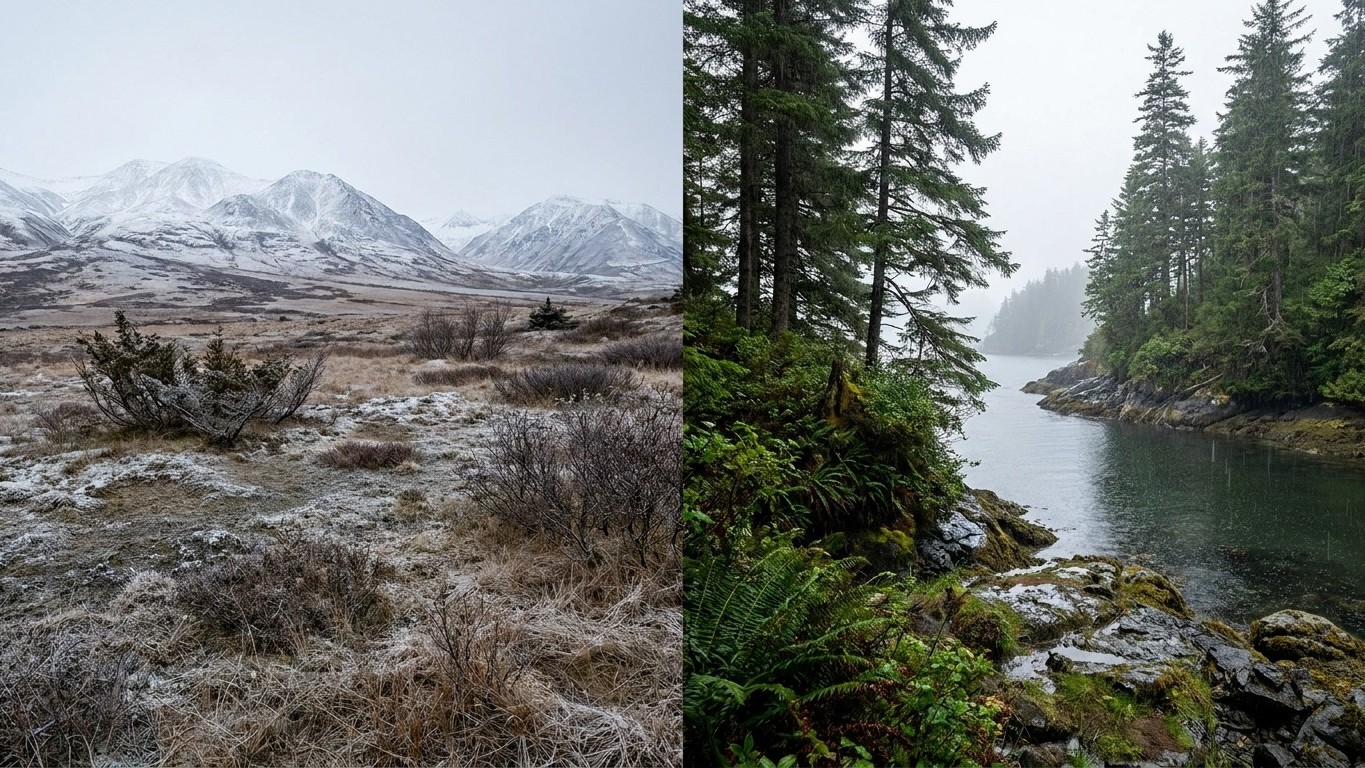

Idaho’s growing conditions run from USDA zone 3b in the highest mountain valleys to zone 7b along the warmest stretches near the Snake River, a span wide enough that almost nothing fails across the whole state. Of the 65 Trees, Shrubs and Perennials this site tracks, 29 survive everywhere in Idaho, 36 survive in only part of it, and none survive nowhere. The real question isn’t whether a plant is hardy here. It’s where.
What will not survive a winter in Idaho

Idaho’s hardiness range, under the USDA Plant Hardiness Zone Map’s 2023 update, stretches from zone 3b to zone 7b. That’s one of the wider spans held by any single state on this site, and it explains why the count above lands the way it does: of the 65 species crossed against that range, not one fails everywhere. Zero.
That zero is worth a second look before it reads as a blanket green light. A hardiness rating is built on a single measurement, the average annual extreme minimum temperature a plant is known to survive. It says nothing about comfort, only survival. The warm end of a range, the 7a-7b territory that covers Idaho’s lowest valleys, is often a heat limit rather than a cold one. A plant rated hardy from zone 3 up through zone 7 can technically “survive” a hot, dry Boise-area summer while still struggling with it, because the rating never measured heat tolerance in the first place.
The other reason nothing outright fails is less interesting than it sounds: the 65 species this site documents were already chosen as reasonable candidates for temperate North American landscapes, not pulled at random from every plant on the planet. Species that would have failed outright, tropical or subtropical stock with no cold tolerance at all, never made the list to begin with. Among the ones that did, the real split in Idaho isn’t between plants that live and plants that die. It’s between plants that cover the entire 3b-7b spread and plants that only cover part of it, which turns out to be the far more common story here.
The plants that work in part of the state and not the rest
Thirty-six of the 65 plants this site tracks are hardy in only part of Idaho’s range, and the pattern leans hard in one direction: almost all of them drop out at the cold end, in zone 3b and sometimes 4a and 4b as well. A gardener working a high mountain valley or a cold Panhandle pocket has a shorter list to choose from than someone gardening in the Boise area or along the lower Snake River, where the full 3b-7b spread is represented.
Only two plants run into the opposite problem. Common lilac (Syringa vulgaris) covers everything except zone 7b, and Weigela florida fails at both ends of the state’s range, missing 3b on the cold side and 7a-7b on the warm side.
| Where it fails in Idaho | Hardy in Idaho from zone | Plants |
|---|---|---|
| Coldest valleys only (3b) | 4a-7b | Diospyros virginiana, Morus rubra, Prunus domestica, Pyrus communis, Rubus idaeus, Rubus occidentalis, Sambucus canadensis, Heuchera americana, Monarda didyma, Phlox paniculata, Salvia nemorosa, Hylotelephium spectabile, Ilex glabra, Kalmia latifolia, Betula nigra, Cercis canadensis, Nyssa sylvatica, Platanus occidentalis, Quercus rubra |
| Cold zones, 3b through 4b | 5a-7b | Asimina triloba, Fragaria virginiana, Fragaria x ananassa, Prunus persica, Amsonia hubrichtii, Lavandula angustifolia, Buxus sempervirens, Fothergilla gardenii, Itea virginica, Cornus florida, Liquidambar styraciflua |
| Cold and mid-elevation zones, 3b through 5b | 6a-7b | Hydrangea macrophylla, Lagerstroemia indica, Magnolia grandiflora |
| Everything but the warmest valleys, 3b through 6b | 7a-7b | Ficus carica |
| Warmest zone only (7b) | 3b-7a | Syringa vulgaris |
| Both extremes, 3b and 7a-7b | 4a-6b | Weigela florida |
Finding out which of these zones covers your own address means finding your own USDA zone within Idaho’s 3b-7b spread, which varies by county and by elevation inside a county. Idaho’s insulation page on this site carries the county-level zone picture that pins that down.
The soil and the summer they will be planted into
Idaho’s representative surface soil, the Threebear series, is an Andisol built from volcanic ash: light, porous, and unusually good at holding both water and phosphorus, with a texture around 35 percent sand, 15 percent clay and 50 percent silt. It’s classed as moderately well drained. For a woody plant, drainage matters more than winter cold ever will, since soggy roots kill more shrubs and trees than a hard freeze does. A porous, ash-derived soil like this one tends to shed excess water reasonably well while still holding onto moisture between rains, which is a favorable starting point for planting a tree or shrub, though the strongly acid surface pH, around 5.0, will suit some species better than others and is worth confirming with a soil test rather than assumed from a statewide average.
None of that describes any one garden, though. The Threebear series is what USDA lists as representative of Idaho, not a measurement of a particular yard. River bottoms, hill country, and any lot a builder has graded or filled will differ, sometimes completely.
Summer rainfall across the state’s reference station averages about 1.1 inches total for June, July and August combined, out of 11.5 inches for the year. August is the driest month at just 0.17 inches. That figure never reads alone. The same 1.1 inches behaves differently depending on what it lands on: a sandy surface lets it drain through within a day, while a clay-heavy one holds it for a week. Idaho’s silt-dominant surface soil sits between those extremes, holding moisture longer than sand would but still classed as only moderately well drained, so a summer with almost no rain in it puts real pressure on a newly planted tree or shrub regardless of how the soil is built. A rain gauge on the actual planting site, not the statewide normal, is what settles how dry a given summer actually runs.
When to plant, here
At the reference station used for these normals, the last spring frost falls between April 23 and May 7, and the first fall frost arrives between October 7 and October 21. That’s a frost-free window of roughly five months at that one location, and it frames the two planting seasons available for woody plants anywhere in Idaho. A newly planted tree or shrub needs time to grow roots before it’s asked to support leaves through summer heat or hold on through a hard freeze, and that reasoning, not a specific date, is what should drive the choice between spring and fall.
| Window | What it suits | Main risk |
|---|---|---|
| Spring (after the last frost, April 23-May 7 at the reference station) | Plants that need a full growing season to establish before their first winter | A late frost can still catch tender new growth right after planting |
| Fall (after summer heat breaks, ahead of the first frost, October 7-21 at the reference station) | Trees and shrubs that root well in cool soil and benefit from a head start before spring growth | Not enough time to establish roots before a hard freeze, especially at the state’s cold end |
In the coldest parts of Idaho’s range, up near zone 3b, that fall window is shorter than it looks on the table, since frost can arrive early at elevation even when the valley floor is still mild. And these dates are averages built from one reference station over the 1991-2020 period. They’re not a promise for any specific property, especially in a state where the terrain changes elevation as fast as Idaho’s does. Whichever season a plant goes in, it needs regular water through its first year no matter how drought-tolerant the species is rated, because those drought ratings describe plants that have already finished establishing, not ones still building their first root system.
Where to read about each one
Among the trees on this site’s list, Idaho readers working the full 3b-7b range have Acer rubrum, Acer saccharum, Amelanchier canadensis, Carpinus caroliniana, Ginkgo biloba, Juniperus virginiana, Picea abies, Pinus strobus, Quercus alba, Thuja occidentalis and Tilia americana to choose from without worrying about zone gaps. Shrubs with the same whole-state coverage include Aronia arbutifolia, Clethra alnifolia, Hydrangea paniculata, Ilex verticillata, Physocarpus opulifolius, Spiraea japonica and Viburnum dentatum. Among perennials, Achillea millefolium, Asclepias tuberosa, Baptisia australis, Echinacea purpurea, Iris sibirica and Rudbeckia fulgida all cover the entire range as well.
For readers in the warmer end of the state, the partial-coverage list opens up further options, including trees like Betula nigra, Cercis canadensis and Cornus florida, shrubs like Buxus sempervirens and Kalmia latifolia, and perennials like Lavandula angustifolia and Phlox paniculata, all of which drop out only in the coldest 3b and 4a-4b zones.
The hardiness ranges behind every plant named on this page come from the North Carolina Extension Gardener Plant Toolbox, a university extension plant database, crossed here against Idaho’s own 3b-7b zone range. These are hardiness ranges built on winter survival, not the adaptation ranges used elsewhere on this site for apple varieties, which measure something different and shouldn’t be read as interchangeable with the figures above.