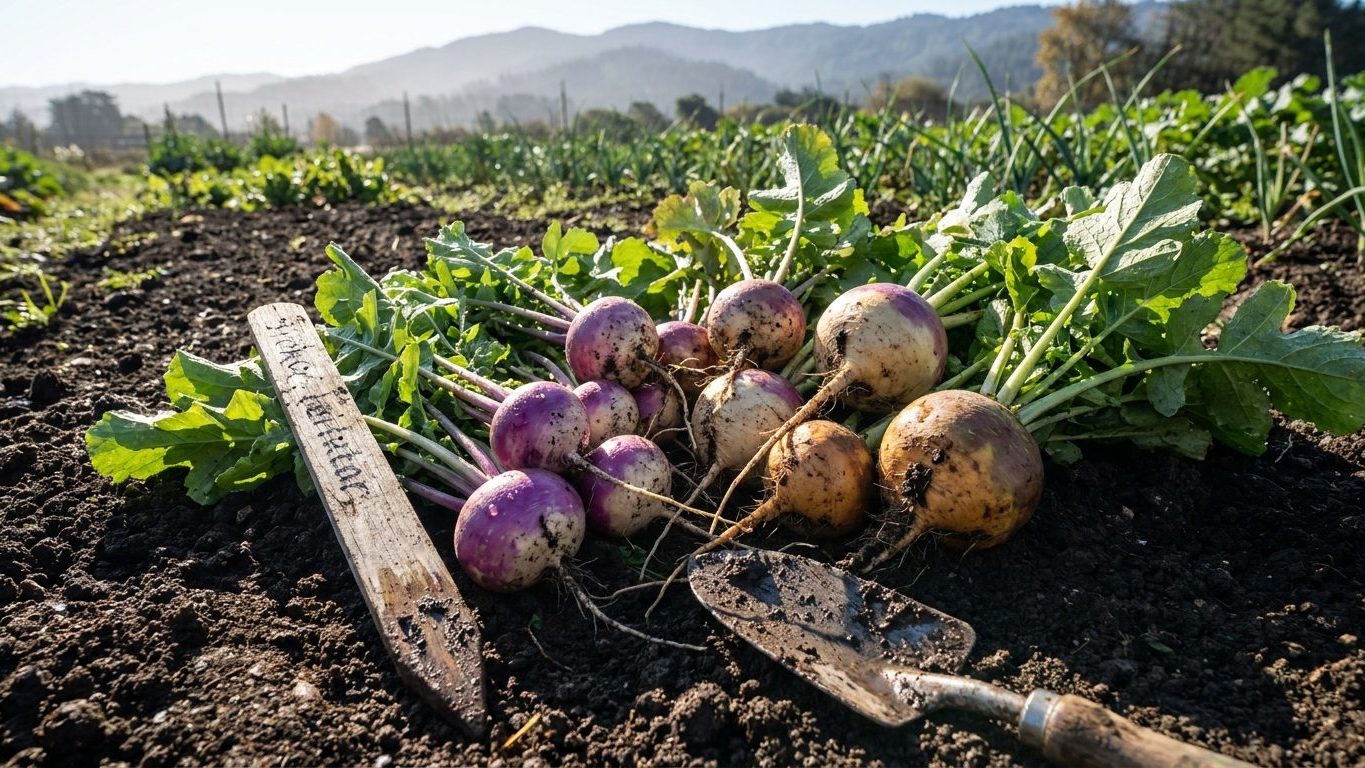

The best turnips for Oregon depend on which side of the Cascades you garden on. West of the mountains, fast salad turnips for spring and fall, a sturdy globe turnip for fall storage, and a rutabaga sown in summer all do well. East of the Cascades, the season is far shorter, so stick to the quickest types and skip the slow ones. Days to maturity count more than variety names.
The short answer for Oregon
Choose by type: quick salad turnips for spring and early fall, a globe turnip for a fall harvest you can store, and rutabaga sown in midsummer for fall and winter. That pattern fits the mild, wet-winter gardens west of the Cascades. In the high desert, plan on the fastest salad types only.
The dates come from Portland’s NOAA 1991-2020 climate normals, which give the 32°F freeze probabilities in a 30 to 70 percent band. Mean last spring frost falls between March 6 and March 21. Mean first fall frost falls between November 11 and November 27. Those dates mark when the odds of a 32°F freeze (another one in spring, the first one in fall) sit between 30 and 70 percent. A freeze outside that window is still possible. Portland is also west of the Cascades, so central and eastern Oregon cannot borrow this window.
The coldest month at that station has a mean daily minimum of 36.2°F. Winter nights there average above freezing, which is why fall-sown roots can stay in the ground well into winter. Turnip roots shrug off light frost, and a cold snap sweetens rutabaga.
Which turnip type fits a Willamette Valley-style climate?
Salad turnips are the easiest win. They are small, white and tender, and ready quickly, so a sowing in early spring and another in early fall fit the long mild shoulders of the year. A globe or purple-top type sown in late summer gives bigger roots that hold in the ground or store. A greens type, grown mainly for the tops, fills in anywhere between.
Which rutabaga fits?
Rutabaga takes the longest of the group, and packet days count from sowing. Sown in midsummer, it matures in the cooling weather of fall, which is when the flavor turns sweet. Sown in spring, it ripens into summer heat and turns coarse.
| Type | Best sowing time west of the Cascades | Strength | Weak point |
|---|---|---|---|
| Salad turnip | Early spring, early fall | Fastest, tender, good raw | Bolts and turns pithy in heat |
| Globe or purple-top | Late summer | Large roots, stores well | Needs thinning, attracts slugs |
| Greens type | Spring or fall | Quick leaf harvest | Small, tough roots |
| Rutabaga | Midsummer | Sweetens in cool weather, stores | Slowest, so a poor fit where the season is short |
For sowing dates within these windows, see When to Sow Turnips in Oregon. The broader crop guide is Growing Turnips and Rutabaga in Oregon.
What will not work here

Three plans fail in Oregon, and each one fails for a reason tied to the climate.
Why does a slow rutabaga fail in a short season?
Rutabaga needs the most time of any root in this family. Where the season is short, the roots never finish. In central and eastern Oregon the high desert has a far shorter frost-free stretch than Portland’s March-to-November window. A rutabaga sown in late June there may meet hard freezes before it reaches full size. Pick the quickest turnip types, sow them as soon as the soil can be worked, and treat rutabaga as a gamble unless you have a long, mild site.
Sowing rutabaga in spring west of the Cascades fails too, for the opposite reason. The roots bulk up in July and August and come out woody and strong-flavored.
Why does weekly watering fail in a dry summer?
Summers west of the Cascades are dry, and a summer-sown crop needs even moisture from the day the seed goes in. Turnips watered once a week swing between dry and soaked. That swing splits roots, makes them fibrous, and sharpens the flavor. A deep soak every week is fine for a shrub but wrong for a seedling bed.
The fix is practical. Water shallowly every day or two until the seedlings are up. After that, keep the top few inches of soil as damp as a wrung-out sponge. A layer of straw or compost between the rows slows evaporation. Seed sown into dry August soil often sits and never sprouts evenly, so soak the row before sowing.
Does close spacing hurt in a wet fall?
Fall and winter west of the Cascades are wet, and crowded turnips stay damp. Leaves that touch hold water, slugs move in, and roots rot at the shoulder. Thin globe turnips so the leaves just barely touch at full size, and give rutabaga more room than that. Thinning feels wasteful, but the thinnings make good greens and the remaining roots grow larger.
Closely packed rows also make the slug problem worse. Pull mulch back from the crowns once fall rains begin, and check under boards in the evening.
What changes across Oregon
Oregon is not one garden. The USDA Plant Hardiness Zone Map (2023, based on 1991-2020 normals) spans zones 4a through 9b inside the state’s borders. Zone is built on one variable, the average annual extreme minimum temperature, so it tells you about winter cold and nothing about summer heat or rain. With a spread that wide, there is no single answer. The Portland station used here sits at the mild end, and other parts of the state differ a great deal.
West of the Cascades and along the coast, winters are mild enough that fall turnips and rutabaga can stay in the ground for months. A light mulch handles most freezes. Here the gardener’s real limits are summer dryness and slugs, which is why sowing in late summer works so well.
East of the Cascades, in the high desert, nights stay cold later into spring and return earlier in fall. A reader in that country should shift in three ways. Sow the first salad turnips as soon as the soil is workable, and do not wait for a Portland-style date. Choose the quickest types, and pull the whole crop before hard freezes arrive. A second sowing in late summer is still possible if you can keep the bed moist, but give it fast types too.
Altitude works the same way inside the Cascades and in the eastern mountains. Every step up in elevation shortens the season, delays soil warming, and makes frost more likely in both spring and fall. A garden in a mountain valley may need to plan like the high desert, even if it sits only a few counties from a mild one. A south-facing slope or a spot beside a wall can extend the useful season.
Which zone your garden sits in is something to read off the USDA map rather than guess. Enter your ZIP code at the USDA plant hardiness map site and compare it with the range above. Then use the zone only for winter hardiness and use local frost experience for dates.
Where to check this for your own county
The best local source is Oregon State University Extension, Oregon’s land-grant extension service. It has county offices staffed by horticulture agents and Master Gardener volunteers who work the same soil and weather you do.
Look for two things there. First, the local planting calendar for your county, which will give sowing windows that fit your own frost dates rather than Portland’s. Second, any varieties that have been trialled in your county or a nearby one. A variety that did well in a trial in your climate is a better bet than one that looks good in a catalog.
Checking this against your own garden
Your own observations outrank any date printed in a guide. Three things are worth watching.
- Soil warmth by feel. Push your hand into the bed in the morning. If the soil feels cold and clammy, seed will sit and may rot. If it feels cool but comfortable, turnip seed will sprout. A bed that warms earlier than your neighbor’s has good drainage or sun exposure, and you can sow there first.
- First true leaves. The first pair of leaves after sprouting are seed leaves. The next pair, rougher and shaped like a turnip leaf, are the first true leaves. How fast they appear tells you how quickly your bed is growing. Slow true leaves in fall mean the days are already too short and cool for a rutabaga.
- Where frost shows first. Look at your yard on a cold, clear morning. Frost sitting in low spots and missing on slopes or near walls marks your frost pockets and your warmest corners. Put the late sowings in the warm corners and the quick spring crop wherever the frost melts first.
Write down what you see for a season or two. A note on the day you first sowed, the day the true leaves came, and the day frost first whitened the low corner gives you a calendar that fits your garden better than any average.
Common questions
What is the best turnip for a home garden in Oregon?
For most gardens west of the Cascades, a quick salad turnip is the most reliable choice, followed by a globe type sown in late summer for storage. Choose by days to maturity counted from sowing, then match it to your frost window.
Can I grow rutabaga in eastern Oregon?
It is a gamble. Rutabaga needs the longest season of the group, and the high desert has a much shorter one than Portland. If you try it, sow as early as the soil allows on a warm, sheltered site and keep the bed evenly moist.
When should I sow turnips for a fall crop?
West of the Cascades, late summer to early fall works, timed so the roots finish before hard freezes. The Portland reference station has a mean first fall frost between November 11 and November 27. Count back from your own frost date using the days on the seed packet.
Do turnips survive an Oregon winter?
In mild areas west of the Cascades, roots can stay in the ground through much of winter, especially with a mulch. In colder zones, pull them before the ground freezes hard and store them cool and damp.