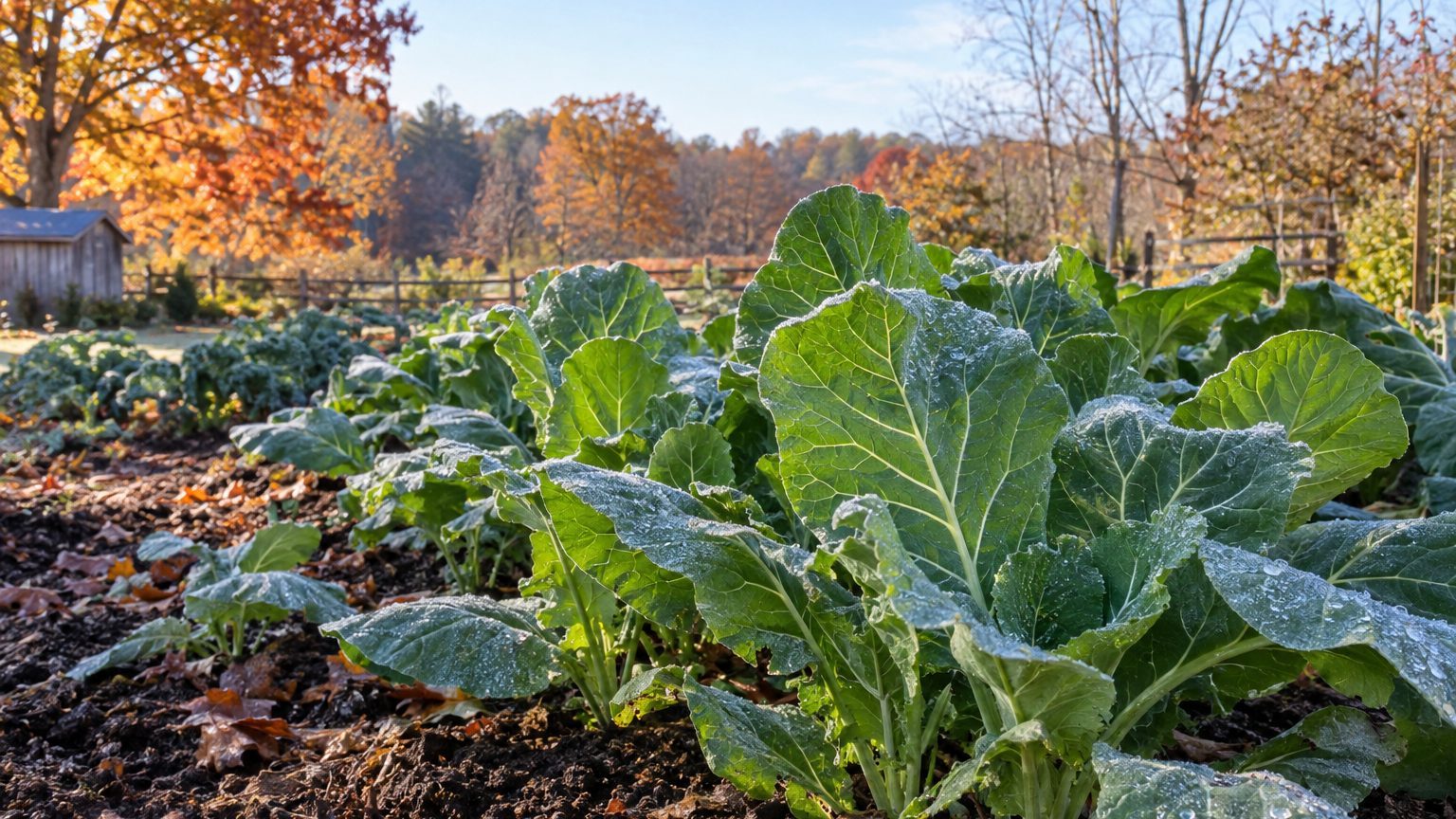

Collards go in twice in Pennsylvania, once in spring and once in summer for a fall harvest, and both plantings are timed backward from frost. The reference dates below come from Philadelphia, the mildest corner of the state. Anyone farther north or higher in the Alleghenies should add weeks in spring and subtract weeks in fall.
The short answer for Pennsylvania
Near Philadelphia, start seed indoors in early February and set transplants outdoors from mid-March to mid-April. For the fall crop, sow seed or set transplants from late June through July. Collards shrug off light frost, so the spring planting can go in ahead of the last freeze. The fall planting needs to be well-sized before the first hard one.
The frost dates behind that advice are March 29 to April 6 for the last spring frost and November 5 to November 16 for the first fall frost. They come from NOAA’s 1991-2020 U.S. Climate Normals for the Philadelphia station. Each is a probability of a 32°F freeze. The spring range marks where the odds of one more freeze fall between 30 and 70 percent. The fall range marks where the odds that the first freeze has already arrived fall in the same band. A freeze in mid-April or a mild stretch into late November still fits those numbers.
Spring plantings have a short runway. Collards set out in mid-March have several weeks of cool weather before summer heat arrives. Fall plantings run the other way. Leaves grow through the last warm weeks of summer. Many gardeners rate the fall harvest higher for that reason alone.
| Timing | Philadelphia area | Northern tier and Alleghenies |
|---|---|---|
| Last spring frost window | March 29 to April 6 | Two to four weeks later |
| Spring transplants outdoors | Mid-March to mid-April | Early April to early May |
| Fall crop sown or transplanted | Late June through July | Late June through mid-July, sooner than feels natural |
| First fall frost window | November 5 to November 16 | Earlier than Philadelphia’s window |
The northern column is a shift from the Philadelphia dates, not a separate measurement. For the full crop picture, see Growing Collards in Pennsylvania.
What will not work here
Setting collards out in cold, saturated soil in early March fails more often than gardeners expect. Seed sown into soil that is still near freezing sits for weeks. Transplants stall if roots sit in cold mud. The Philadelphia window opens in mid-March only because the plants are hardy. Soil that has not drained yet is another matter, and in the northern tier it rarely has by then.
Copying Philadelphia’s dates into the northern tier or the Alleghenies is the most common mistake. The spring frost window there runs two to four weeks later than the March 29 to April 6 range. A gardener in a colder county who sets out transplants on a Philadelphia schedule is planting into a freeze that can still arrive. Hardy collards take a light frost, but a hard freeze on tender, freshly moved seedlings is a different matter.
A late spring crop also runs into trouble. Collards sown in May at the mild end of the state mature into July heat, humid and buggy. Cabbage worms and aphids are heaviest then. If the spring window is missed, skip to the fall planting instead of forcing a late one.
Humid summers punish close spacing. Collards are big plants, and crowded leaves stay wet after rain and dew. Air movement matters more than squeezing in extra plants. Give each plant room to spread to its full width, and water at the base in the morning.
The slowest varieties are a risk wherever autumn arrives early. A long-maturing collard sown in July in the northern tier or at altitude has fewer weeks before the first fall frost than the same variety near Philadelphia. Choose faster types there, and see The Best Collards and Greens for Pennsylvania for how to match variety to season length.
Overwintering is not a safe plan everywhere. At the Philadelphia reference station the mean daily minimum of the coldest month is 26.0°F. A mature collard can ride out that average. Average minimums do not describe the worst nights, and colder parts of the state have much lower numbers. Treat a surviving plant as a bonus, not the plan.
What changes across Pennsylvania
The state spans USDA hardiness zones 5a to 7b, a wide spread with no single answer. The USDA system is built on one variable, the average annual extreme minimum temperature, so it describes how cold winters get. It does not describe how long the growing season runs. The two overlap, but a zone number alone will not tell you when to sow.
The Philadelphia dates sit at the warm end of that spread. The northern tier and the Alleghenies run two to four weeks later in spring, so a gardener in either place should expect an April start to be a May start in practice. Starting seed indoors matters more there, because the days between thawed soil and the first fall frost are fewer. A row cover over spring transplants helps in a cold snap.
At altitude and in the north, the fall planting often becomes the main crop. A midsummer sowing grows during a stretch of the year when nights are cooling but days are still long, and the plants meet frost already large. Count backward from your own area’s fall frost, and allow extra weeks if you are choosing a long-season variety.
In the warmer southeast, around the Philadelphia area, the calendar stretches the other way. The gardener there has the longest spring window and a fall window that runs well into November. Plants that are still green after the first frosts can be picked into early winter.
Nobody should assume which zone they are in from a neighbor’s advice or a seed packet. The USDA Plant Hardiness Zone Map lets you enter a ZIP code and read your zone directly. Check it, then adjust the Philadelphia dates by the weeks that match your part of the state.
Where to check this for your own county
The best next stop is Penn State Extension, the state’s land-grant extension service. Its county offices work from local weather records and local trials, and they know which microclimates in your area run warmer or colder than the regional picture.
Look for two things there. The first is a local planting calendar for cool-season vegetables, ideally one that gives dates for spring transplants and the fall sowing in your county. The second is a list of varieties trialled nearby, which tells you what has actually performed in your soil and season length instead of what looks good in a catalog.
A county recommendation beats a state one. State-level dates average across zones 5a to 7b and a spread of weeks in frost timing, so they are a starting point and nothing more. Your county office can narrow that spread to your own ground. If a local calendar disagrees with the dates above, trust the local one.
Extension offices also answer practical questions that no calendar covers, such as which pests are active in your county this month and whether a late cold snap is likely. A phone call or an email to the county office is a normal use of the service, and the staff are used to garden questions that start with “when.”
Checking this against your own garden
What you see in your own yard outranks every date above. Three observations cost nothing and tell you more about your garden than a regional average can.
- Soil by feel. Push a hand or trowel into the bed. If the soil crumbles and feels cool but not icy, it is workable for transplants. If it forms a cold, sticky clump, wait. A bed that dries out early in spring is warmer and better drained than the one next to it.
- Where the last frost lands. Notice which spots still show white on the grass or bench in spring mornings. Low corners hold cold air, so frost lingers there longest. Collards in those spots need the later end of your window or a cover.
- First true leaves. Seedlings first put out two rounded seed leaves, then true leaves with the shape of a collard. Slow growth at that stage points to a cool windowsill or a bed that has not warmed.
Over a season or two, these notes build a calendar for your own garden that is more accurate than the state one. Keep a simple log with the date, the weather and what you did. It will show how many days your garden runs ahead of or behind the numbers.
If you follow the almanac, here is when to plant collard greens by the moon. It is a tradition, not a proven method.
Common questions
Can you plant collards in both spring and fall in Pennsylvania?
Yes. Spring transplants go out from mid-March to mid-April near Philadelphia, later in colder parts of the state. A second planting in late June through July gives a fall crop that is often sweeter. Gardeners in the northern tier and Alleghenies should treat the fall planting as the main one.
How late can you plant fall collards?
Early enough that plants have real size before the first fall frost window, which begins November 5 near Philadelphia and arrives sooner farther north. Sowing earlier is safer than later in the colder parts of the state. Plants that are too small by frost stop growing and give little to harvest.
Do collards survive a Pennsylvania winter?
Sometimes, in the mildest areas. The mean daily minimum of the coldest month near Philadelphia is 26.0°F. Colder zones, up to 5a, are harder on them. Treat overwintering as a bonus.
Should you start collards from seed or buy transplants?
Either works. Seed started indoors in early February gives you a head start for the spring planting, which matters most where spring arrives late. Buying transplants saves the effort and suits the fall crop, when seed is awkward to start in summer heat. Harden off any transplant for a few days before it goes in the ground.