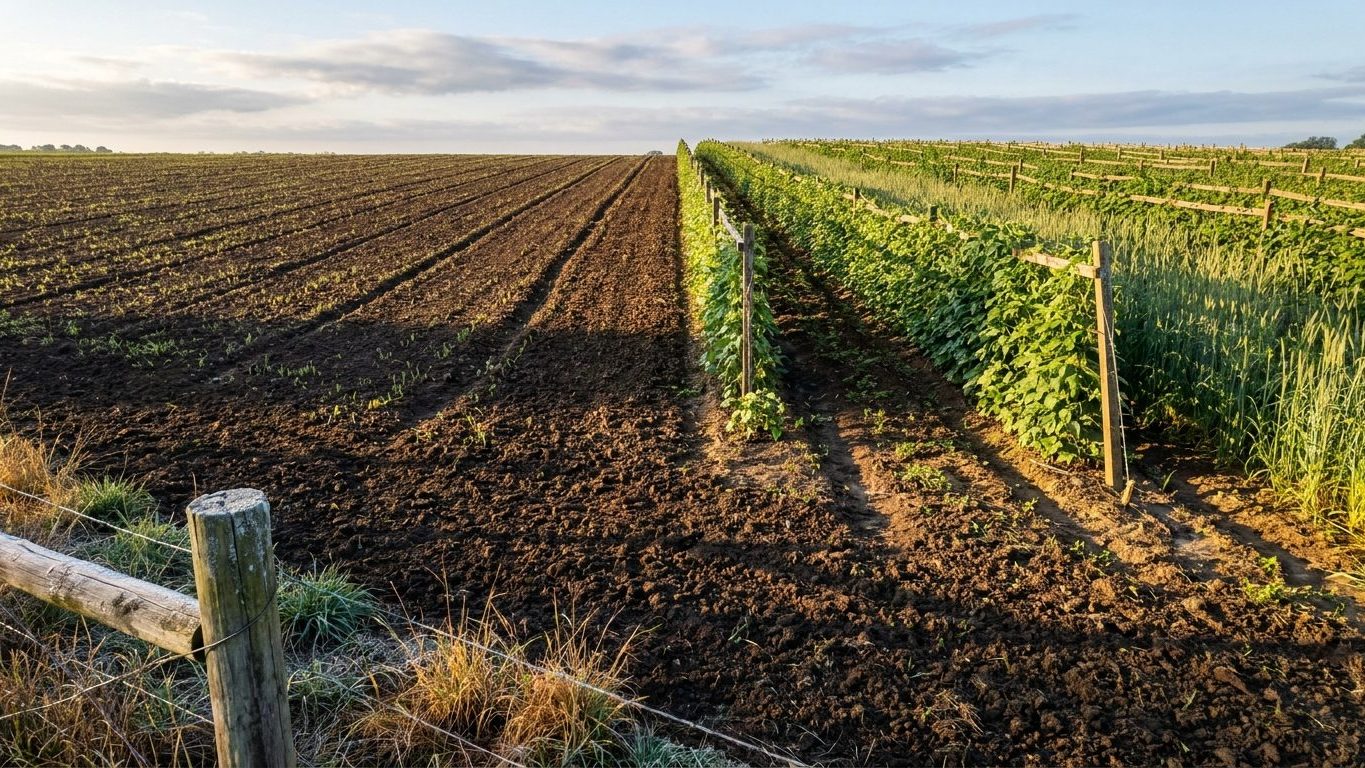

Pennsylvania gardeners sow winter-hardy cover crops like cereal rye and hairy vetch in late summer through early fall, timed to the state’s first fall frost, and sow frost-tender summer covers like buckwheat only after the last spring frost has passed. The exact week shifts by where you garden.
The short answer for Pennsylvania
Two frost dates run this calendar, and they answer two different questions. The first fall frost, which the National Weather Service station in Philadelphia places between November 5 and November 16, marks the point where growth for the season effectively stops. That date is a probability band, not a guarantee: it’s the window in which a 32°F freeze has a 30 to 70 percent chance of happening on any given day, based on the 1991-2020 climate record. Winter-hardy cover crops like cereal rye, winter wheat, hairy vetch, and crimson clover need roughly four to six weeks of active root and shoot growth before that freeze risk climbs, so they get established enough to survive winter and resume growth in spring.
Counting backward from the earlier end of that fall frost window gives Philadelphia gardeners a sowing target of the first three weeks of September through early October for those winter covers. Wait longer than that and the plants go into winter too small, with shallow roots that heave out of the ground during freeze-thaw cycles.
The other half of the calendar covers frost-sensitive summer species: buckwheat, cowpeas, and sorghum-sudangrass. These can’t go in the ground until the last spring frost has passed, which at the Philadelphia station falls between March 29 and April 6. That date is also a probability band, the same 30 to 70 percent freeze-chance window used for the fall date, meaning a frost after that date is common enough that a truly cautious gardener could wait another one to two weeks before trusting the soil to stay frost-free. Oats and spring field peas, both more frost-tolerant, can go in a little earlier since they shrug off a light freeze that would kill buckwheat outright.
Everything above is calibrated to the Philadelphia reference station specifically. Pennsylvania is a big state with a lot of elevation change, and that single station does not describe the whole commonwealth, a point the next section covers in detail.
What will not work here
The number that trips people up most is not a frost date at all. It’s the mean daily minimum temperature during the coldest month at the Philadelphia station: 26°F. That’s not the record low for the winter and not the average temperature for the day, it’s the average low a plant actually experiences on a typical cold night. Cover crops rated as hardy to 10°F or 15°F look safe on paper next to that number, but the figure is a mean, not a floor. Individual nights swing well below it, especially away from Philadelphia’s urban and river-valley moderation, and a cover crop sown too late in fall with too little top growth going into winter is the one that gets caught by those colder swings.
This is why sowing crimson clover in late October instead of early September is a common and costly mistake in Pennsylvania. Clover sown late doesn’t build the crown and root reserves it needs, and a stretch of nights well under that 26°F coldest-month average kills it outright rather than just setting it back. Cereal rye is the safer bet for late plantings precisely because it tolerates a much wider swing below that mean minimum and still greens up in spring.
On the other end of the calendar, buckwheat sown even slightly ahead of the last spring frost window is money and seed thrown away. Buckwheat has essentially no frost tolerance, and a single night at or near 32°F during that March 29 to April 6 window, or in the week or two after it, wipes out a stand that had just started to emerge. There’s no partial recovery with buckwheat the way there sometimes is with hardier spring crops; a frosted stand needs to be reseeded entirely.
The state’s frost-date spread also rules out treating any single sowing date as universal. A planting schedule built around the November 5 end of the fall frost window will get a grower in a colder pocket of the state into trouble, because their local first frost may already have arrived weeks earlier.
What changes across Pennsylvania
Pennsylvania sits across USDA Hardiness Zones 5a through 7b, a spread built entirely on one measurement: the average annual extreme minimum temperature, per the USDA Plant Hardiness Zone Map’s 2023 update using 1991-2020 climate normals. Going from 7b to 5a is not a minor shift. It represents a difference on the order of 20°F in the coldest temperature a garden can expect to see in an average year, and that gap changes which cover crops reliably overwinter and which ones need to be treated as spring-sown annuals instead.
There is no single sowing date that works for both ends of that range, and this page cannot hand out one. The Philadelphia dates above describe the state’s mildest corner. The documented caution attached to those frost dates is direct: the northern tier and the Allegheny highlands run two to four weeks later in spring for the last frost, and correspondingly earlier in fall for the first one. That’s not a rounding error. A grower in one of those colder zones who sows hairy vetch on the Philadelphia-derived early-September date is giving the crop three to four extra weeks of growth it wasn’t counting on, which is a bonus. But that same grower sowing buckwheat on the Philadelphia last-frost date is planting into a frost risk that hasn’t cleared yet at all.
Elevation compounds the zone effect inside a single county. Two gardens ten miles apart, one in a valley bottom and one on a ridge, can differ by a full hardiness zone because cold air pools in low ground on clear, calm nights. That’s a local pattern this page can name but not size, since it depends on terrain this page doesn’t have data for. The practical response isn’t to guess at an adjustment from a map. It’s to find out which zone applies to your specific location, which the next section covers.
Where to check this for your own county
Penn State Extension is Pennsylvania’s land-grant university extension service, and it’s the source built to translate a state-level frost calendar into a county-level one. The address is https://extension.psu.edu/, and it’s the right next stop after this page, not a substitute for reading it.
What to look for there falls into two categories. First, a county or regional planting calendar that accounts for local frost timing rather than the single Philadelphia reference station used here. Given how much the last and first frost dates shift across the state’s elevation and latitude, a county-specific calendar corrects for exactly the gap this page can only flag in general terms. Second, look for variety trial results and cover crop performance data specific to Pennsylvania growing conditions, since county extension offices and the university’s agronomy programs run field trials that show which cereal rye, vetch, or clover varieties actually perform well in that region’s soils and winters, as opposed to what a seed catalog claims nationally.
A county-level recommendation beats a state-level one every time, for a simple reason: this page is built from one climate station’s data and a statewide hardiness zone range, while a county extension resource is built from local frost records and, often, from field trials run within that same county. This page is meant to explain the mechanism, the frost windows, the winterkill risk, the zone spread, so that a county recommendation makes sense when you read it. It isn’t meant to replace that recommendation.
If your county doesn’t publish its own calendar, Penn State Extension’s regional offices can usually point to the nearest one that does, or to a county agent who works with cover crops directly. That conversation is worth having before committing a field or a large garden bed to a sowing date pulled from a statewide average.
Checking this against your own garden
Every date on this page is an average built from decades of station data. Your own garden runs on its own schedule, and three simple observations tell you more about it than any calendar.
Start with the soil itself. Push a bare hand a couple of inches into the bed where you plan to sow. Soil that’s still cold and clumps together like modeling clay hasn’t warmed enough for spring-sown covers like oats or field peas to germinate reliably, regardless of what the last-frost date says. Soil that crumbles and feels closer to room temperature is ready, and that feel-test often beats the calendar in a season that ran unusually cool or warm.
Second, watch for the first flush of common weed seedlings, chickweed or henbit are typical early risers, in any bare patch nearby. Their germination marks the point where soil temperatures have crossed the threshold that most cool-season cover crop seed also needs to sprout, and it’s a free, no-equipment signal that’s specific to your exact plot.
Third, track the first light frost that blackens tender leaves on anything frost-sensitive already growing nearby, whether that’s a leftover basil plant or tomato foliage. That’s your garden’s real first-frost date, not the station’s, and comparing it against the November window given here tells you how much earlier or later your specific spot runs. If it happens two weeks before the Philadelphia-based window, treat every fall sowing date on this page as two weeks earlier next year, no station data required.