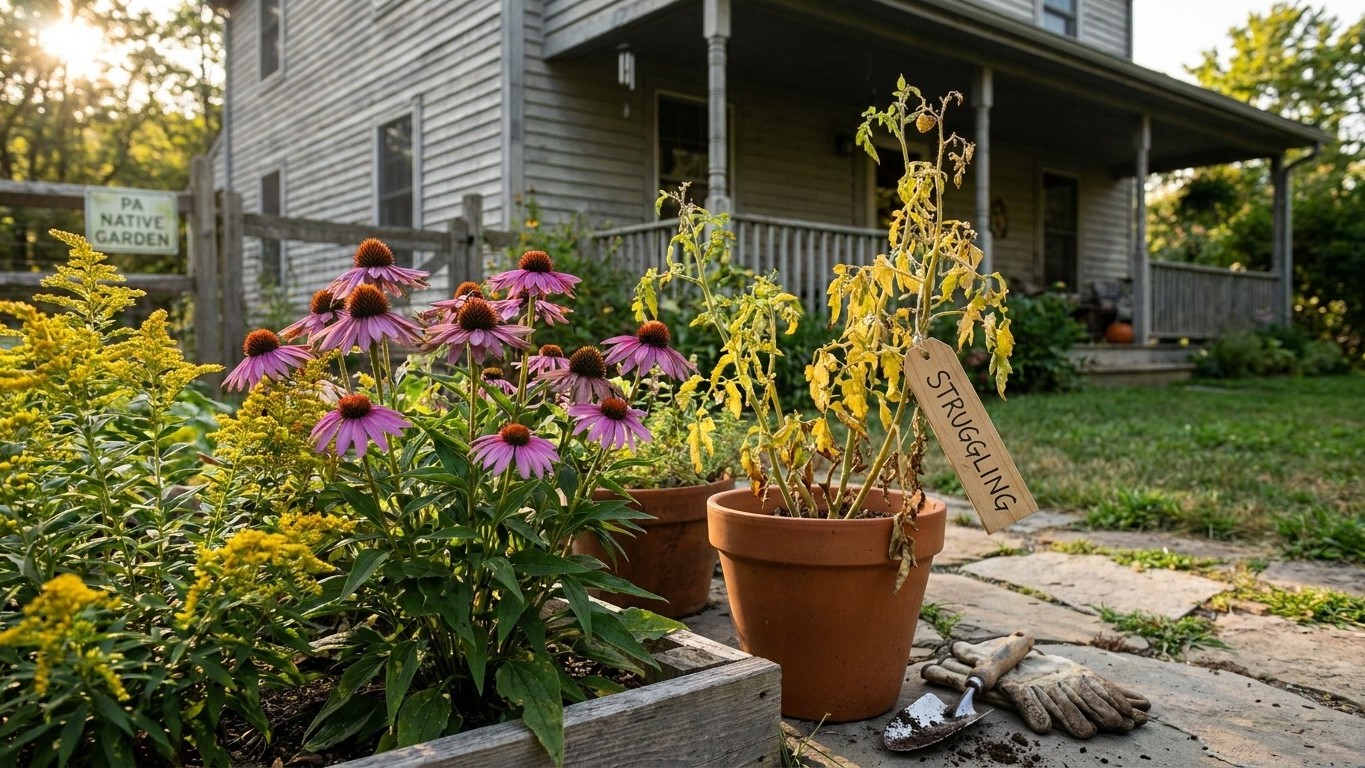

Some flowers make it through a Pennsylvania winter and summer both, and some just can’t take the swing between them. Purple coneflower, black-eyed Susan, garden phlox, daylily and bearded iris are the ones that do, holding on through a hard freeze and a stretch of 90-degree days in the same year without much fuss. What kills the rest is usually a mismatch nobody checked for at the garden center. So before anything goes in the ground, look at the zone printed on the plant tag and hold it against your own county, not against Philadelphia’s milder corner of the state.
What thrives in Pennsylvania

Pennsylvania spans USDA zones 5a to 7b, according to the USDA’s 2023 Plant Hardiness Zone Map, which means a flower that sails through winter in the Philadelphia suburbs can die outright in the Alleghenies eighty miles west. The number that matters most for winter survival isn’t the record cold snap, it’s the ordinary one: NOAA’s NCEI 1991-2020 climate normals put Philadelphia’s coldest month at a mean nightly low of 26.0F, and that’s the temperature a perennial has to shrug off most winters, not just in a bad one. A plant tagged hardy to zone 6 or colder handles that without protection. One tagged to zone 7 or 8 is a gamble anywhere outside the milder southeastern corner of the state.
Summer brings the opposite problem. Philadelphia logs 24 days a year at 90F or hotter under NOAA’s 1991-2020 normals, and that heat arrives with humidity, which is harder on foliage than dry heat is. Gray-leaved, silver-foliage plants bred for Mediterranean summers, lavender and rosemary among them, tend to rot at the crown here faster than they scorch in the sun. Flowers that hold up instead usually have thick or hairy leaves, deep taproots, or both.
The traits that matter
- Cold hardiness to at least zone 6, so an average Pennsylvania winter doesn’t kill the crown or roots outright.
- Heat and humidity tolerance, since Philadelphia-area summers combine 90F days with the kind of moisture many gray-leaved plants can’t take.
- Drought tolerance once established, useful in the dry spells that interrupt an otherwise wet growing season.
- Fast, deep rooting, so a new planting isn’t still fragile when the first hard freeze arrives.
The Asteraceae family carries most of these traits at once: purple coneflower (Echinacea purpurea), black-eyed Susan (Rudbeckia hirta) and New England aster all combine cold hardiness with heat tolerance and need little water once settled. Daylily (Hemerocallis hybrids) and bearded iris (Iris germanica) are reliable across the whole zone range too. Garden phlox (Phlox paniculata) tolerates the humidity if it’s given air circulation, and mildew-resistant cultivars like ‘David’ hold their leaves clean through a wet August when older phlox varieties would already be spotted and dropping.
Native plants worth the space
Native plants earn their space by needing less once they’re in the ground. A purple coneflower or black-eyed Susan planted in spring will still need regular watering through its first summer, but by its second or third year its root system reaches deep enough to ride out an ordinary dry spell without supplemental water. Non-native perennials bred for uniform bloom often keep shallow, dependent root systems for their whole lives, which is why they still need watering in year five.
Butterfly weed (Asclepias tuberosa) is the only larval host for monarch butterflies among the plants on this list, and its bright orange flower clusters draw them reliably through mid-summer. Wild bergamot (Monarda fistulosa) pulls in hummingbirds and a wide range of native bees, and its lavender-pink flowers hold up better in humid summers than many mophead bee balm cultivars bred from it. New England aster closes out the season in September and October, when its purple, daisy-like flowers are often the last nectar source before frost for late-flying bees and southbound monarchs.
Foxglove beardtongue (Penstemon digitalis), with white, tubular spring flowers, and Joe Pye weed (Eutrochium purpureum), a tall plant topped with dusty pink flower domes in late summer, round out a native planting that blooms from May through frost with no fertilizer and no routine pesticide.
These species aren’t unique to Pennsylvania. The same native perennials anchor pollinator plantings across the Northeast and mid-Atlantic, and the reasoning behind using them holds whether you’re reading about the flowers that thrive in Rhode Island or the cooler hollows covered in our guide to flowers that thrive in West Virginia. What changes from state to state is which exact species is common locally, not the underlying case for planting them.
Perennials that come back

Perennials that come back reliably in Pennsylvania are the ones whose hardiness range comfortably covers zone 5a, not just the milder zone 7b pocket around Philadelphia. Daylily (Hemerocallis hybrids), hardy hibiscus (Hibiscus moscheutos), garden phlox (Phlox paniculata), Russian sage (Perovskia atriplicifolia), peony (Paeonia lactiflora) and the sedum sold as ‘Autumn Joy’ (Hylotelephium) are all rated hardy from zone 3 or 4 through zone 8 or 9 on their catalogue tags, which means they return every spring whether you garden in the Poconos or along the Delaware River.
Reading the tag against your zone
A plant tag lists a hardiness range, something like “zones 6 to 9,” and that lower number is the coldest zone the plant is bred to survive. The mistake is comparing that number to the state’s overall span of USDA zones 5a to 7b instead of to the zone where you actually garden. A homeowner near Philadelphia, close to zone 7b, can grow a plant tagged to zone 6 without much worry. The same plant in a zone 5a county in the northern tier or the Alleghenies needs a sheltered spot and a thick mulch layer, or should be swapped for something rated to zone 5 or lower.
Some flowers sold every spring at Pennsylvania garden centers are perennial only in warmer climates and get grown here as annuals instead. Lantana, hardy only to zone 9 or 10, is one. Many tender salvias, Salvia guaranitica among them, are rated to zone 7 or 8 at best, which puts them on the edge of survival even in the mildest counties and out of reach everywhere else without heavy winter protection. Growing them as annuals, replaced every spring, is simpler than gambling on a zone 7b microclimate that only exists in a handful of counties.
Putting a border together
A border that looks planned rather than scattered starts with height. Put the tallest plants, Joe Pye weed or hardy hibiscus at five to seven feet, along the back or center of an island bed, then step down through mid-height phlox and Russian sage at two to four feet, to low edging plants like catmint or creeping sedum at the front. Skipping a height tier is the most common reason a new border looks flat from the sidewalk.
Bloom succession matters more in Pennsylvania than the length of the growing season suggests. Philadelphia’s frost-free window runs from the last spring freeze, which NOAA’s NCEI 1991-2020 normals place between March 29 and April 6, to the first fall freeze, dated between November 5 and November 16 at the same station. Gardens in the northern tier and the Alleghenies lose two to four weeks off both ends of that window, so the same border there needs earlier spring bloomers and earlier-finishing fall color to make full use of a shorter season. Stagger plants so one is just opening as its neighbor finishes, rather than clustering everything into a single June peak.
Repeating one or two colors at intervals through the bed, instead of scattering every color once, is what makes a border read as a single composition rather than a plant collection. Leave the spacing the tag recommends between new perennials even though the bed looks sparse the first year. Crowding plants to fill the gap now means dividing or ripping out the losers in three years, once the roots collide underground.
| Plant | Height | Bloom season | Border position |
|---|---|---|---|
| Joe Pye weed (Eutrochium purpureum) | 5-7 ft | Late summer | Back |
| Garden phlox (Phlox paniculata) | 2-4 ft | Mid to late summer | Middle |
| Russian sage (Perovskia atriplicifolia) | 3-4 ft | Summer | Middle |
| Catmint (Nepeta ‘Walker’s Low’) | 1-2 ft | Late spring through summer | Front |
| Creeping sedum (Sedum spurium) | 4-6 in | Summer | Front edge |
Local help
Penn State Extension runs Master Gardener programs in counties across the state, and its county offices keep plant lists tuned to local conditions, from the Piedmont soils around Philadelphia to the shale ridges of the Alleghenies. Check with your county office for current recommendations through Penn State Extension before committing to a large native planting or a new border. For more on gardening elsewhere in the state, our Pennsylvania guides cover vegetables, soil and other topics county by county.
Common questions
Why do my flowers from the garden center die every winter even though the tag said perennial?
The tag’s hardiness zone is probably milder than your county’s. Garden centers stock plants that survive somewhere in the region, not necessarily in every part of it, so a plant rated to zone 7 can die in a zone 5a county in the northern tier or the Alleghenies even though it thrives near Philadelphia.
Can I grow lavender in Pennsylvania?
English lavender cultivars like ‘Munstead’ and ‘Hidcote’ are rated hardy to zone 5 and can survive the cold here. What usually kills them is wet soil around the crown through winter, not the temperature itself, so plant in a raised bed or gravel-amended soil with sharp drainage rather than average garden loam.
When is it safe to plant flowers outside in spring?
Wait until after your local last frost date, not a fixed calendar date. NOAA’s NCEI 1991-2020 normals put Philadelphia’s last spring freeze between March 29 and April 6, but the northern tier and the Alleghenies typically run two to four weeks later, so check your own region’s frost data rather than borrowing Philadelphia’s window.
Do I need to deadhead perennials to get them to rebloom?
Some do, some don’t. Repeat bloomers like garden phlox and many daylilies rebloom faster if you remove spent flowers before they set seed, while others, like most coneflower and black-eyed Susan, finish their bloom cycle for the season regardless and are often better left standing so the seed heads can feed birds through fall.
Related guides
- Flowers That Actually Thrive in New York, and the Ones That Struggle
- Flowers That Actually Thrive in New Jersey, and the Ones That Struggle
- Flowers That Actually Thrive in Rhode Island, and the Ones That Struggle