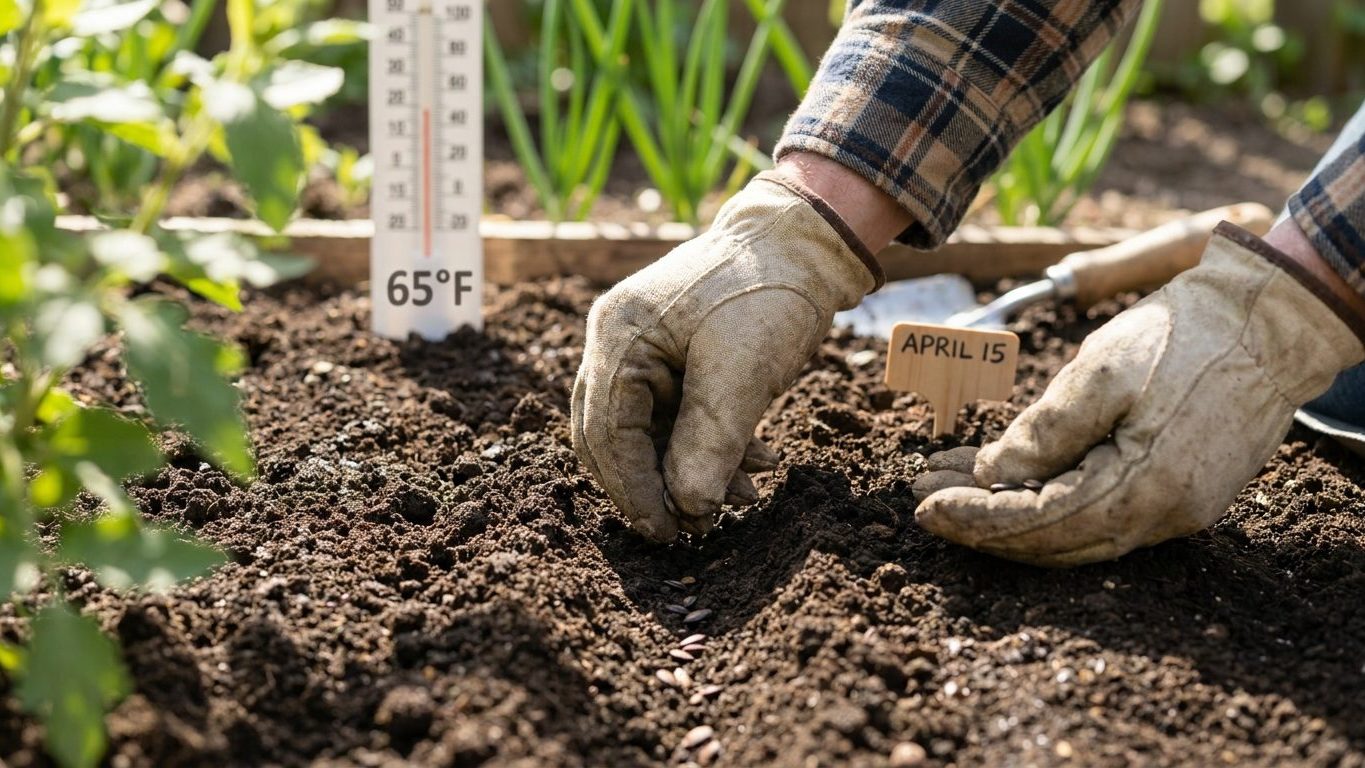

Pennsylvania’s melon window sits between two moving targets: a last spring frost that falls somewhere between March 29 and April 6 near Philadelphia, and a first fall frost arriving November 5 to November 16. Add the two to three weeks melons need for truly warm soil, and the realistic start lands in mid-to-late May, with harvest wrapped up well ahead of that fall frost band.
The short answer for Pennsylvania
Plant Melons in the ground two to three weeks after the last spring frost date, once soil has had time to bank heat. For the Philadelphia reference station, that frost date falls between March 29 and April 6, which pushes a safe transplant or direct-sow date into the second half of April at the earliest and, for the soil-temperature cushion melons actually need, closer to mid-May. That frost window is not a guarantee. It is a probability band: NOAA’s 1991-2020 climate normals show the chance of a 32F freeze dropping from roughly 70% to roughly 30% across those days. Frost is still plausible on the late end, just less likely with each passing day.
Melons don’t care about the calendar so much as they care about heat in the ground. Seeds germinate poorly below 65F soil, and transplants set out into cold soil often sit and sulk for two weeks rather than grow. That’s the reasoning behind waiting past the raw frost date rather than sowing the moment it passes.
Working backward from the fall frost
On the other end of the season, the first fall frost normally arrives between November 5 and November 16 at the reference station. Counted from a mid-to-late May start, that leaves close to six months of frost-free growing time, which is generous for melons: most varieties need somewhere between 65 and 100 days from transplant to harvest, so timing is rarely the limiting factor in the milder parts of the state. It becomes a much tighter equation once you move north or up in elevation, where both frost dates shift and the season shrinks from both ends at once.
The practical takeaway: use the last-frost band as a floor, not a start date, add the soil-warming buffer, and count backward from the fall frost band to make sure the variety on your seed packet actually fits inside what’s left. A 100-day melon started in late May against a November 5 frost date is cutting it close in a cool year; an 85-day melon has room to spare.
What will not work here

Three things reliably sink a Pennsylvania melon crop, and none of them are exotic. The first is choosing a long-season variety and planting it late. If a gardener waits until early June to get melons in, hoping to dodge a cool spring, a 100-plus day variety pushed against a November 5 frost date has almost no margin left. Losing even ten days to a cool, wet stretch in September, which happens often enough in this climate, can mean fruit that never finishes ripening.
The second failure is watering on a fixed weekly schedule through a Pennsylvania summer. The reference station averages about 12.7 inches of rain across June, July, and August, with June the driest month at 4.04 inches. That sounds like enough, until it lands as a handful of heavy thunderstorms rather than steady soaking rain, and until you factor in the roughly 24 days a year that hit 90F or higher. Heat that intense pulls moisture out of soil fast, and a single weekly watering can’t cover for the days in between, especially on sandy soil that drains within hours. Melons stressed by inconsistent moisture respond with blossom drop, bitter fruit, or blossom-end problems, not with patience.
Crowding plants in a humid state
The third mistake is spacing melons the way a drier climate’s gardening guide might suggest. Pennsylvania’s summer humidity, layered on top of that rainfall pattern, creates real pressure from powdery mildew and other foliar disease. Vines planted too close together stay damp longer after rain or dew, and dense foliage traps moisture against the leaves overnight. In a state where June rainfall alone averages over 4 inches, airflow between plants isn’t a nice-to-have; it’s what keeps a healthy-looking July vine from collapsing into mildew by August. Wider spacing than a seed packet’s minimum, and pruning to open up the canopy, both pay off here in ways they might not in a drier region.
What changes across Pennsylvania
Pennsylvania is not one growing climate, and the USDA Plant Hardiness Zone Map makes that obvious: the state spans zones 5a through 7b. That’s a range built on one measurement, the average annual extreme minimum winter temperature, but it lines up with real differences in how long the frost-free season runs from one county to the next. A gardener working from the Philadelphia numbers cited above is looking at the mildest corner of the state. The northern tier and the Allegheny highlands run two to four weeks later in spring and correspondingly earlier in fall, which tightens the melon-growing window from both directions at once.
That two-to-four-week shift matters more for melons than for many other crops, because melons are already working with a season that has to accommodate both a soil-warming delay at the start and a full ripening period at the end. A variety that comfortably finishes with weeks to spare near Philadelphia can end up racing the frost in a colder pocket of the Alleghenies, even though both gardens are technically in the same state and reading the same seed catalog.
None of this can be resolved by picking a single date for “Pennsylvania.” With a hardiness zone spread of 5a to 7b, there is no one answer that fits a garden outside Erie the same way it fits one outside Lancaster. A reader trying to figure out where their own plot falls on that range should check the current USDA Plant Hardiness Zone Map rather than guess from a regional label, since even neighboring counties can land in different zones depending on elevation and local terrain.
Where to check this for your own county
Everything above is a state-level picture, built from one reference station’s climate normals. It’s useful for understanding the mechanics of a Pennsylvania melon season, but it isn’t a substitute for what your own county’s extension office has on file. Penn State Extension runs that service for the state, and its site at extension.psu.edu is where county-specific guidance lives.
Two things are worth looking for there specifically. The first is a local planting calendar, which will reflect the actual frost dates and season length for a specific county rather than the Philadelphia-area normals. A county in the Poconos or the northwest corner of the state can have a meaningfully different safe-planting date than the one implied here, sometimes by several weeks. The second is any list of melon varieties that have actually been trialled in that county or region. Extension offices track which varieties held up to local disease pressure and finished ripening reliably in local trials, which is a more direct answer than a general statement about days-to-maturity on a seed packet.
A county recommendation beats a state one every time, because it’s built on conditions closer to the actual garden. For the specific date to circle on a calendar, the county extension office is the better source, and it costs nothing but a phone call or a visit to the website to get it.
Checking this against your own garden
Every date here is a normal, built from thirty years of averages at one weather station. A gardener’s own plot can run a week or two warmer or colder than that station depending on slope, sun exposure, nearby pavement, or how sheltered the yard is, and that gap is exactly what firsthand observation is for.
Soil warmth by feel is the first check. Push a bare hand a couple inches into the planting bed in the morning; if it feels cool and slightly damp rather than cool and cold, and holds that warmth through the day, the soil is likely in range for melon roots to get moving. Cold, sluggish soil that stays chilly even on a sunny afternoon means waiting longer, regardless of what the calendar says.
The first flush of male flowers on an already-growing vine is the second signal. Male flowers typically show up before the female flowers that actually set fruit, and their appearance is a rough marker of how much heat the plant has banked so far that season. A vine throwing male flowers early and heavily suggests a warm run of weeks; a slow, sparse flush points to a cooler stretch that might delay fruit set.
The third is simply how fast true leaves appear after the first seed leaves. Quick, vigorous true-leaf growth within a week or so signals a garden running warm for the season; a long stall says the local microclimate is running behind the regional normal, and later plantings or covered starts might make more sense there going forward.
Some gardeners also time melons by the Moon: when to plant watermelon and cantaloupe by the moon, as almanac tradition rather than fact.