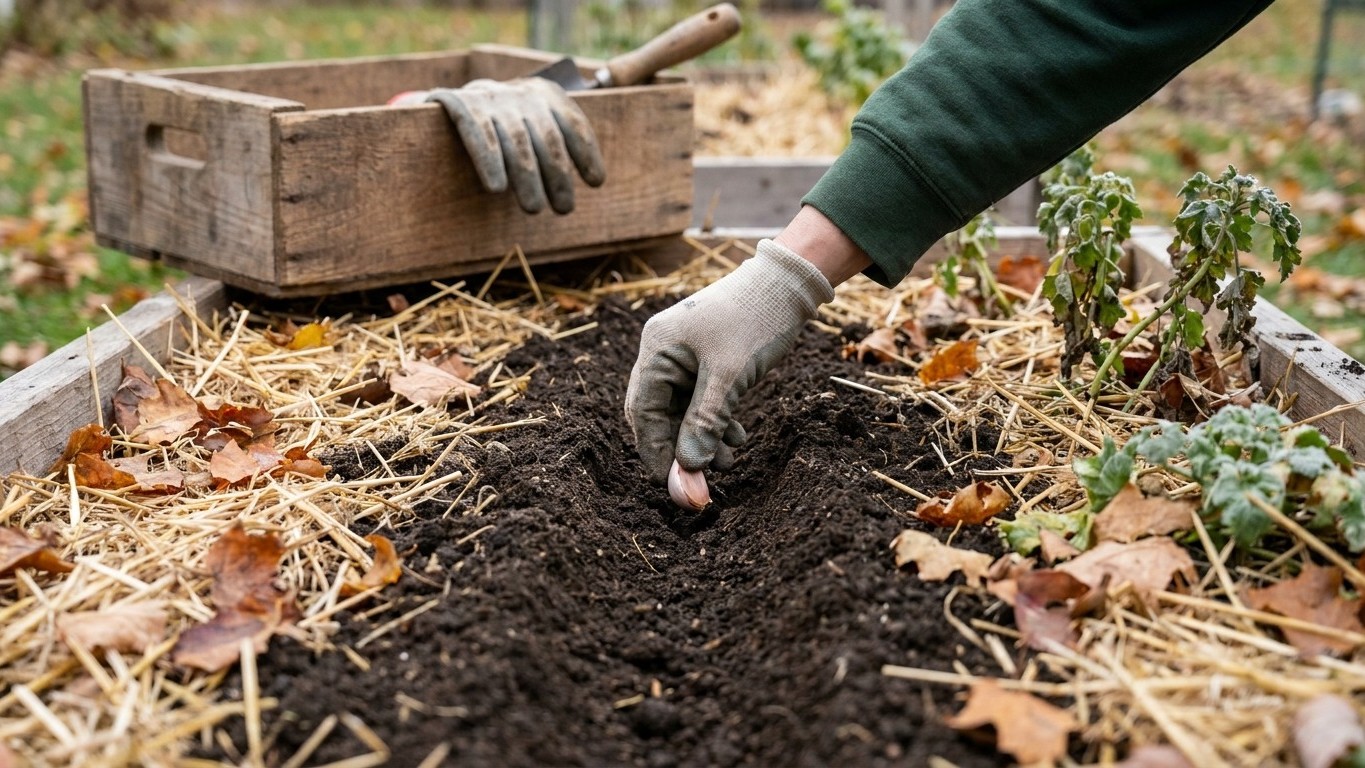

Garlic cloves and shallots are the main things still going into Pennsylvania ground this month, along with spring bulbs and bare-root trees while the soil stays workable. By November, the first fall frost has already arrived across most of the state, so the open-garden season for tender crops is closed. What’s left is dormant planting, cold frames, and the long list of jobs that set up next spring.
What goes in the ground in November

The decision here isn’t the calendar, it’s soil temperature and the frost window. NOAA’s 1991-2020 climate normals put Pennsylvania’s first fall freeze between November 5 and November 16. That means for most counties, by the time this month is underway, the ground has already had its first hard freeze, or is about to. Anything that dies at 32F is off the table. That includes tomatoes, peppers, squash, beans, and basically every warm-season crop that survived October on borrowed time.
What still goes in is the dormant, cold-hardy category. Garlic cloves and shallot sets can go into the ground right up until the soil is frozen solid or too wet to work, planted pointy-side up about two inches deep and mulched heavily once temperatures drop for good. Spring-flowering bulbs, tulips, daffodils, crocus, follow the same rule: get them in before the ground locks up, not after.
Bare-root fruit trees, roses, and shrubs can also be planted this month in the milder parts of the state, as long as the ground hasn’t frozen. Here the USDA Plant Hardiness Zone Map matters, because it’s built on one number, the average annual extreme minimum temperature, and Pennsylvania spans a wide range on it, from about 5a in the northern tier and the Alleghenies to 7b around Philadelphia. That range translates directly into how many extra weeks of workable soil the milder southeastern corner gets compared to the higher, colder ground up north.
What still makes sense this month
- Garlic cloves and shallot sets, planted before the ground freezes
- Spring bulbs (tulips, daffodils, crocus, alliums)
- Bare-root trees, shrubs, and roses where soil is still workable
- Cold frames or low tunnels holding greens sown earlier in fall
- Forced chicory (witloof endive) or rhubarb crowns brought indoors for a dark, warm push
Anything not on that list is a gamble against a frost window that, in a lot of the state, has already closed.
What to start under cover
Very little gets started indoors for transplant in November, and the arithmetic explains why. Counting backward from the last spring frost (March 29 to April 6 per NOAA’s normals), most transplants have lead times that land the indoor-sowing window well past this month. Tomatoes typically need 6 to 8 weeks before transplant, peppers 8 to 10, onions 10 to 12. Backed up from early April, those dates fall in mid-January through early March, not November. Start them now and you’ll get leggy, rootbound plants long before it’s safe to set them outside. That’s the classic too-early failure mode, and it’s the one to avoid this month.
What actually fits November’s clock is different. Quick, cold-tolerant greens, spinach, mâche, claytonia, arugula, can be direct-sown under a cold frame lid, row cover, or low tunnel. These germinate in soil down to around 40F and grow slowly through the cold, finishing for harvest in late winter or early spring. They’re not raced against a frost date the way summer crops are; they’re grown through the cold on a season-extension schedule instead.
This is also a reasonable month to begin cold, moist stratification for seeds that need it, hardy perennial flowers and some native shrub or tree species won’t germinate reliably without a chilling period first. Packed in damp sand or peat inside a sealed bag in the refrigerator or an unheated shed, checked monthly for mold, that seed will be ready to sow once the spring frost window opens. Skip this step, or start it too late, and you’re left waiting an extra season for germination that stratified seed would have delivered on schedule.
What is ready to pick
Fresh harvest from the open garden is thin once the first fall frost has passed through, and honestly, for a lot of the state that’s already happened by November. What’s still coming in are the crops built to take a hit of cold. Kale, collards, and Brussels sprouts actually improve after frost, the cold converts some of the plant’s starches to sugar, so a frost-touched harvest often tastes better than the same crop picked in September. Leeks left in the ground hold well under a heavy mulch layer, and parsnips and carrots can stay put under straw or leaves and be dug as needed, even after light ground freezes.
Cold frames and hoop houses sown in September or October should be yielding baby greens, spinach, mâche, arugula, on a slow but steady basis. Indoors, sprouts and microgreens fill the gap for households wanting something fresh and fast; both are ready in a week to ten days from seed with no soil or frost window to worry about.
This is also the month to go through stored crops methodically. Winter squash, potatoes, and onions in storage should get a hands-on check: any squash with a soft spot near the stem, any potato going soft or sprouting, any onion turning papery and dark at the neck needs to be pulled and used immediately, before it spreads rot to the crops around it.
The jobs that matter this month

Dormant pruning tops the list for fruit trees and cane berries. Cutting back apple, pear, and stone fruit while they’re fully dormant, and before the coldest stretch of winter sets in, reduces disease risk and shapes the tree for next season’s growth without the stress that pruning during active growth causes. Raspberry and blackberry canes that fruited this year can be cut to the ground now if they’re the type that fruits on new wood, or thinned if they fruit on second-year canes.
Seed ordering belongs on this month’s list too, not because it’s urgent in the garden, but because popular varieties of vegetables and flowers sell out early, and the good ones are gone well before spring planting starts. Pairing that with a rough plan for next season’s crop rotation, deciding where the nightshades, the brassicas, and the legumes will go, means spring arrives with a plan instead of a scramble.
Soil testing is worth doing now while beds are cleared and the results have months to work with; lime or sulfur applied in fall has time to adjust pH before spring planting, which a spring-only application doesn’t. Turning the compost pile, cleaning and sharpening tools before they sit idle all winter, and repairing raised bed frames or fencing while the ground is still workable are all jobs that cost far more time to fix in a rush next spring than they cost to handle now.
Mulching perennial beds matters too, but the timing has a trick to it: mulch should go down after the ground has had its first hard freeze, not before, since mulching too early traps warmth that can delay the plant’s dormancy and invite rodents looking for a mild place to nest.
What not to do in November
The most common mistake this month is trusting a mild afternoon over the calendar and the forecast. A run of warm days doesn’t mean the frost window has passed for good, it just means the next cold snap hasn’t arrived yet. Uncovering cold frames or pulling row cover off hardy greens during a warm stretch, then failing to get it back on before the next freeze, is one of the more preventable losses gardeners see this month.
Feeding nitrogen to perennials, lawns, or shrubs now is another one to avoid. Nitrogen pushes soft, leafy new growth, and that new growth has no time to harden off before a hard freeze arrives, so it dies back and wastes the plant’s stored energy in the process. If soil needs amending, this is the month for lime, sulfur, or compost, not a nitrogen-heavy fertilizer.
Leaving tender bulbs like dahlias and gladiolus in the ground after their foliage has blackened from frost is also a common slip. Once the tops die back, it’s time to lift the tubers or corms, let them cure, and store them somewhere cool and dry, not to leave them in ground that’s about to freeze solid around them.
Planting bare-root stock or bulbs into soil that’s already frozen or waterlogged is the last trap. If a shovel won’t go in cleanly, the ground isn’t ready, and forcing the issue damages roots more than waiting a few days for a thaw or a dry spell.
Checking this against your own county
A statewide month is a starting point, not an instruction. Pennsylvania’s elevation changes, the moderating effect of Lake Erie in the northwest corner, and the sheer distance between the Philadelphia area and the northern tier or the Alleghenies can shift these windows by two to four weeks in either direction. A bare-root planting date that works in a Philadelphia backyard can arrive weeks too early for a garden in the state’s higher, colder ground. For a planting calendar built around a specific county, and for local frost data pulled from the nearest weather station, the Penn State Extension service is the resource built for exactly that kind of local check.
Common questions
Can garlic still be planted in Pennsylvania in November?
Yes, as long as the ground hasn’t frozen solid or turned to mud. Garlic actually needs a cold period to form proper bulbs, so a November planting, mulched heavily after the ground firms up, is standard practice across the state.
Is it too late to plant grass seed in November?
For most of Pennsylvania, yes. Cool-season grass seed needs several weeks of soil warm enough for germination before a hard freeze sets in, and with the first fall frost already landing between November 5 and 16 in most areas, that window has generally closed by this point.
What vegetables can survive a Pennsylvania frost still in the garden?
Kale, collards, Brussels sprouts, leeks, parsnips, and carrots all tolerate frost well and, in several cases, taste better for it. A heavy mulch layer over root crops extends the harvest window even after the ground starts to freeze at the surface.
Should mulch go down before or after the first hard freeze?
After. Mulching too early traps soil warmth and can delay the dormancy plants need going into winter, and it also creates a cozy spot for rodents. Wait until the ground has frozen once, then mulch to keep it that way through winter’s freeze-thaw cycles.
Gardeners who plant by the Moon can check the November 2026 moon planting calendar, a tradition rather than a proven method.
Related guides
- the Pennsylvania planting calendar
- What to Plant in Pennsylvania in October
- What to Plant in Pennsylvania in December
Elsewhere? See what to plant in November in every state and province.