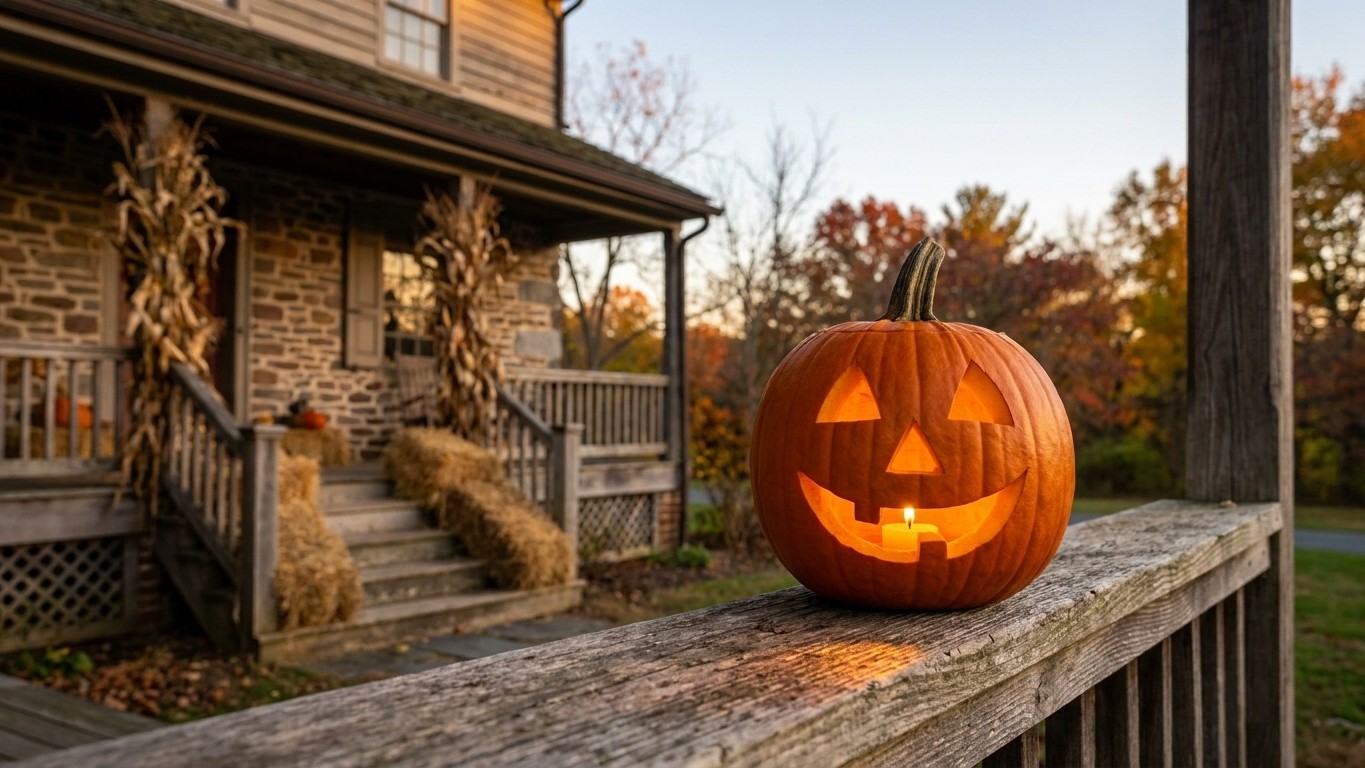

Philadelphia’s mean first fall frost lands sometime between November 5 and November 16, well after Halloween arrives. That gap matters: a pumpkin carved in the last week of October and left outside in the Philadelphia corridor isn’t facing frost damage before the big night. Farther north and in the Alleghenies, the calculus shifts earlier, so the safest approach statewide is to time carving to the day, not the season.
The short answer

For most of Pennsylvania, and especially the southeastern corner around Philadelphia, the mean first fall frost falls somewhere between November 5 and November 16. That’s a range, not a guarantee, and it’s worth remembering that a “mean” date means half the years run earlier and half run later. Still, it tells you something useful: in the mildest part of the state, frost typically arrives around one to two and a half weeks after Halloween, not before it.
What that means for a pumpkin sitting on a porch through October is straightforward. In Philadelphia and the surrounding lowlands, you’re not racing frost at all in the days leading up to Halloween. The threat, if there is one, comes from warmth and moisture, not cold. You have essentially the whole month to display an uncarved pumpkin outdoors without frost risk, and you can carve close to October 31 without worrying that a hard freeze will beat you to it.
The picture changes as you move north and into higher elevation. Pennsylvania’s northern tier and the Allegheny highlands run noticeably colder than the Philadelphia reference station used for these averages, and their frost season historically arrives ahead of the southeast’s. Nobody publishes an exact mean first frost date for every ridge and valley in that part of the state, but the pattern is consistent enough to plan around: if you live in the northern counties or up in the mountains, treat late October as a period when frost is plausible, even likely, rather than a safe zone.
So the practical window looks like this. In and around Philadelphia, carve whenever it suits you in the days before Halloween, since frost is not the limiting factor there. In the colder northern and mountain counties, lean toward carving closer to Halloween itself, because an early frost is more likely to arrive before the holiday than after it. Either way, the mean date is an average pulled from thirty years of records, not a promise for this particular year. Treat it as a planning tool, and check current forecasts as Halloween approaches rather than relying on the climate normal alone.
Frost or heat: which one gets it here
A whole pumpkin keeps best stored between 45 and 50 degrees Fahrenheit, in a cool, dark spot, according to University of Illinois Extension. That’s a narrow band, and it’s worth measuring against what late October actually looks like across Pennsylvania, because the state splits into two different problems depending on where you live.
The cold end: northern tier and Alleghenies
Philadelphia’s coldest month averages a daily minimum of 26 degrees Fahrenheit, and that’s the mild end of the state. Head north or up into the Allegheny highlands and winter minimums run colder still. That matters less for late October carving decisions than it does for storage location: an unheated shed or garage in the northern counties can dip well below the 45-50 degree storage band on a cold night, even before true winter sets in. Freezing temperatures break down the cell walls in pumpkin flesh, turning a firm gourd soft and eventually mushy. In this part of the state, the risk that matters is cold, not warmth. A pumpkin left in an uninsulated outbuilding on a frosty night can suffer real damage well before Halloween even arrives.
The warm end: Philadelphia and the southeast
Down in the Philadelphia corridor, the opposite problem shows up. Late October days here can still push well above 50 degrees, especially with any lingering warm spell, and a pumpkin sitting on a sun-facing porch or a warm mudroom floor spends plenty of hours above the ideal storage range. Warmth speeds up the natural breakdown that eventually leads to collapse, and it’s a bigger factor in the southeast than frost ever is in late October. So the risk here isn’t a hard freeze; it’s simply keeping the pumpkin cool enough, consistently enough, in a climate that doesn’t reliably deliver 45-50 degree days until later in the fall.
Where to keep it until you carve
Given that split, where you store a whole pumpkin in Pennsylvania depends on which end of the state you’re in, but a few principles hold everywhere.
- Look for a spot that stays close to 45-50 degrees Fahrenheit and stays dark. In the southeast, an unheated basement or an interior closet away from windows usually beats a warm porch. In the north and the mountains, an attached but unheated garage often works, since it buffers against the coldest overnight swings better than a detached shed.
- Keep the pumpkin away from any ripening fruit or vegetables, including apples, potatoes, and tomatoes. Ripening produce releases a gas that accelerates aging in nearby pumpkins, which is exactly why a fruit bowl or an apple crate on the same porch is the worst possible neighbor.
- Avoid heat vents, radiators, and any spot near a furnace or water heater, since consistent warmth pushes the pumpkin above the ideal range even in an otherwise cool room.
- Check the stem before you commit to a storage spot. Look for one to two inches of stem left intact, and never lift or carry the pumpkin by that stem. Once it breaks off, that exposed section becomes a likely entry point for rot, so handle the pumpkin by its base or sides instead.
- In the coldest parts of the state, if an unheated space is prone to dipping toward freezing overnight, move the pumpkin somewhere slightly warmer for the coldest stretches rather than leaving it exposed to a hard freeze.
Checking this against your own county
Climate normals from a single reference station only go so far in a state as geographically varied as Pennsylvania, where a fifty-mile drive can mean a meaningfully different frost calendar. For a forecast and guidance specific to your own county, Penn State Extension is the land-grant resource built for exactly this kind of local question, and it can point you toward frost data and seasonal guidance tailored to your part of the state rather than a single statewide average.
That local check matters most if you’re in the northern tier, the Alleghenies, or anywhere at higher elevation, where frost can behave differently than the Philadelphia-based averages suggest. A quick look at county-level guidance, paired with a current forecast as Halloween approaches, will tell you more than any statewide mean ever can.
Common questions
How long does a carved pumpkin actually last?
No university extension publishes a reliable number for a carved pumpkin, and none has tested preservation tricks like bleach dips or petroleum jelly coatings, so there’s no research-backed timeline to hand you. What is published is guidance on the whole pumpkin: choose one with an intact stem and no soft spots, keep it whole and stored properly for as long as possible, and carve it as close to the day you’ll display it as your plans allow.
Should I worry about frost before Halloween in Philadelphia?
Not much. The mean first fall frost there lands between November 5 and November 16, meaning frost typically arrives after Halloween rather than before it. It’s still an average, so treat it as a general expectation and check the forecast as the date gets closer.
Is a pumpkin patch pumpkin different from one at a grocery store?
The same selection rules apply either way. Look for one to two inches of stem, avoid blemishes and soft spots, and pick one that feels heavy for its size. Shape doesn’t matter for storage or carving quality.
Can I store a pumpkin outside in a Pennsylvania winter?
Only if the location stays within roughly 45-50 degrees Fahrenheit, and Pennsylvania winters, especially in the north and the mountains, routinely drop well below that. An unheated but insulated indoor space, like a garage or basement, is a far more reliable choice than anything left outdoors once temperatures start falling.