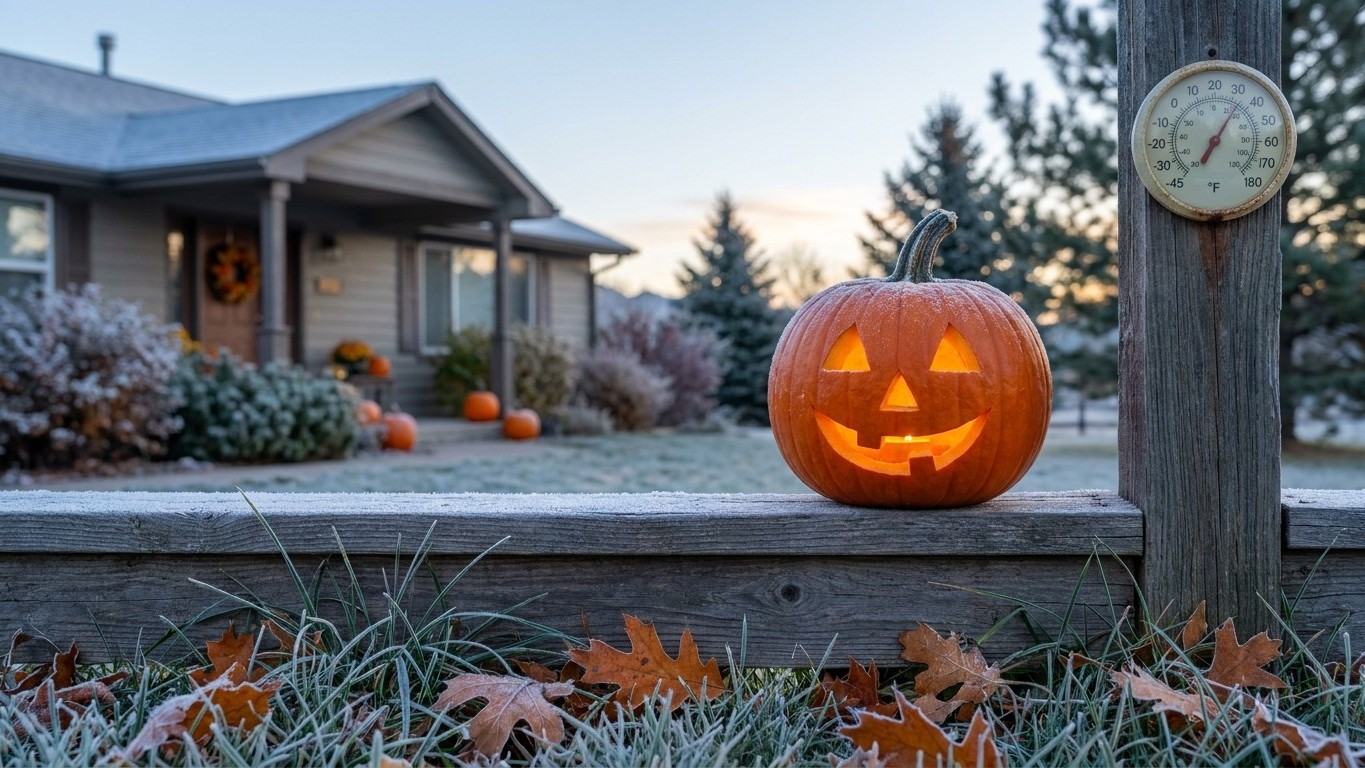

Along Colorado’s Front Range, the mean first fall frost lands somewhere between September 30 and October 12, weeks before Halloween even shows up on the calendar. That timing changes the whole calculation for a pumpkin sitting on a porch: cold arrives early here, not late, which means the carving window is shorter than in milder states and tied more to storage temperature than to any single date.
The short answer

Start with the number that matters: around September 30 to October 12 is when the first fall frost typically shows up near Denver, based on NOAA’s 1991-2020 Climate Normals for station USW00003017. That’s a mean, not a promise, but it tells you something useful. By the time Halloween rolls around on October 31, frost has usually already happened, in some years by three full weeks.
What does that mean for a pumpkin? Less than you’d think, as long as it’s whole. A whole pumpkin doesn’t need protection from a light frost the way a tomato plant does. It needs a steady 45-50 F and darkness, according to University of Illinois Extension. So the real question isn’t “when does it get cold in Colorado” but “when does the pumpkin’s environment drift outside that 45-50 F band,” and that can happen from either direction, cold nights or an unusually warm indoor stretch.
Given the frost timing, a practical window for carving in most of the Front Range and eastern plains is anywhere from about three weeks before Halloween up to the day itself, provided the pumpkin has been kept in that 45-50 F range the whole time rather than sitting on an unprotected porch through freezing nights. Carve earlier and you risk a longer stretch of exposure to temperature swings; carve closer to October 31 and you shorten that risk considerably.
One caution matters more here than in almost any other state. Denver sits at 5,280 feet on the plains, and the NOAA frost window above describes that kind of elevation and terrain. Colorado’s mountain towns run dramatically shorter growing seasons and can see frost as early as July. The Western Slope runs on its own pattern again, shaped by valley drainage and different elevation bands. A pumpkin patch in Steamboat Springs or Leadville is not operating on the same clock as one outside Denver or Colorado Springs, so treat the September 30 to October 12 figure as a Front Range and plains reference point, not a statewide rule.
Frost or heat: which one gets it here
A whole pumpkin wants 45-50 F. Colorado in late October rarely sits neatly inside that band, and the direction it misses matters.
The cold end
This is the one that applies in Colorado. With the mean first frost already arriving by September 30 to October 12, late October nights along the Front Range are frequently at or below freezing, well under the 45-50 F storage target. The coldest month’s mean daily minimum in Denver runs 18.4 F, which signals just how far winter cold pushes once it settles in. A pumpkin left on an open porch overnight in late October isn’t facing gentle chill, it’s facing temperatures that can dip meaningfully colder than what whole-pumpkin storage calls for.
The warm end
Heat isn’t the local risk in October. Colorado’s late-fall days can still be sunny and mild, especially with the state’s high elevation and lower humidity, but nights turn cold fast once the sun drops, and that swing is what defines the season here rather than any lingering summer-like warmth. The warm-end problem, a pumpkin baking indoors near a heat vent or in direct sun through a window, is a household storage mistake, not a regional climate pattern.
So the answer for Colorado is straightforward: cold is the threat, not heat, and it’s specifically the swing below 45 F on clear autumn nights that pushes a stored pumpkin outside its ideal range faster than warmth ever would this time of year.
Where to keep it until you carve
Given that Colorado’s risk runs cold rather than hot, the goal is finding a spot in a typical home or yard that holds closer to 45-50 F and stays dark, without drifting toward freezing on the coldest nights.
- Check an unheated garage first. In most Colorado homes this is the closest match to 45-50 F through mid and late October, especially if it’s attached and gets some residual warmth from the house.
- A basement works well too, particularly an older, unfinished one that stays cool and dark year-round regardless of what’s happening outside.
- Avoid an open, unprotected porch once nights start dropping toward or below freezing. That’s the exact scenario the NOAA frost data points to for late September through mid-October, and it’s colder than the storage band calls for.
- Keep it away from any ripening fruit, apples, potatoes, and tomatoes included. These give off ethylene gas that speeds up a pumpkin’s aging, according to University of Illinois Extension, so a shared crate or bowl with the fall apple haul is one of the worst combinations for shelf life.
- Keep it away from heat vents, radiators, and direct sun through glass. Even in a cold state, an entryway warmed by a furnace duct can push a pumpkin well above 50 F.
- Check the stem before it goes into storage. Look for 1 to 2 inches of stem intact. Once that stem breaks off, the exposed spot becomes an entry point for spoilage, so never lift or carry a pumpkin by the stem itself, only handle it by the body.
Checking this against your own county
NOAA’s frost data reflects one reference station near Denver, and Colorado’s terrain makes local variation the rule rather than the exception. A property outside Grand Junction on the Western Slope, a mountain valley near Gunnison, and a suburb east of Denver can all see frost on meaningfully different dates within the same season.
For a number specific to your area, contact Colorado State University Extension. County extension offices track local frost data and seasonal conditions and can tell you whether your area tends to run earlier or later than the Front Range reference point used here. That’s worth a quick call before deciding how early to bring a pumpkin in from an outdoor display.
Common questions
How long does a carved pumpkin actually last?
No extension service publishes a shelf-life number for a carved pumpkin, and none publishes a preservation protocol involving bleach dips or petroleum jelly. Those figures come from general content, not research. What is published: choose a pumpkin with 1 to 2 inches of stem still attached, keep it whole and stored between 45-50 F for as long as possible, and carve it close to when you plan to display it.
Should I carve before or after the first fall frost?
A whole, uncarved pumpkin doesn’t need protection from a light frost. The 45-50 F storage guidance matters more than the frost date itself, so focus on where the pumpkin sits, not on beating the frost by some number of days.
Is Denver’s frost date the same as the mountains?
No. The September 30 to October 12 window comes from a Front Range station near Denver at 5,280 feet. Colorado’s mountain towns run far shorter seasons and can see frost as early as July, and the Western Slope follows its own separate pattern.
Can I Carve a Pumpkin two or three weeks before Halloween in Colorado?
Yes, as long as it’s kept whole in a spot near 45-50 F and dark until you’re ready. The cold risk in Colorado runs toward freezing rather than heat, so an unheated garage or basement usually manages that window better than an open porch once nights turn cold.