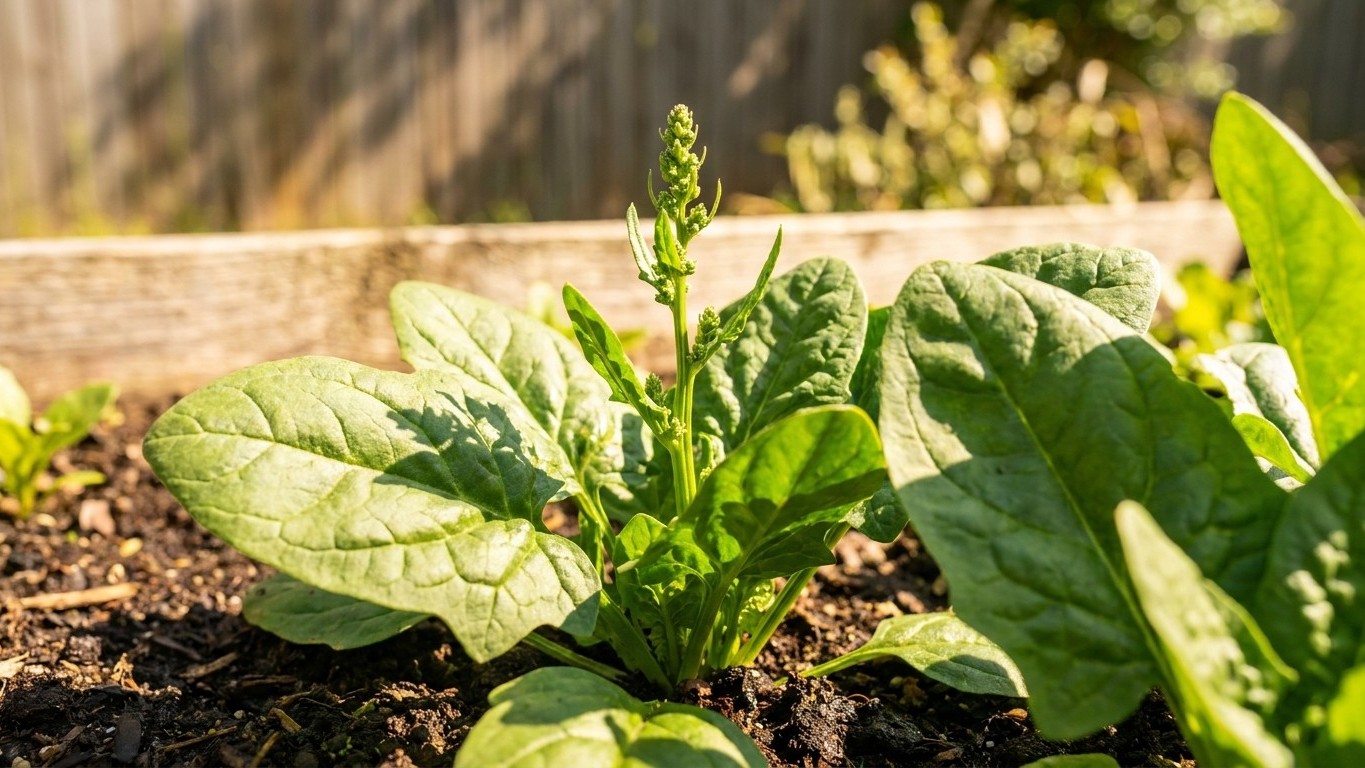

Spinach in Pennsylvania bolts early most years, and the reason has less to do with the state’s weather than most gardeners expect. At 14 hours and 50 minutes of daylight on the longest day, southeastern Pennsylvania gets plenty of summer sun, and that day length alone pushes spinach toward flowering. Add a summer that averages 24 days at 90°F or hotter, and the plant gets pushed twice. The limiting factor here is day length first, heat second.
The short answer
Fourteen hours and fifty minutes of daylight on the summer solstice, measured at the Philadelphia reference station, is a lot of light. For most vegetables that’s a selling point. For spinach it’s the opposite. Long days trigger the hormonal switch that sends the plant from leaf production into flowering, a process gardeners call bolting. That switch doesn’t care whether the afternoon feels comfortable or brutal. It fires on the calendar, driven by day length, and a mild or cloudy summer in Pennsylvania does nothing to delay it.
This matters because a lot of gardening advice assumes cooler summers simply buy more growing time. That logic works for tomatoes, for peppers, for plenty of warm-season crops that stall in heat and recover when it breaks. Spinach doesn’t follow that pattern. Once day length crosses the threshold that triggers flowering, the plant starts bolting whether the thermometer reads 68°F or 88°F. So even a Pennsylvania summer with a run of unusually mild weeks won’t rescue a spring spinach bed sown too late.
Heat still plays a role, just a supporting one. Spinach grows best where temperatures stay under 75°F, and Pennsylvania’s summer climate crosses that ceiling regularly, not just on the 24 days a year that reach 90°F or higher, but on plenty of ordinary June and July afternoons that sit in the upper 70s and 80s. Above that 75°F line, growth quality drops and leaves turn bitter, the same threshold doing double duty as both a growth ceiling and a flavor problem. So the honest answer is that day length starts the bolting process in Pennsylvania, and above-normal heat speeds it along and ruins the flavor of whatever leaves are left by the time it happens.
None of this means spinach can’t be grown well here. It means the crop has to be treated as a cool-season sprinter, not a season-long resident. Two short windows, one in spring and one in fall, do the job. Trying to stretch either one into summer is where most home gardens run into trouble.
How long the spring window really is
- Start counting from the last spring frost. Philadelphia’s last spring frost falls between March 29 and April 6. The northern tier and the Alleghenies run two to four weeks later, so gardeners in those regions should shift every date that follows by that same margin.
- Sow two to three weeks before that frost date. Spinach seed tolerates cold soil and light frost far better than most vegetables, so there’s no reason to wait for the ground to fully warm. In the Philadelphia area that puts sowing in mid-to-late March; in the higher, colder parts of the state it slides into early-to-mid April.
- Track the calendar toward the 75°F growth ceiling. Spring temperatures in Pennsylvania climb steadily through April and May, and by the time day length is closing in on its June peak, afternoons pushing past that 75°F mark become common rather than occasional.
- Add up the usable weeks. From a mid-to-late March sowing to the point where both long days and rising heat make growth poor and flavor bitter, southeastern Pennsylvania gets roughly eight to ten weeks of good spring spinach growing. Higher, cooler regions of the state get a similar span, just shifted later on the calendar.
Eight to ten weeks sounds workable, and it is, provided the sowing happens promptly rather than getting pushed back by a wet March or a late start. Every week of delay at the front end shortens the harvest window at the back end by roughly the same amount, since the crop doesn’t get more time just because it started later. The day length that ends the window keeps its own schedule regardless of when the seed went in the ground.
| Region | Typical spring sowing window | Typical first fall frost |
|---|---|---|
| Philadelphia and the mild southeast | Mid-to-late March | November 5 to 16 |
| Northern tier and the Alleghenies | Early-to-mid April | Two to four weeks earlier |
The autumn crop, and when the soil lets you sow
Fall spinach is often the more reliable of the two Pennsylvania crops, mostly because shortening days work in the plant’s favor instead of against it. But it comes with its own obstacle, and it isn’t cold. It’s heat still sitting in the ground.
Soil still too warm to germinate
Utah State University Extension notes that spinach germination drops off once soil temperature climbs above 80°F. Late summer soil in Pennsylvania, especially in a sunny raised bed or a south-facing plot, routinely sits above that mark well into early September, even after air temperatures have started to ease. Sowing into soil that hot means poor, spotty germination no matter how good the seed. The practical fix is to hold off until soil has cooled, checking with a simple soil thermometer rather than trusting the air temperature or the calendar, and using light shade or mulch in the interim if an early sowing date matters.
The frost that ends the season
Philadelphia’s first fall frost lands between November 5 and November 16. Spinach tolerates frost far better than it tolerates heat, so this date isn’t a hard stop so much as a marker for planning the harvest. Utah State’s guidance is to sow 50 to 75 days before the date a gardener wants to harvest, not before the frost itself. Counting back from a harvest target in early-to-mid November, that puts sowing somewhere between late August and mid-September for the Philadelphia area, a window that lines up well with when soil temperatures typically drop out of the germination danger zone. Gardeners in the northern tier and the Alleghenies, where frost arrives earlier, should shift both the harvest target and the sowing window back accordingly.
Several spinach varieties are commonly grown for fall harvest in Pennsylvania, including Bloomsdale, Melody, Teton, and Olympia, though no published days-to-maturity or performance data distinguishes one from another for this purpose. Choosing among them comes down to seed availability and personal preference rather than any documented difference in bolt resistance or cold tolerance.
Common questions
Does shade help spinach avoid bolting in Pennsylvania summers?
Shade can lower leaf temperature and help with the 75°F growth ceiling, but it does nothing about day length, which is the trigger that starts the bolting process. Shade slows the damage without stopping the cause.
Is there a spinach variety that resists bolting long enough to grow through a Pennsylvania summer?
No variety data addressing bolt resistance is published for the varieties commonly available, including Bloomsdale, Melody, Teton, and Olympia. Planning around the spring and fall windows remains the more reliable approach than betting on a summer-hardy variety.
Why does fall spinach often taste better than spring spinach in Pennsylvania?
Shortening days in fall move the plant away from the flowering trigger instead of toward it, and cooling temperatures keep growth under the 75°F ceiling that causes bitterness in spring crops pushed into early summer.
Should gardeners in the Alleghenies use the same dates as Philadelphia?
No. The Alleghenies and the northern tier see a last spring frost two to four weeks later than Philadelphia, and a first fall frost that arrives correspondingly earlier, so both the spring sowing date and the fall harvest target need to shift to match the local frost pattern.