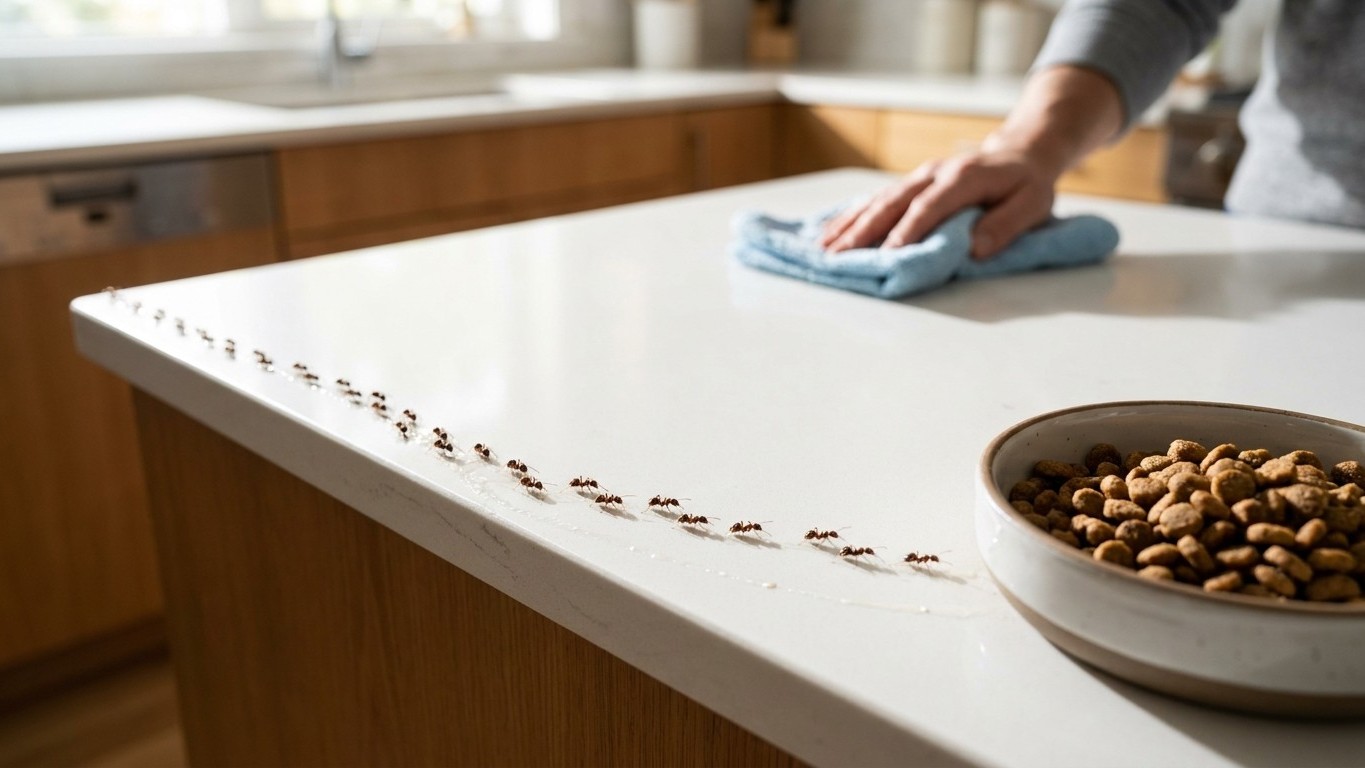

The clearest sign of ants indoors is a visible trail, usually along a wall, a countertop edge, or a windowsill, moving in one direction toward food or water and back toward a nest you likely can’t see. A single ant means little. A repeating line of them, especially one that reappears within hours of being wiped away, means a colony already knows your kitchen is worth the trip.
What you notice first

A trail is not the ants wandering. It’s the result of one scout finding something worth eating and leaving a chemical marker for the rest of the colony to follow. That’s why spraying or wiping away the ants you can see rarely solves anything: the colony that sent them is still intact, often behind a wall or under a slab, and will send more scouts within a day or two if the food source is still there.
Most households notice the trail first because it’s the loudest sign, visually. A line of small dark or reddish-brown insects, sometimes single file, sometimes fanned out around a spill or a pet bowl. Second most common: the ants show up at a consistent time, often early morning or right after the kitchen goes quiet at night, which tells you something about which species you’re dealing with and how it forages.
Signs that are easy to miss
Some signs get overlooked because they don’t look like an insect problem at all.
- Tiny piles of what looks like fine sawdust or dirt near baseboards, window frames, or door casings, which can mean ants are excavating a nest inside wood rather than just passing through.
- A faint, sweetish or slightly musty odor when a group of ants is crushed, which some species release as a warning signal.
- Small, irregular holes in soft wood, foam insulation, or even wall voids that show no obvious entry point from outside.
- A handful of winged ants appearing indoors, often near a window, which can signal a mature colony nearby that’s producing new reproductives.
The U.S. Environmental Protection Agency frames the right first move plainly: “IPM programs work to monitor for pests and identify them accurately, so that appropriate control decisions can be made.” That’s the whole reason identification comes before any decision about what to do next. Guessing the species from a glance and reaching for a product wastes time and money if the guess is wrong.
What it is confused with
Ants get mistaken for other pests more often than most people expect, and the confusion isn’t harmless. Treating the wrong problem means the real one keeps going while you spend money on something that was never going to work.
| What you saw | What it might actually be | How to tell them apart | Why the mix-up costs you |
|---|---|---|---|
| Small pile of “sawdust” near a windowsill | Termite frass, or carpenter ant debris | Termite frass looks like tiny pellets or coarse sand; carpenter ant debris looks more like fine wood shavings and often includes dead insect parts | Treating for ants when it’s termites lets structural damage continue unaddressed for months |
| Winged insects near a window | Flying ants, or termite swarmers | Ants have bent antennae, a pinched waist, and unequal-length wings; termites have straight antennae, a thick waist, and wings of equal length | Buying an ant bait station does nothing for an active termite swarm |
| Trail of tiny insects on a counter | Ants, or a different small insect like a psocid or a young cockroach | Ants move with visible purpose along a set path; most other small household insects don’t form organized trails | Store-bought ant bait won’t attract or kill unrelated pests, so the real problem is never touched |
| Ants appearing only outdoors near the foundation | Pavement ants that never actually entered the structure | Check whether the trail crosses the threshold or stops at an exterior crack or expansion joint | Indoor treatment is unnecessary and doesn’t address the outdoor colony driving the sightings |
The costliest mistake on that list is the first one. Carpenter ant damage and termite damage can look similar to an untrained eye, but the pests, the timeline, and the fix are completely different. Some homeowners spend on ant bait for weeks before realizing the debris was frass from a termite colony that had been active far longer than any ant infestation would need to be noticed.
Telling a sighting from an infestation
One ant crossing a kitchen floor is not an infestation. It’s a data point. The judgment call homeowners actually need, and rarely get told directly, is where the line sits between “normal for a house with doors that open” and “something is established inside.”
A few measurable questions do most of the work. Where are you seeing them, only near a specific entry point or spread across multiple rooms? How many at a time, a handful or dozens? At what time of day, only after a spill, or at a consistent hour regardless of food being present? And critically, are you seeing life stages other than adult foragers, larvae, pupae, or winged reproductives, which point to an active nest producing more ants rather than a few scouts passing through.
The EPA’s own framework for pest decisions starts here, before any action is taken: “Before taking any pest control action, IPM first sets an action threshold, a point at which pest populations or environmental conditions indicate that pest control action must be taken.” That threshold is different for every household. A single ant near a door in summer might not clear it. A daily trail of 20 or more, or any sighting of winged ants indoors outside of a brief seasonal swarm, usually does.
Acting too early has its own cost. Buying and placing bait, sealing entry points, or calling a technician for a single sighting wastes money and sometimes disrupts the very evidence that would have helped identify the species and the nest location later. Waiting for a pattern, a few days of consistent observation, gives you the information an accurate response actually needs.
Signs that confirm an established nest
- The same trail reappears in the same location within 24 to 48 hours of being cleaned
- You find winged ants indoors more than once, not just a single stray
- Multiple separate trails lead toward different food or water sources in the same structure
- Wood shavings, frass, or small holes appear alongside the trail, not just the ants themselves
What to do once you are sure
Once the pattern is clear, the identification is confirmed, and the sightings cross whatever threshold makes sense for your household, the next steps split into two separate questions: what’s drawing them in, and how to remove them without wasting effort.
The EPA’s guidance on the first line of defense is worth repeating exactly: “As a first line of pest control, IPM programs work to manage the crop, lawn, or indoor space to prevent pests from becoming a threat.” For a house, that means figuring out the specific food, water, or shelter source pulling ants inside before reaching for any product. That question, what’s attracting them, deserves its own answer rather than a guess, and it’s covered in detail on our page about what attracts ants into a house.
Only after prevention and identification does the EPA’s order of methods point toward control: “Effective, less risky pest controls are chosen first, including highly targeted chemicals, such as pheromones to disrupt pest mating, or mechanical control, such as trapping or weeding,” with broad measures held back, since “broadcast spraying of non-specific pesticides is a last resort.” What that looks like in practice for the species you’ve identified, and which tools actually work at each stage, is covered on our how to get rid of ants page.
Carpenter ants are the one case where a homeowner should treat a confirmed sighting as a call to a licensed pest management professional rather than a DIY project, since an established nest inside structural wood is difficult to locate and treat completely without training. The same is true any time frass or damage patterns raise even a partial suspicion of termites: that identification question needs a professional inspection, not a home remedy, because the cost of being wrong compounds every month the colony keeps feeding.
If you’re ever unsure whether a specific product is appropriate or safe to use around children, older adults, or anyone with a compromised immune system, the EPA’s National Pesticide Information Center takes public questions directly at 1-800-858-7378. That’s a more reliable answer than any general guidance, since registered products and labels vary by state and change over time, and the label on the product in your hand is the only one that legally applies.
Common questions
Do a few ants indoors always mean an infestation?
No. A handful of ants, especially near a door or window and only after a spill or open food, is often just foraging from an outdoor colony. An infestation is suggested by a recurring trail, multiple trails, or the presence of winged ants or larvae indoors.
Why does the trail keep coming back after I clean it?
Because wiping the surface removes the scent trail temporarily but does nothing to the colony that sent the scouts. Ants that found a reliable food source will send more scouts along the same general path until the food source itself is removed or the nest is treated.
Are winged ants indoors always a sign of a mature colony?
Usually, yes. Winged ants, sometimes called swarmers, are reproductive members produced by an established colony looking to start new nests. Seeing them indoors, especially more than once, points to a nest that’s been active long enough to mature, not a brand-new problem.
When should I stop trying to handle this myself and call a professional?
If the species appears to be carpenter ants, if you find wood damage or frass alongside the ant sightings, or if bait and sealing entry points haven’t reduced activity after a couple of weeks of consistent effort, a licensed pest management professional can locate the nest and confirm the species in ways a homeowner typically can’t.