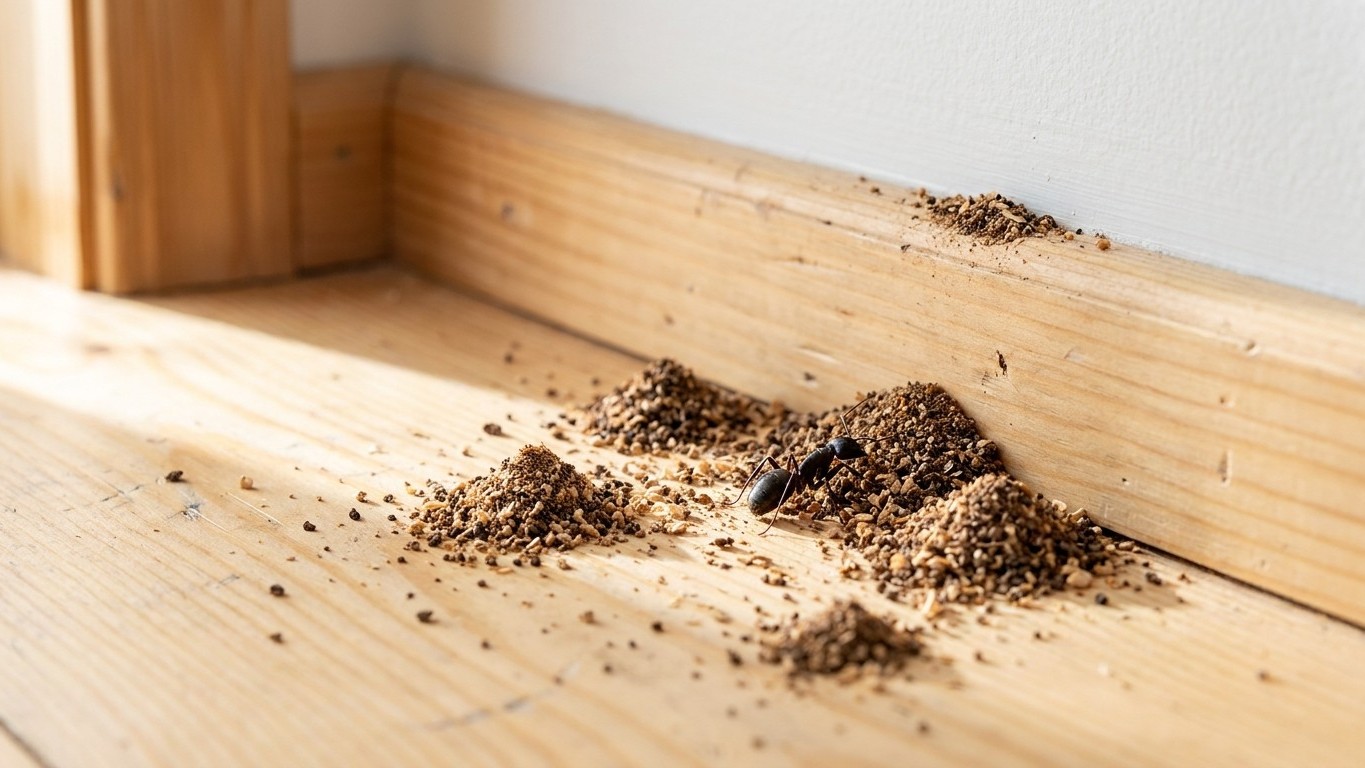

Frass piles that look like fine sawdust, faint rustling inside a wall after dark, and large black ants showing up in a bathroom or kitchen with no obvious food source nearby: these are the signals that point to carpenter ants rather than any other household insect. The insects themselves don’t eat the wood they tunnel through, they push it out as debris while carving nesting galleries, which means every visible sign traces back to moisture sitting somewhere in the structure. Spotting the pattern early, rather than reacting to one ant, is what separates a quick fix from a multi-week repair.
What you notice first

The most common sign, and the easiest one to miss, is frass. It gathers in small, cone-shaped piles near baseboards, window sills, door frames, or inside a wall void behind an outlet cover. Unlike true sawdust, carpenter ant frass is coarse, mixed with tiny fragments of dead ants and bits of insulation, and it has no uniform texture. Homeowners often sweep it up for weeks, assuming it’s construction dust or debris from a pet, before connecting it to anything living in the wall.
Sound comes next for a lot of people, particularly at night. Carpenter ants are mostly nocturnal foragers, and a mature colony inside a wall stud can produce a faint dry rustling or crackling, sometimes described as the sound of cellophane being crushed slowly. It’s quiet enough that a running dishwasher or a window air conditioner will mask it completely, which is why it tends to get noticed only in a still house, late at night, in a bedroom that backs onto an exterior wall.
Visually, the workers themselves are large, up to about half an inch long, uniformly dark or bicolored (black body with a reddish thorax), with a smoothly rounded, evenly curved profile when viewed from the side. Finding a handful of them trailing along a countertop toward a sink or a potted plant, especially after dark, is a stronger sign than a single ant seen at midday near an open door.
The most telling sign, and the one that ends most guessing games, is winged swarmers appearing indoors, usually in spring. Their presence inside a window sill or light fixture almost always means there’s a mature nest somewhere in the structure, not just an outdoor colony passing through. Small slit-like openings in trim or siding, sometimes called kick-out holes, where frass gets expelled, and wood that sounds hollow or gives slightly under a screwdriver’s pressure, round out the physical evidence.
None of these signs, taken alone, tells the whole story, which is exactly why the U.S. EPA frames identification as a distinct step in pest management before any decision gets made: “IPM programs work to monitor for pests and identify them accurately, so that appropriate control decisions can be made.”
What it is confused with
The signs above overlap with several other insects, and mixing them up sends a homeowner toward a fix that has no chance of working. The confusion that costs the most money is between carpenter ants and termites: both produce debris near baseboards, both swarm indoors in spring, and both suggest wood damage. But a treatment aimed at one does nothing against the other, and a termiticide bait station or a moisture-focused ant treatment applied to the wrong pest means the real problem keeps progressing while the bill adds up.
| Look-alike | What it looks like | How to tell it apart | Why the mistake matters |
|---|---|---|---|
| Termites (swarmers) | Winged insects near windows or lights, similar size to carpenter ant alates | Termite wings are equal length and shed easily; termite antennae are straight, not bent; termites have a thick, straight-sided waist instead of a narrow pinch | Termite damage requires structural treatment; an ant-focused fix leaves an active termite colony untouched |
| Field ants | Large, reddish-brown to black ants, sometimes seen indoors near foundations | Field ants don’t nest in sound wood and rarely produce indoor frass; they’re usually just passing through from an outdoor mound | Treating the house interior for a colony that actually lives outside wastes effort and product |
| Wood-boring beetles | Small round exit holes in wood, fine powdery frass | Beetle frass is powder-fine and uniform, not coarse and mixed with insect fragments; no live ants are ever seen | Beetle damage needs a different inspection approach and a different repair timeline |
| Odorous house ants | Small dark ants trailing on counters, especially after rain | Much smaller (about 1/8 inch), no wood damage, no frass, gives off a rotten-coconut smell when crushed | These ants respond to baiting; carpenter ant moisture problems don’t get solved by bait alone |
The antenna shape and the waist are the fastest field checks: an ant’s antennae have a distinct bend, and its waist is pinched into a narrow segment, while a termite’s antennae run straight and its body stays roughly the same width from head to tail.
Telling a sighting from an infestation
One ant crossing a counter is not an infestation, and treating it like one is its own kind of mistake. The EPA’s integrated pest management framework builds this judgment call into the very first step: “Before taking any pest control action, IPM first sets an action threshold, a point at which pest populations or environmental conditions indicate that pest control action must be taken.” Acting before there’s anything measurable to act on wastes time and, often, money on products aimed at nothing in particular.
What actually indicates a colony indoors, rather than a few foragers wandering in from outside, comes down to a handful of measurable things. Location matters: ants seen consistently in one specific area, especially near a window sill, bathroom, or kitchen plumbing wall where moisture tends to accumulate, point toward a nest close by. Numbers matter: a couple of ants a week is very different from a steady stream of a dozen or more workers following the same trail every night. Timing matters, since these ants forage mainly after dark, so a nighttime kitchen full of large ants is a stronger indicator than a single one seen crossing a sunlit patio.
The clearest confirmation is finding evidence of the breeding stages rather than just workers. Frass piles that keep reappearing after being cleaned up mean an active gallery is still being excavated nearby. Winged swarmers found inside the house, as opposed to ones seen outdoors near a stump or woodpile, confirm a mature colony living in the structure rather than one simply sending scouts through an open door. Sound at night, heard repeatedly in the same wall section over several evenings, adds another layer of confirmation.
Put together, a single sighting deserves watching, not panic. A pattern across location, numbers, timing, and physical debris is what crosses the threshold into something that needs a real response.
What to do once you are sure
Once frass keeps reappearing, swarmers show up indoors, and the sightings settle into a nighttime pattern near one wall or one room, the next two questions are what’s feeding the colony and how to stop it. Carpenter ants nest almost exclusively in wood that’s already damp or already damaged, which means the fix usually starts with tracking down a leak, a clogged gutter, or a spot where wood contacts soil, rather than reaching for a spray. A separate page in this series covers what draws them into a structure in the first place, and another walks through the control options that actually work once identification and moisture are sorted out.
For carpenter ants specifically, calling a licensed pest control professional as the first move is a reasonable, often the smartest, choice rather than a last resort. Colonies frequently split into a main nest and several satellite nests scattered through a structure, hidden behind siding, inside a bath trap, or above a porch ceiling, and finding all of them usually requires tools and experience a homeowner doesn’t have on hand. A professional inspection also settles the termite-versus-carpenter-ant question definitively, which matters given how differently those two problems get treated.
The EPA’s broader guidance on pest management follows a specific order for a reason: identify first, manage the conditions that attract the pest, and treat the actual cause of the site, then reserve broad chemical treatments for last. As the agency puts it, “Effective, less risky pest controls are chosen first, including highly targeted chemicals, such as pheromones to disrupt pest mating, or mechanical control, such as trapping or weeding,” and “broadcast spraying of non-specific pesticides is a last resort.” Pesticides are built to be toxic to pests, and the EPA notes they can be toxic to people when used improperly, with children, older adults, and people with compromised immune systems named as especially vulnerable. Anyone with questions about a specific product’s label or safe use around a household can call the National Pesticide Information Center at 1-800-858-7378 rather than guessing.
Common questions
Can carpenter ants actually damage a house’s structure?
Given enough time, yes. They don’t eat the wood, but repeated gallery excavation weakens support beams, sills, and framing, especially where moisture has already softened the material. Damage tends to be slower and more localized than termite damage, but it isn’t cosmetic once it’s been going on for months or years.
Do carpenter ants bite people?
They can, using their mandibles, and a bite can pinch or sting briefly, but they aren’t considered a household health hazard the way some other pests are. They’re far more of a structural and moisture-indicator concern than a bite risk.
How do I know if they’re in the walls or just visiting from outside?
Repeated sightings in the same indoor location, frass that reappears after cleanup, winged swarmers found inside rather than outdoors, and nighttime sounds in one wall section over multiple nights all point to an indoor nest rather than outside foragers passing through.
Why do carpenter ants suddenly swarm inside the house?
Swarming, usually in spring, is how a mature colony sends out new reproductive males and females to start additional colonies. Seeing swarmers indoors specifically means the colony producing them is already living inside the structure, not somewhere out in the yard.