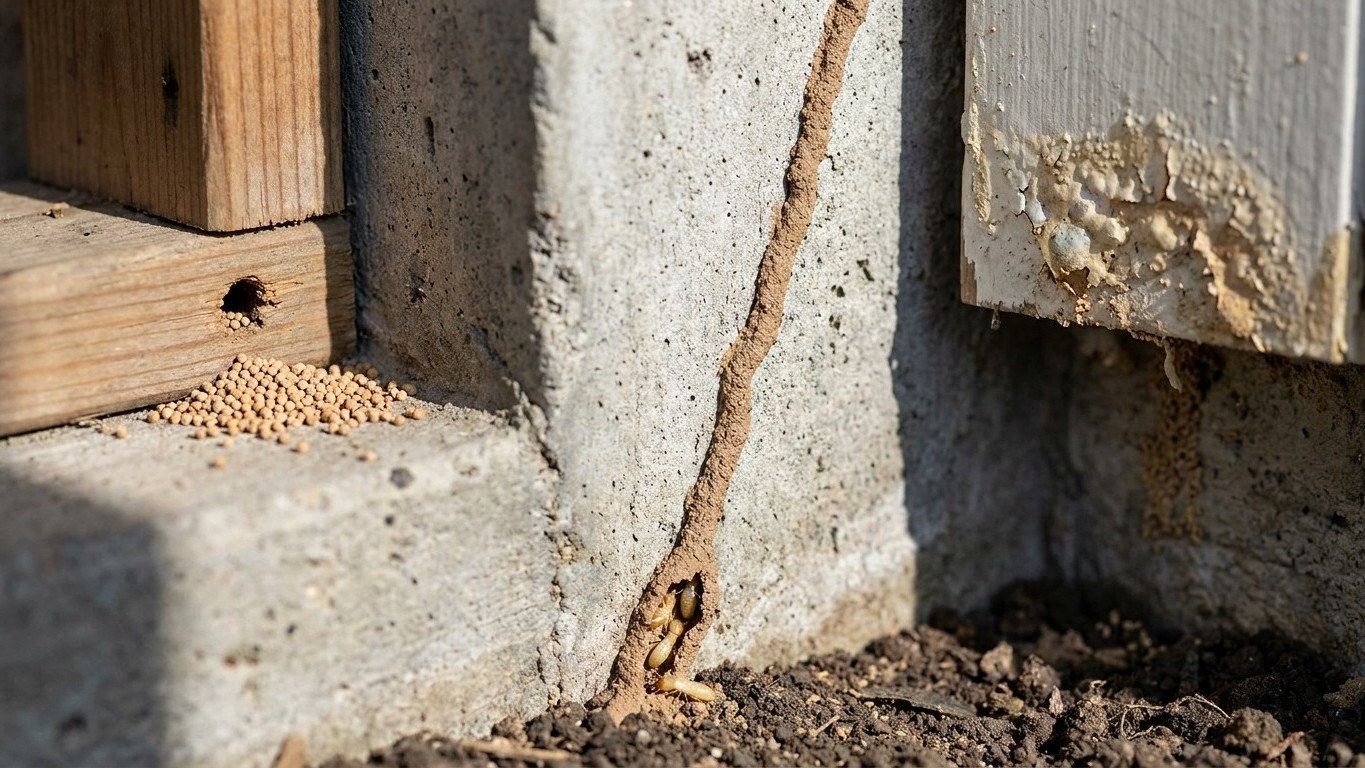

Termites reveal themselves through a short list of signs: pencil-width mud tubes running up a foundation, piles of six-sided pellets under a tiny hole in trim, wings shed in matching pairs near a windowsill, wood that sounds hollow when tapped, and paint that bubbles for no reason connected to plumbing. None of these show up early. A colony can work inside a sill plate or wall stud for years before any of that surfaces, which is why the sign you notice is rarely the first damage done, only the first damage visible.
What you notice first

Termites eat wood from the inside, following the grain, and they avoid breaking through the outer surface until the damage underneath is already extensive. A joist can lose most of its structural strength while the paint on top of it still looks fine. Subterranean species, the most common across the United States, also build their tunnels through soil and wall voids, keeping almost the entire colony out of sight for its whole life.
The most common sign, and the one homeowners actually catch, is mud tubes: pencil-width tunnels of soil and saliva running up a foundation wall, a support pier, or a plumbing penetration. They let workers travel between the soil and the wood above without drying out, since subterranean termites die quickly outside a humid tunnel. Break one open. If it’s active, you’ll find cream-colored workers inside within minutes; if it’s abandoned, it stays empty and often crumbles.
Discarded wings are the second most noticed sign, usually found in matched pairs near a window ledge, a light fixture, or a spider web indoors, left behind after reproductive termites have mated and shed wings they no longer need. Homeowners often sweep these up without a second thought, which is exactly how an early warning gets lost.
Two signs are easy to miss because they require deliberate checking rather than casual noticing. Frass, the six-sided fecal pellets drywood termites push out of tiny kick-out holes, collects in small mounds that look like sawdust or ground pepper and is often mistaken for construction debris. Hollow-sounding wood only shows up if someone taps a baseboard, a deck post, or a door frame with a screwdriver handle and notices it sounds papery rather than solid. Blistered or sunken paint on wood trim, caused by tunnels just beneath the surface, is frequently blamed on humidity and repainted over.
Because none of these signs reliably show up until a colony has been established for a while, the U.S. Environmental Protection Agency’s approach to pest management puts confirmation ahead of any response: “IPM programs work to monitor for pests and identify them accurately, so that appropriate control decisions can be made.” For termites, that identification step is the one homeowners are least equipped to finish alone, since it usually means opening a wall void or a mud tube rather than reading a sign from across the room.
What it is confused with
Termite signs overlap with several ordinary household problems, and the confusion runs in both directions: some homeowners treat for termites when they have something else entirely, and just as many dismiss real termite activity as one of these harmless look-alikes.
| Sign observed | What it might be instead | How to tell the difference | Why the mix-up costs you |
|---|---|---|---|
| Winged insects swarming indoors | Flying ants, especially carpenter ants | Termite wings are equal in length and extend well past the body; ant wings are unequal, with the front pair longer. Termite antennae are straight, ant antennae are bent, and a termite’s waist is thick while an ant’s is pinched. | Ant treatments do nothing to stop a termite colony feeding on the frame behind the wall |
| Small pellet-like debris | Carpet beetle casings or rodent droppings | Drywood termite frass is uniform and six-sided under magnification, and piles beneath a pinhole-sized kick-out opening rather than being scattered randomly | Vacuuming it up as generic bug debris removes the only visible evidence of an active colony |
| Wood that sounds hollow when tapped | Ordinary wood rot from moisture | Rot leaves wood soft, spongy, and dark-stained, usually near a known leak; termite-damaged wood keeps a thin outer shell over a honeycombed interior | Fixing the moisture source without checking for termites leaves an active colony untouched |
| Bubbling or peeling paint on trim | Humidity or a plumbing leak | Leak damage tracks back to a pipe, window, or roof penetration; termite-related bubbling can appear on interior trim with no water source nearby | Repainting covers the surface sign without addressing what caused it |
The costliest version of this mix-up is the first one. Termite swarmers and flying ant swarmers appear at similar times of year, often after rain, and both show up around windows and doors looking for a way out. A homeowner who calls a pest control company for “ants” based on a description over the phone, without anyone examining the actual insects or wings left behind, can pay for a treatment that leaves a termite colony completely unaffected. The reverse happens too: real termite swarmers get dismissed as flying ants and swept into the trash, and the infestation goes unaddressed for another season.
Telling a sighting from an infestation
One winged insect on a windowsill in October is not an infestation. Termites and ants both produce reproductive swarmers that disperse to start new colonies, and a single insect that wandered in through a gap or hitched a ride on firewood doesn’t mean a colony is established inside the structure. The judgment homeowners need, and rarely get spelled out, is where the line sits between a sighting worth watching and a confirmed infestation worth acting on.
Location is the first measure. A swarmer found near a foundation wall, a crawl space vent, or a sill plate carries more weight than one found in the middle of a living room, since it suggests proximity to an existing colony rather than random wandering. Count matters next: a handful of insects scattered over several days is different from dozens to hundreds emerging at once from the same crack or gap, which is what an actual colony swarm looks like. Time of day adds information too, since subterranean termite swarms in much of the country tend to happen during daylight, often within a day or two of rain, while some drywood species swarm at night and are drawn to light.
The clearest confirmation comes from finding more than one stage or sign in the same location: swarmers alongside mud tubes, workers found the moment a tube is broken open, or frass accumulating steadily over several weeks rather than a one-time pile. That combination points to a breeding colony rather than a stray visitor, and it’s the point where the EPA’s own framework says a response is warranted, not before: “Before taking any pest control action, IPM first sets an action threshold, a point at which pest populations or environmental conditions indicate that pest control action must be taken.”
Acting before there’s anything to act on wastes money and, in the case of do-it-yourself soil or spot treatments, can push an active colony to relocate deeper into a structure rather than eliminate it. Waiting past that threshold, on the other hand, lets a colony already established near framing lumber keep expanding for another season. The practical middle ground for termites is documentation: mark or photograph a mud tube’s location, note the date insects were seen, keep any frass instead of vacuuming it up, and bring that record to whoever inspects the property, rather than trying to make the call from a single glance.
What to do once you are sure
Termites are one of the household pests where a professional inspection is the reasonable first call, not a last resort after home remedies fail. Confirming an active colony usually means opening a wall void, probing a sill plate, or identifying a species from wing and body features under magnification, work that requires training most homeowners don’t have, along with treatment tools, such as soil treatment around a foundation, bait stations, or structural fumigation for drywood species, that aren’t available over the counter.
The EPA’s own order of operations explains why a scattershot response doesn’t work here. Prevention comes first in its framework: “As a first line of pest control, IPM programs work to manage the crop, lawn, or indoor space to prevent pests from becoming a threat.” For a house, that’s the subject of what attracts termites in the first place, things like wood-to-soil contact, mulch piled against a foundation, and moisture sitting near a crawl space, all worth fixing whether or not a colony is already present.
Once prevention hasn’t been enough and a colony is confirmed, the framework calls for the least risky effective option before anything broader: “Effective, less risky pest controls are chosen first, including highly targeted chemicals, such as pheromones to disrupt pest mating, or mechanical control, such as trapping or weeding.” Wide, non-specific spraying sits at the opposite end of that list on purpose: “Broadcast spraying of non-specific pesticides is a last resort.” That ordering is also a safety matter, since pesticides are designed to be toxic to the organisms they target and can be toxic to people when handled or applied incorrectly, with children, older adults, and anyone with a compromised immune system named as more vulnerable than the general population.
None of that is a reason to guess at a product yourself. If a pest control company proposes a specific treatment and you want to understand what’s in it before it goes anywhere near your house, the National Pesticide Information Center takes calls from the public at 1-800-858-7378 and can walk through what a label actually means. The two practical next steps from here are separate questions worth their own answers: what conditions around this particular house are drawing termites in, and what a licensed treatment for the species found actually involves.
Common questions
What is the very first sign of termites most people notice?
Usually either a mud tube along a foundation wall or a small pile of discarded wings near a window, since both are visible without opening anything up. Both are also easy to overlook if no one is looking for them specifically.
Can you have termites without seeing any swarmers?
Yes. A colony can feed inside walls or under a slab for a long stretch without ever swarming indoors, especially if the nest itself stays outside in the soil. Mud tubes, frass, and hollow wood can all appear with no swarmers ever spotted.
Do termite signs always mean an active infestation?
Not always. An old, dry, crumbling mud tube or a single wandering swarmer can be leftover evidence rather than proof of a current colony, which is why location, count, and repeated evidence over time matter more than any single sighting.
How fast do termites cause visible damage?
There’s no fixed timeline, since it depends on colony size, species, and how much wood is available, but visible signs like sagging floors or hollow trim typically mean the colony has already been established for a while, not that damage just started.