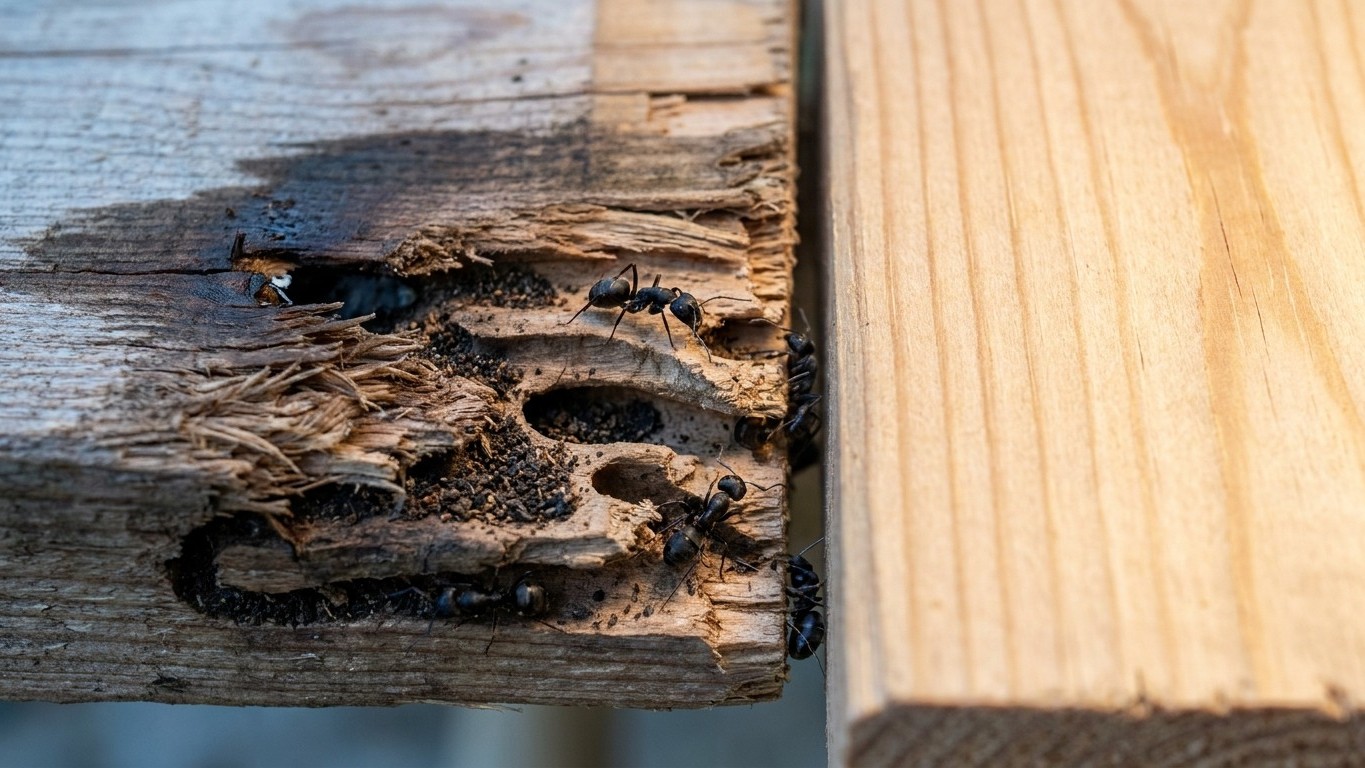

Carpenter ants don’t come inside to eat your house. They come inside because something in it is already wet, soft, or falling apart, and that damage tells them a nesting site is ready. Food matters too, but it’s the secondary draw. Once you know which condition is doing the inviting, the fix stops being about chasing ants and starts being about removing the one thing they showed up for in the first place.
What they are actually looking for

Every pest that ends up indoors is chasing one of three things: food, water, or shelter. For most ants, that’s a smear of syrup or a dropped cracker. Carpenter ants are different. They don’t eat wood the way termites do, but they excavate it to build galleries, and they overwhelmingly prefer wood that’s already damp or damaged. A leaking pipe under a sink, a windowsill that’s been soaking up rain for two seasons, a porch post rotting from the ground up. That’s the real target, not your pantry.
This distinction changes what prevention actually looks like. A species drawn by crumbs gets discouraged by a clean counter. A species drawn by moisture doesn’t care how tidy the kitchen is if there’s a slow leak in the wall behind it. That’s why a spotless house can still end up with an active colony, and why a house with dust on every shelf can stay ant-free if the wood stays dry.
Water first, food second
Carpenter ants do forage for food, sugars and proteins mostly, and they’ll travel a surprising distance from a nest to find it. But the nest site itself is chosen for moisture and softness, not calories. Softened wood is easier to hollow out, and damp wood usually means a fungal component is already breaking down the fibers, which makes excavation even easier. Fix the moisture source and the wood dries and hardens again, and that alone makes a spot far less attractive for a new colony even before any product touches it.
This is also the piece that pest control agencies put first, ahead of any spray or bait. The U.S. Environmental Protection Agency frames it plainly: “As a first line of pest control, IPM programs work to manage the crop, lawn, or indoor space to prevent pests from becoming a threat.” For a carpenter ant problem, managing the indoor space means finding and drying out the wet wood, not just finding the ants walking across it. Skip that step and any control measure is working against a condition that keeps renewing itself.
How they get in
Carpenter ants rarely march through a wide-open door. They use small, specific gaps, and the same handful of spots account for most entries. Walking a house in this order catches the majority of them:
- Gaps around pipes and cables where they pass through a foundation or exterior wall, often left unsealed after plumbing or electrical work.
- Door sweeps that have worn down or were never fitted tight to the threshold.
- Window screens and frames with gaps at the corners or a track that no longer closes flush.
- Vents, including dryer vents and foundation vents, especially ones missing a mesh cover.
- Material carried in by hand, most commonly firewood stacked against the house or brought inside already carrying a satellite nest.
What surprises most homeowners is scale. Carpenter ants can use openings you’d swear were too small to matter, gaps you could barely slip a business card through around a utility line or a warped piece of trim. A gap that looks cosmetic from the outside is functionally a doorway from an ant’s perspective, and sealing the obvious cracks while leaving these small utility penetrations open is one of the most common reasons a sealing effort doesn’t hold.
Firewood deserves its own mention because it’s the one entry point that isn’t really about the house’s construction at all. A stack kept against an exterior wall does two things at once: it keeps a moisture source right against your siding or foundation, and it gives an established colony a bridge straight to that dampness. Moving the stack away from the structure and off the ground addresses both problems without touching a single crack or seam.
When they come, and why
Activity isn’t random through the year. Colonies expand when conditions favor foraging and shrink or shelter when they don’t, and a run of wet weather that softens exterior wood, or a stretch of drought that pushes ants toward the only reliable moisture left, will both increase what a homeowner notices indoors. Neither pattern is really about the calendar. It’s about which conditions exist outside and how they compare to what’s available inside.
That’s part of why giving a specific month or a specific temperature as a national rule doesn’t hold up. A pattern that’s reliable in one climate zone can be reversed in another, and even within a single state, a coastal property and an inland one can see activity shift by weeks in either direction. Rather than repeat a threshold here that won’t apply evenly, it’s worth checking the page covering carpenter ant activity for your specific region, since the timing that matters is the one tied to your local climate, not a generic average.
The colony’s own calendar
There’s also an internal driver that has nothing to do with weather: a mature colony produces winged reproductives that leave the nest to start new colonies elsewhere. When that happens indoors, seeing a cluster of winged ants inside, especially near a window, is usually a sign of an established nest already in the structure, not ants that just wandered in from outside. That distinction matters for what happens next. A few foraging workers suggest a nest somewhere nearby, possibly outdoors. A swarm of winged ants indoors points to a nest already inside the walls, which is a different and more urgent situation.
Fixing the reason rather than the symptom
A house that offers nothing, no persistent damp wood, no easy entry gaps, no firewood pile against the siding, simply attracts fewer carpenter ants to begin with. That’s not a guess; it’s the logic behind how pest management agencies say the work should be sequenced. The EPA describes the broader approach, Integrated Pest Management, this way: “Integrated Pest Management (IPM) is an effective and environmentally sensitive approach to pest management that relies on a combination of common-sense practices.” The sequence behind that sentence is specific, and the order isn’t arbitrary.
It starts with deciding whether action is even warranted: “Before taking any pest control action, IPM first sets an action threshold, a point at which pest populations or environmental conditions indicate that pest control action must be taken.” Next comes confirming what’s actually there: “IPM programs work to monitor for pests and identify them accurately, so that appropriate control decisions can be made.” Only after prevention and identification does the agency describe choosing a method, and even then it favors the least disruptive option first: “Effective, less risky pest controls are chosen first, including highly targeted chemicals, such as pheromones to disrupt pest mating, or mechanical control, such as trapping or weeding.” Broad chemical treatment sits at the very end of that list, not the beginning: “Broadcast spraying of non-specific pesticides is a last resort.”
That order is the whole point of this page. Treating a house that still has a wet sill plate, an open utility gap, and a woodpile against the wall means treating the same problem again next season, because nothing about the conditions changed. Every quote above assumes the wood is dry and the entry points are closed before a product is even on the table. If ants are already active and you need to know what to do this week, the practical steps, including when a licensed applicator is the right call rather than a homeowner attempting it, are covered on the control page for this species. This page is the one that keeps them from coming back once that work is done. If you’re weighing a product and want an answer that isn’t a guess, the National Pesticide Information Center takes calls directly at 1-800-858-7378, and pesticides are meant to be toxic to the pest, which the EPA notes means they can also be toxic to people when misused, with children, older adults, and anyone with a compromised immune system named as most at risk.
Common questions
Do carpenter ants mean my house already has water damage?
Not necessarily existing structural damage, but their presence almost always points to a moisture source somewhere nearby, whether that’s a slow leak, condensation, or wood that’s stayed damp longer than it should have. Finding that source is worth doing regardless of the ants, since the moisture itself is a problem on its own.
Can carpenter ants come in even if my house has no wood damage at all?
Yes. Foraging workers travel from an outdoor nest, sometimes in a nearby tree stump or woodpile, into a house purely looking for food or a path to water, without any intention of nesting there. That’s a different situation than an indoor nest, and it usually resolves once outdoor entry points are sealed.
Is seeing one or two carpenter ants a sign of an infestation?
Not on its own. A couple of foraging workers is common and doesn’t confirm an indoor nest. Repeated sightings in the same spot, or winged ants appearing indoors, are the signals worth acting on.
Should I try to handle an indoor carpenter ant nest myself?
A nest that’s already established inside a wall or structural beam is generally beyond what a homeowner can resolve with store-bought products, since the colony can be split across multiple satellite locations. That’s a case for a licensed pest control professional who can locate and treat the actual nest rather than just the ants you can see.